

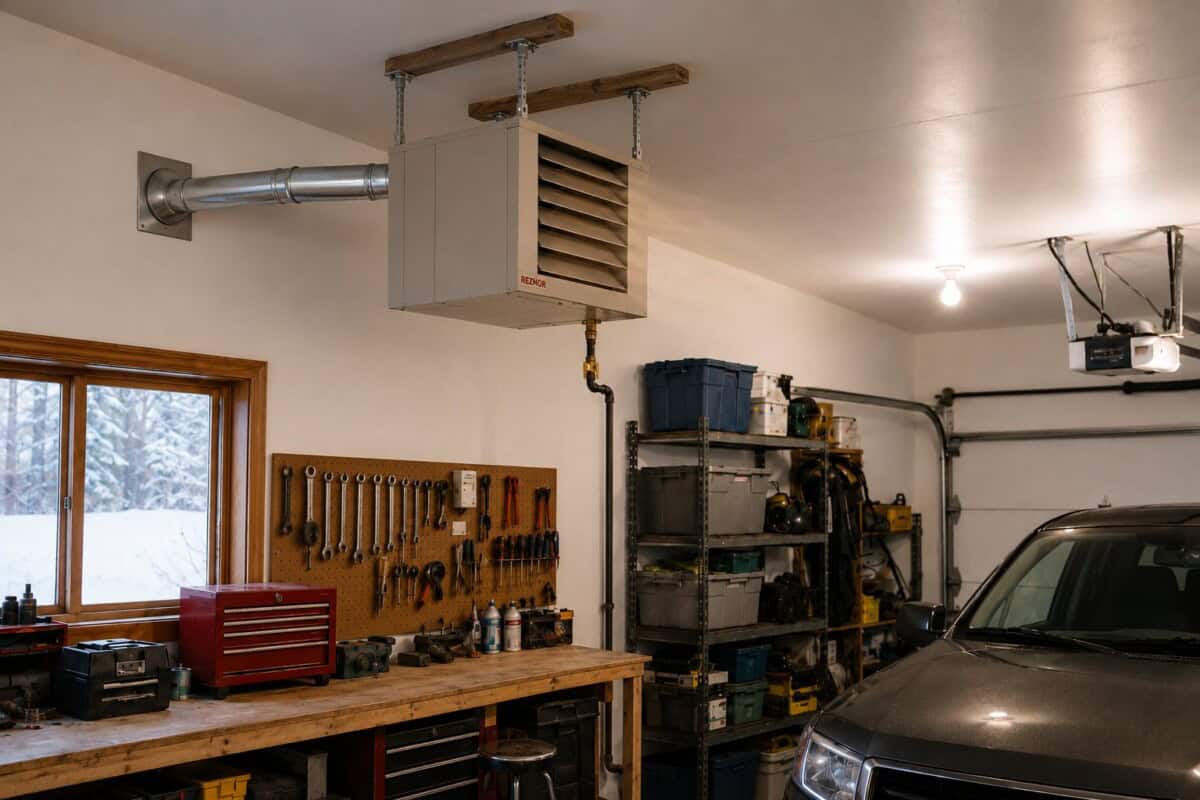
A cold garage makes working on projects miserable during winter months. Whether you’re fixing a car, running a woodshop, or just need a comfortable space to store items, the right heating solution makes all the difference.
The best garage heater depends on your space size, power access, and budget, with electric forced-air models like the 7,500-watt units offering the most versatile option for typical two-car garages, while propane heaters work well for spaces without electrical hookups. Electric garage heaters are easier to install and safer to operate, though gas-powered options can heat larger areas more cost-effectively.
Choosing the wrong garage heater leads to wasted money and inadequate warmth. This guide covers the different types of garage heating systems, safety features to look for, proper sizing calculations, and top-rated models tested by experts to help you find the perfect match for your workspace.
Key Takeaways
- Electric heaters are the safest and easiest to install for most garages, while gas heaters handle larger or poorly insulated spaces better
- Proper sizing requires calculating your garage’s square footage and multiplying by 50 to determine the necessary BTU output
- Safety certifications, tip-over shutoffs, and proper ventilation are essential features that prevent fires and carbon monoxide hazards
Last Updated: May 2026 | Will Montgomery has an engineering background and has evaluated garage heaters across propane, natural gas, and electric types. He focuses on BTU output accuracy, safety certifications, and real-world performance in uninsulated spaces.
Garage Heater Types and How They Work

Garage heaters fall into four main categories based on their fuel source and heat delivery method. Electric models plug into standard or dedicated circuits, propane units burn liquid fuel for portable heat, natural gas and kerosene options offer powerful stationary heating, and infrared systems warm objects directly instead of heating air.
From experience: A garage that doubles as a workspace changes your heating needs fast. For years, a portable propane torpedo heater has been the go-to — it puts out serious BTUs quickly and requires no permanent installation, which matters when the space is still full of projects and evolving. The long-term plan is to insulate properly and run natural gas once the shop is organized. That pattern is common: start with portable propane, upgrade to a fixed natural gas or electric infrared unit when the space and budget are both ready.
Electric Garage Heaters
Electric garage heaters convert electricity into heat through metal coils or ceramic elements. A forced-air heater uses a fan to blow air across heated coils and distribute warmth throughout the space. These units come in two voltage options: 120V models plug into standard outlets and max out around 1,500 watts, while 240V versions require a dedicated circuit but deliver up to 10,000 watts of power.
The main advantage of electric garage heaters is their simplicity. They need no venting, produce no combustion byproducts, and work with a simple thermostat control. A 240V electric forced-air heater can heat a well-insulated two-car garage effectively.
Installation costs range from zero for plug-in models to $200-500 for hardwired 240V units. Operating costs run higher than gas options at roughly $0.50-1.30 per hour depending on wattage and local electricity rates.
Propane Garage Heaters
A propane garage heater burns liquid propane from portable tanks to generate heat. Most portable space heater models designed for garages range from 4,000 to 30,000 BTUs and require no installation beyond connecting a standard propane cylinder. These units work anywhere without electrical service, making them ideal for detached garages or power outages.
Modern propane models include oxygen depletion sensors (ODS) that automatically shut off the unit if oxygen levels drop too low. Despite these safety features, adequate ventilation remains essential. Users should keep a window cracked 2-4 inches and install a carbon monoxide detector when running any propane heater indoors.
Operating costs average $0.60-0.80 per hour at 18,000 BTU output. Propane tanks need regular refilling, which adds inconvenience compared to hardwired options. These portable garage heater units excel at occasional weekend use but become expensive for daily operation.
Natural Gas and Kerosene Heaters
Natural gas heaters connect to a home’s gas line and mount to the ceiling for efficient heat distribution. These shop heater models deliver 30,000 to 125,000 BTUs and represent the most cost-effective option for regular use. A ceiling-mounted heater saves floor space and provides even heat coverage across large garages.
Professional installation costs $500-2,000 with existing gas lines or $1,500-4,000 when running new lines. Operating costs stay low at $0.20-0.50 per hour. All natural gas units require venting to the outside and produce combustion byproducts.
A kerosene heater offers similar BTU output without requiring gas line access. These units burn liquid kerosene fuel and provide portable heating power. They work well in remote locations but require more maintenance than natural gas models and produce stronger odors during operation.
Infrared and Radiant Heaters
An infrared heater emits electromagnetic waves that warm objects and people directly rather than heating air first. This radiant heater technology works especially well in drafty or poorly insulated garages where forced-air systems waste energy heating air that escapes through gaps. An infrared patio heater uses the same technology and can double as a garage space heater in smaller spaces.
Electric infrared models operate silently and mount to walls or ceilings. They require 7-foot minimum ceiling clearance and cost $150-800 for residential units. Gas-powered infrared heaters deliver higher BTU output but need professional installation and venting.
The main limitation of infrared technology is directional heating. A radiant heater warms the area directly in front of it effectively but struggles to heat an entire garage evenly. These units excel at spot heating specific work zones rather than whole-space comfort.
Key Performance Metrics: Heat Output and Efficiency
Heat output determines how quickly a garage heater warms your space, while efficiency affects your monthly operating costs. The right combination of BTUs or wattage, proper heat distribution, and energy-saving features can make the difference between a comfortable workspace and wasted money.
Understanding BTU and Wattage
British thermal units (BTUs) measure the heat output of gas-powered heaters, while electric models use wattage. A general rule of thumb requires 45 BTUs per square foot for gas heaters or 10 watts per square foot for electric units.
A typical two-car garage of 360 square feet needs approximately 16,200 BTUs or 3,600 watts. The Mr. Heater Big Buddy delivers 18,000 BTU output on its highest setting, making it suitable for spaces up to 450 square feet.
Three-car garages require significantly more power. A 10,000-watt electric heater handles these larger spaces effectively.
Electric heaters maintain consistent output throughout operation. Gas and propane models often feature multiple heat settings, allowing users to adjust BTU output based on current needs and outdoor temperatures.
Heat Distribution and Coverage
Heat distribution methods vary significantly between heater types. Forced-air models use integrated fans to circulate warm air throughout the entire garage space, creating more uniform temperatures.
Infrared heaters warm objects and people directly rather than heating the surrounding air. They provide instant warmth when standing in front of them but offer limited coverage outside their direct path. This makes them ideal for workbench areas where you spend most of your time.
Propane heaters without fans rely on natural convection, causing heat to rise directly off the unit. This works best in garages with lower ceilings where warm air can circulate more easily.
Temperature readings taken 10 feet from a heater reveal actual coverage capabilities. Quality forced-air models maintain noticeable warmth at this distance, while radiant heaters show minimal temperature change.
Energy Efficiency and Eco Mode
Electric heaters convert 100% of consumed electricity into heat at the source, making them technically the most efficient option. However, electricity costs often exceed natural gas or propane rates, especially when heating larger spaces.
Gas heaters achieve lower energy efficiency due to heat loss during combustion but typically cost less to operate. Features like adjustable thermostats, timers, and auto shut-off help reduce energy consumption regardless of fuel type.
Eco mode functionality automatically adjusts heat output to maintain set temperatures without constant maximum operation. This prevents energy waste once the garage reaches the desired warmth level.
Temperature control systems cycle the heater on and off as needed, eliminating the inefficiency of continuous full-power operation. Units with built-in thermostats provide better efficiency than models requiring manual adjustment.
Safety Features and Certifications
Garage heaters need specific safety mechanisms to prevent fires, burns, and dangerous gas buildup in enclosed spaces. Modern units include multiple layers of protection through automatic sensors, physical switches, and air quality monitors that work together to reduce risks.
If you’re also concerned about winter damage beyond heating, see our guide on keeping pipes from freezing in attached garages and unheated spaces.
Overheat Protection Systems
Overheat protection prevents heaters from reaching dangerous temperatures that could ignite nearby materials or damage internal components. Most electric garage heaters include a thermal shut-down mechanism that cuts power when the unit exceeds its safe operating temperature. This feature activates automatically without user intervention.
The system typically uses a thermal sensor placed near the heating element. When temperatures climb too high, the sensor triggers a switch that stops electricity flow. Many units reset automatically once they cool down to safe levels.
Electric models with overheat protection systems provide an essential safety layer for garage environments where dust and debris can accumulate on heating elements. Gas-powered heaters often incorporate a thermo-electric safety valve that shuts off fuel flow if the pilot light goes out or temperatures become unsafe.
Tip-Over and Automatic Shutoff
A tip-over switch cuts power immediately when a heater falls or tilts beyond a certain angle. This automatic shutoff prevents the heating element from contacting flammable surfaces like cardboard boxes, wood, or carpeting. The mechanism relies on a small weight or sensor that detects position changes.
Portable garage heaters benefit most from tip-over shut-off features since they can be accidentally knocked over during work activities. The switch typically activates at angles between 30 and 45 degrees from vertical.
Wall-mounted and ceiling units still include automatic shutoff capabilities even without tip-over switches. These systems monitor internal temperatures and electrical current to detect malfunctions. Garage-safe space heaters combine multiple automatic shutoff triggers for comprehensive protection.
Oxygen Depletion Sensors and Carbon Monoxide Detectors
Gas-powered garage heaters consume oxygen during combustion and can produce carbon monoxide in enclosed spaces. An oxygen depletion sensor monitors air quality and shuts off the heater when oxygen levels drop below safe thresholds. This sensor is required on most unvented gas heaters.
The oxygen-depletion sensor works by detecting changes in the combustion flame pattern as available oxygen decreases. When oxygen falls too low, the sensor triggers the thermo-electric safety valve to stop gas flow within seconds.
Carbon monoxide detectors provide an additional safety layer beyond oxygen sensors. While not always built into the heater itself, a separate carbon monoxide detector should be installed in any garage using combustion-based heating. These detectors alert users to dangerous gas buildup before it reaches lethal concentrations.
Controls, Installation, and Ease of Use
The right controls make a garage heater simple to operate, while proper installation ensures safety and efficiency. Some heaters plug in and work right away, while others need hardwiring by an electrician.
Thermostats and Temperature Settings
A built-in thermostat lets users set an exact temperature and maintain it automatically. The DuraHeat hardwired ceiling heater allows precise adjustments from 65 to 95°F in 1-degree increments through its digital thermostat. This level of control prevents energy waste from overheating.
Some heaters lack thermostats entirely. The Mr. Heater forced air propane model doesn’t have automatic temperature adjustment, so it keeps running at whatever setting the user selects. This makes it less energy efficient since it can’t shut off when the space reaches the desired warmth.
Infrared heaters typically offer wattage settings rather than specific temperatures. Units like the Briza provide three heat levels at 900, 1,200, and 1,500 watts, giving users basic control without precise temperature targeting.
Timers and Programmable Features
Timers help users heat their garage before they arrive without wasting energy all day. Many ceiling-mounted units include 12-hour timers with remote controls. The ComfortZone ceiling heater cycles on and off automatically based on programmed schedules.
Wi-Fi-enabled heaters add another level of convenience. The Heat Storm infrared model connects to a smartphone app, letting users adjust settings from anywhere. This works well for preheating a garage about 30 minutes before starting work.
Basic portable models rely on manual operation without timers. Users turn these heaters on when needed and off when leaving, which requires more attention but keeps the design simple and affordable.
Professional Installation vs. DIY
Electric garage heaters that plug into standard 120V outlets need no special installation. Portable propane heaters like the Mr. Heater Big Buddy simply attach to propane canisters and work within 10 minutes of setup.
Hardwired 240V units require professional installation by a licensed electrician. The DuraHeat ceiling heater took under an hour for a professional to install, including mounting and electrical connections. Installation fees add to the total cost but ensure safe operation.
Natural gas heaters need both gas line connections and electrical hookups, making them the most complex to install. A propane conversion kit can adapt some natural gas models to use propane tanks instead, offering more flexibility for garages without gas lines.
Portability and Adjustable Louvers
Portable garage heaters move easily between locations or store away when not needed. The Mr. Heater Big Buddy weighs around 19 pounds with a sturdy top handle, making it simple to carry. This works well for users who heat different areas or take the unit to job sites.
Adjustable louvers direct heat where it’s needed most. Forced air heaters typically include vents that pivot to aim the warm air toward work areas. Fixed-position heaters like some infrared models can only be mounted horizontally, limiting placement options.
Some portable propane heaters sit on the floor while others mount to walls or tripods. The Briza infrared heater includes an adjustable 48- to 75-inch tripod but cannot tilt vertically, which restricts corner placement. Wall-mounted units stay permanently in place but keep floor space clear.
Sizing Your Heater and Preparing the Garage

A garage heater only works well when it matches the space and has proper airflow. The BTU output needed depends on square footage and insulation quality, while fuel type determines what ventilation setup keeps the space safe.
Still deciding between heater types? Our guide on what heater you need helps you match the right fuel type and output to your specific space.
Matching Heater Capacity to Garage Size
Calculating the right BTU output prevents buying a heater that either runs constantly without warming the space or cycles on and off wastefully. The basic formula multiplies square footage by temperature rise and an insulation factor.
A typical two-car garage measures 400-500 square feet. An insulated garage in this size range needs 12,000-20,000 BTU. The same garage without insulation may require 40,000-60,000 BTU to reach the same temperature.
Temperature rise equals the target indoor temperature minus the coldest outdoor temperature in the area. A garage in Minnesota aiming for 60°F when outdoor temps hit -20°F needs to account for an 80-degree rise. The same target in Georgia with 20°F lows only needs a 40-degree rise.
Most manufacturers rate electric heaters in watts rather than BTU. A 5,000-watt 240V heater produces roughly 17,000 BTU. Standard 120V plug-in heaters max out at 1,500 watts or about 5,100 BTU—enough for spot heating but insufficient for whole-garage comfort.
The Role of Insulation
Insulation determines whether a $200 heater handles the job or if a $700 unit becomes necessary. Well-insulated garages with R-13 walls and R-30 ceilings use an insulation factor of 0.45 in BTU calculations. Uninsulated spaces use 1.10—more than double the heating requirement.
A 400-square-foot garage with moderate insulation needs about 20,000 BTU in a cold climate. Remove that insulation and the requirement jumps to 45,000 BTU for identical conditions.
Adding insulation before buying a garage heater cuts operating costs permanently. Electric heat costs $0.50-$1.30 per hour for a poorly insulated space but drops to $0.20-$0.40 per hour after proper insulation. Gas heaters show similar savings.
Priority insulation areas:
- Ceiling (greatest heat loss)
- Walls facing prevailing winds
- Garage door weatherstripping
- Gaps around windows and service doors
Ventilation and Safety for Different Fuel Types
Electric heaters need no ventilation since they produce no combustion byproducts. They require only proper electrical capacity—a dedicated 240V circuit for units above 1,500 watts.
Propane and natural gas garage heating systems produce carbon monoxide and require active ventilation. Portable propane heaters rated for indoor use need a window cracked 2-4 inches or a door partially open during operation. Permanently installed gas units require professional venting to the outside.
Required safety equipment for combustion heaters:
- Battery-operated carbon monoxide detector tested monthly
- Minimum 18-36 inch clearance from combustibles
- Never store propane tanks, gasoline, or solvents near the heater
- Adequate makeup air through vents or cracked openings
Sealed combustion units draw air from outside and vent exhaust directly outdoors. These work in tightly insulated garages without opening windows. Standard atmospheric combustion units pull air from inside the garage and must have makeup air provisions to avoid backdrafting.
Top Garage Heater Models and Brands

Several manufacturers have established themselves as leaders in garage heating, with Mr. Heater offering versatile propane options, infrared specialists like Dr. Infrared Heater and Briza delivering targeted warmth, and brands such as Dyna-Glo and DeWalt providing heavy-duty solutions for demanding spaces.
Mr. Heater and Big Buddy Series
Mr. Heater produces some of the most popular propane garage heaters available today. The The Mr. Heater Big Buddy stands out with three heat settings of 4,000, 9,000, or 18,000 Btu that quickly warm small to medium spaces.
This portable unit runs on two small propane canisters and uses four D batteries for the fan. One pound of propane provides up to 11 hours on low heat and 2.8 hours on high.
The Big Buddy includes automatic tip-over shutoff and burns clean enough for indoor use. Its sturdy handle makes moving between locations easy. Users can upgrade to larger propane tanks or AC power for the fan.
The The Mr. Heater MH60QFAV Forced Air Heater delivers more power with a maximum 60,000 Btu output. This model heats up to 1,500 square feet and runs 12 hours on a single 20-pound propane tank. It warms cold spaces noticeably within five minutes but operates louder than other options.
Dr. Infrared Heater and Briza Models
Infrared heaters warm objects directly rather than heating air, which saves energy in large garages. The Briza Infrared Electric Heater offers three heat levels at 900, 1,200, and 1,500 watts without precise temperature controls.
This model features an IP55 rating that protects against dust and wet weather for indoor and outdoor use. The Briza can mount on ceilings or sit on an adjustable 48- to 75-inch tripod.
Heat reaches about 10 feet from the unit, though less warmth comes from the back. The heater operates silently without a fan and shuts off automatically if tipped over. It only positions horizontally, which limits placement options in tight corners.
The Dr. Infrared Heater DR-966, which heat objects instead of air using infrared technology. These units work well for spot heating or when users want to warm specific work areas without heating an entire garage.
Dyna-Glo and DeWalt Options
The Dyna-Glo propane forced air heater specializes in larger workshops and garages. Their forced-air models provide high Btu outputs for spaces that need powerful heating quickly.
The DEWALT DXH70CSFAVX is a 70,000 BTU portable forced air propane heater suited for large garages and workshops. Its output heats up to 1,700 square feet, making it well-suited for two- and three-car garages.
This model features an extra-wide base that resists tipping and a safety switch that shuts off gas if the flame goes out. The handle stays cool enough to move while operating.
The DeWalt heats spaces rapidly but requires plenty of ventilation through open doors or windows. It operates loudly at maximum settings, which can make conversation difficult. The unit may take extra time to warm up in extremely cold conditions.
Other Notable Brands and Unique Features
Comfort Zone produces ceiling-mount heaters that save floor space in crowded workshops. The Comfort Zone CZ220 mounts on walls or ceilings to maximize available room for tools and vehicles. Their models include remote controls with 12-hour timers and overheating sensors.
The Presto Heat Dish Plus uses parabolic reflectors to direct heat precisely where needed. This design works well for personal heating while working on specific projects.
DuraHeat offers hardwired electric ceiling heaters with digital thermostats that adjust from 65 to 95°F in 1-degree increments. Heat Storm provides Wi-Fi-enabled models with app controls for remote temperature management.
Remington manufactures both portable and mounted options for different garage sizes. Each brand brings specific strengths, from smart technology integration to rugged construction for job sites.
Specialty Heaters and Advanced Features
Garage heating extends beyond basic electric models to include propane forced-air units that deliver high BTU output, ceiling-mounted systems that save floor space, and radiant designs like ceramic and oil-filled heaters that provide targeted warmth. Each type offers distinct advantages for specific garage layouts and heating needs.
Propane Forced Air and Hybrid Heaters
A propane forced air heater delivers intense heat quickly, making it ideal for large or poorly insulated garages. These units use a fan to distribute heated air throughout the space, reaching comfortable temperatures faster than most electric models. Propane and kerosene heaters offer intense heat output that electric units cannot match at similar price points.
The main advantage of a propane garage heater is portability. Users can move the unit between different work areas or take it to job sites. No electrical outlet is required, which helps in detached garages or spaces with limited power access.
A hybrid portable heater combines propane with electric options in a single unit. This design allows switching between fuel types based on availability and cost. Safety remains critical with propane models—proper ventilation prevents carbon monoxide buildup, and users must monitor for leaks and maintain clearances from combustible materials.
Ceiling-Mounted and Wall-Mounted Solutions
A ceiling-mounted heater frees up valuable floor space in crowded workshops and garages. These units mount overhead and use fans to push warm air downward, creating even heat distribution across the entire area. Most ceiling-mounted fan-forced heaters require 240V hard-wiring and professional installation.
Wall-mounted models offer similar space-saving benefits with simpler installation requirements. Many plug into standard 120V outlets and include brackets for secure mounting at comfortable heights. Both mounting styles keep heating elements away from tools, vehicles, and foot traffic.
Digital thermostats and remote controls add convenience to mounted systems. Users can adjust temperature settings without climbing ladders or moving equipment. Built-in timers help manage energy costs by limiting runtime to specific periods.
Ceramic and Oil-Filled Radiant Heaters
A ceramic heater uses ceramic plates to generate heat quickly and efficiently. These units warm up in seconds and distribute heat through fans or natural convection. Ceramic models work well as a portable space heater for small garages or focused heating at workbenches.
Oil-filled radiant heaters operate differently by warming oil inside sealed fins. The heated oil releases warmth gradually, maintaining consistent temperatures even after the unit cycles off. This design runs quietly and provides gentle, long-lasting heat without fans.
Both types excel at spot heating rather than warming entire garages. Ceramic models heat faster but cool quickly when turned off. Oil-filled units take longer to reach temperature but retain warmth longer, reducing energy consumption during intermittent use.
Frequently Asked Questions
Heat pump mini-splits offer the best efficiency for electric heating, while natural gas provides the lowest operating costs overall. A 120V heater works only for spot heating or very small spaces, and most two-car garages need 12,000 to 60,000 BTU depending on insulation quality.
Which heater type is most efficient for keeping a garage warm in winter?
Mini-split heat pumps are the most efficient electric heating option available. They produce 2-3 BTUs of heat for every BTU of electricity consumed by moving heat from outside air into the garage.
Natural gas forced-air heaters offer the lowest operating cost per BTU. These units cost roughly $0.20-$0.50 per hour to run compared to $0.50-$1.30 per hour for standard electric heaters.
Electric resistance heaters convert 100% of electricity into heat but cost more to operate than gas. Infrared radiant heaters work well in drafty garages because they heat objects and people directly rather than warming the air.
Is a 120V electric heater powerful enough to heat a typical garage?
A 120V heater maxes out at 1,500 watts, which equals about 5,100 BTU. This output is only sufficient for spot heating in small areas or warming a single workspace within a larger garage.
Most one-car garages need 7,500 to 30,000 BTU depending on insulation. A typical two-car garage requires 12,000 to 60,000 BTU based on climate and insulation quality.
The 120V option works for occasional use in mild climates or as supplemental heat. Anyone heating a full garage regularly needs a 240V electric heater or gas unit.
When should you choose a 240V electric heater instead of a 120V model?
A 240V heater is necessary when heating output needs exceed 5,000 BTU. These units deliver up to 34,000 BTU, which covers most residential garage heating needs.
The installation requires a dedicated circuit with properly rated wire gauge. A 5,000-watt heater draws 20.8 amps at 240V and needs a 30-amp breaker with 10-gauge wire minimum.
Choose 240V for regular use in garages larger than 200 square feet. The higher upfront installation cost of $200-$500 pays off through adequate heating capacity.
What safety features matter most when installing a heater in a garage workshop?
Carbon monoxide detection is mandatory for any combustion heater. A battery-operated CO detector should be installed and tested monthly, and the garage must have ventilation when running propane or natural gas units.
Proper clearances from combustible materials prevent fire hazards. Gas units typically require 18-36 inches of clearance while electric heaters need 12-24 inches.
Tip-over protection and overheat shutoff features prevent accidents with portable heaters. Never store gasoline, paint, solvents, or other flammables near any heater regardless of type.
How do propane and natural gas garage heaters compare for cost and performance?
Natural gas costs less to operate at $0.20-$0.50 per hour for 45,000 BTU output. Propane portable heaters cost roughly $0.60-$0.80 per hour at 18,000 BTU.
Natural gas requires professional installation and an existing gas line or new line installation costing $1,500-$4,000. Propane heaters need no installation and work anywhere with proper ventilation.
Natural gas heaters last 15-25 years and make sense for regular use. Propane works best for occasional weekend projects or detached garages without electrical service.
What size heater (BTU or watts) is needed for a one-car or two-car garage?
A well-insulated one-car garage of 250 square feet needs 7,500-10,000 BTU. The same garage with poor insulation requires 20,000-30,000 BTU.
A two-car garage of 400-500 square feet needs 12,000-20,000 BTU when well insulated. Without insulation, the requirement jumps to 40,000-60,000 BTU.
The BTU calculation uses square footage multiplied by temperature rise and an insulation factor. Insulation quality affects heating needs more than any other variable, so improving insulation before buying a heater reduces long-term costs.