

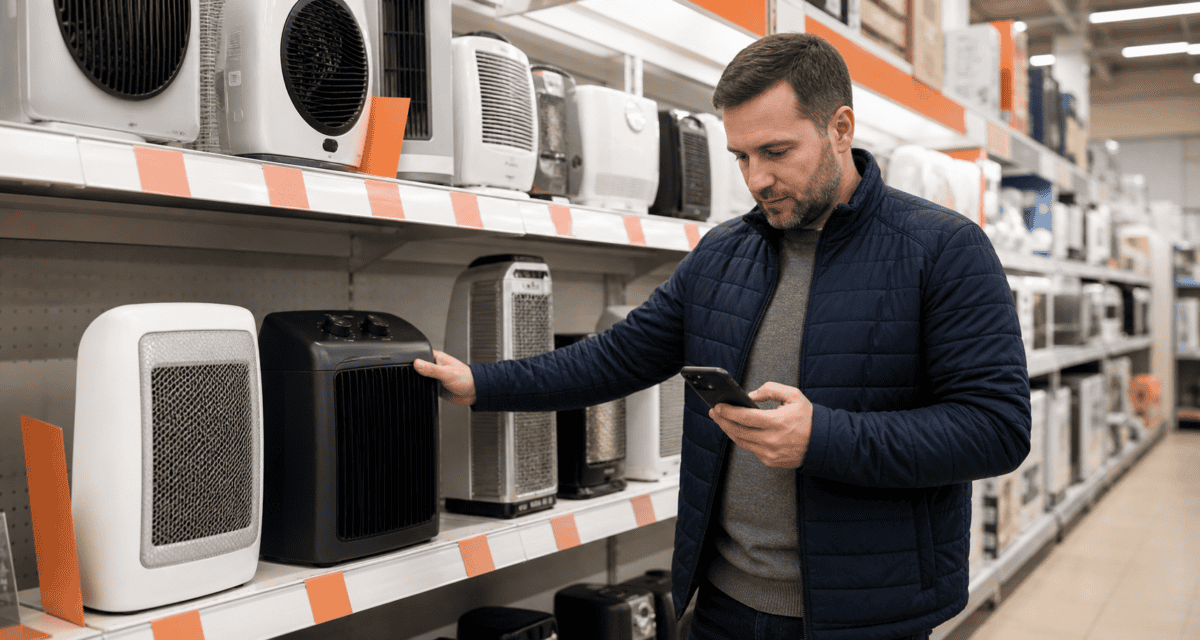
Choosing a heater sounds simple until the room gets real: a drafty garage is not the same problem as a bedroom, a basement corner, a bathroom, or a covered patio. The right answer depends on square footage, ceiling height, insulation, outdoor temperature, whether you need comfort heat or primary heat, and whether the heater will run near kids, pets, water, flammable materials, or sleeping areas.
Use the heater finder below to describe what you want to heat. It estimates a practical BTU range, explains what type of heater fits, and creates Amazon search links you can use to compare products.

Important: This tool is a buying guide, not an HVAC load calculation. For primary heat, hardwired heaters, gas heaters, large garages, workshops with fumes, or any installation that affects wiring, fuel, venting, or code compliance, use a qualified electrician, HVAC technician, or local code authority.
Smart Heater Finder
Smart Heater Finder
Describe the space, answer the basics, and the finder will estimate a BTU range plus Amazon search links for heater categories that fit.
Your estimated heater range
Spec-matched buying brief
10-point product grading checklist
Narrowed Amazon searches to compare
The links above search Amazon by heater category, capacity, safety features, and use case. Prices, ratings, reviews, and availability change, so compare the current product page and manufacturer manual before buying.
Quick Rule Of Thumb
For small electric space heaters, watts matter more than marketing. A common 1,500-watt plug-in electric heater produces about 5,100 BTU per hour because 1 watt equals 3.412 BTU/hr. That is usually enough for a small room or personal comfort zone, but it is not the same as heating a big garage in winter.
- Small bedrooms and offices often land near 3,000 to 6,000 BTU/hr.
- Larger living spaces often need more than a single plug-in heater can provide.
- Drafty garages and workshops can need far more heat because doors, concrete, air leaks, and ceiling height all work against you.
- Patios are usually about radiant comfort, not warming all the outdoor air.

Safety Checks Before You Buy
- Keep portable heaters at least 3 feet from furniture, curtains, bedding, papers, and anything else that can burn.
- Plug electric space heaters directly into a wall outlet. Avoid extension cords and power strips.
- Turn portable heaters off before sleeping or leaving the room.
- Choose heaters with current safety certification such as UL, ETL, or CSA, plus tip-over and overheat protection when portable.
- Keep electric heaters away from water. Use bathroom-rated heaters only where the product manual allows.
- Use fuel-burning heaters only where they are designed and approved to be used. Unvented combustion heaters create carbon monoxide risk and need the ventilation and clearances specified by the manufacturer.
- Keep working smoke alarms and carbon monoxide alarms in the home.
One nuance worth adding: avoiding extension cords is the right default when you are reaching into a drawer for whatever cord is in there — most household cords are 16- or 18-gauge and genuinely cannot carry a heater’s load. If you are buying a cord specifically for the job, the math is straightforward. A 1500-watt heater draws 12.5 amps (watts ÷ volts), and a continuous load should be sized at 125% of that, about 15.6 amps. So look for a cord marked 15 A or better — in practice 12-gauge copper, three-prong grounded, and keep the run under 50 feet. A 12-gauge SJTW cord rated 15 A / 1875 W does it comfortably. The gauge and amp rating are printed on the jacket, so you can check before you buy. Uncoil it fully in use, since a coiled cord traps its own heat. Power strips and surge protectors stay off the list either way — their internal wiring and breakers are built for intermittent electronics, not an appliance drawing 12.5 amps for hours.
How The Finder Makes Recommendations
The calculator starts with the room area and a heating-intensity estimate based on the room type. Then it adjusts for ceiling height, insulation, climate, and whether you want supplemental comfort heat or stronger primary heat.
Sources Used For Safety And Sizing Guardrails
- U.S. Department of Energy: Small Space Heaters

- U.S. Consumer Product Safety Commission: winter heating safety
Frequently Asked Questions
How do I know what type of heater I need?
Start by identifying where you need heat (indoors vs. outdoors), the space size, your fuel source availability (gas, propane, or electric), and your budget. Indoor tankless water heaters, patio heaters, pool heaters, and space heaters all serve different needs. A heater finder tool helps match your answers to the right category.
What is the most energy-efficient heater for a home?
Heat pump water heaters are the most efficient for domestic hot water. For space heating, mini-split heat pumps lead in efficiency. For outdoor or patio heating, infrared patio heaters are among the most efficient because they heat people and objects directly rather than the surrounding air.
What heater is best for outdoor use?
For outdoor patios and decks, a propane or natural gas patio heater (tower or tabletop) is the most common choice. Infrared electric patio heaters are better for enclosed or semi-enclosed areas because they do not require ventilation for combustion.
What is the cheapest type of heater to run?
In most regions, natural gas heaters have the lowest per-BTU operating cost. Where natural gas is unavailable, propane is typically the next most affordable. Electric resistance heaters cost the most to run per BTU, though heat pumps offset this with high efficiency multipliers.
How do I choose between a tank and tankless water heater?
If you run out of hot water frequently, have space for a tankless unit, and plan to stay in your home long-term, a tankless heater is usually worth the higher upfront cost. If you need a simple, lower-cost replacement, a tank heater is easier and cheaper to install.