

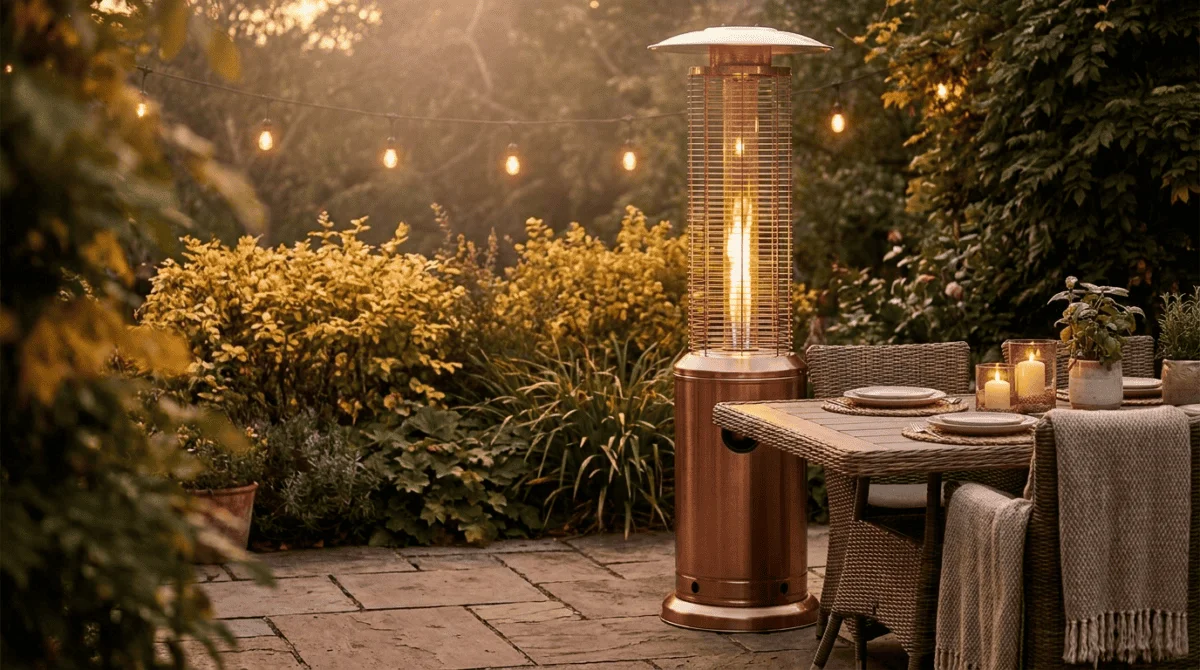
The best garden patio heater comes down to three garden realities: how far the seating is from power, how much area needs warming, and how the heater looks in your space. Electric infrared wins for gardens with a socket and low running costs, propane and bottled gas give total freedom where there is no power or gas line, and natural gas suits permanent hardwired installs — a split HeatersForLife.com’s testers confirmed across a full season of spring and autumn evenings.
Quick Answer: The best garden patio heater depends on your setup: for gardens with a power socket, an electric infrared heater such as a Bromic Platinum runs cheapest and quietest; for open gardens with no power, a propane standing heater gives full freedom; and a natural gas heater suits permanent hardwired installs. Match the heat source to your garden before comparing looks.
A garden patio heater is an outdoor heater — electric infrared, propane, or natural gas — built to warm a seating area rather than a room, chosen around access to power or a gas line and how it looks in the space.
Last Updated: July 2026 | Will Montgomery has spent years testing patio and garden heaters across electric, propane, and natural gas, and knows which ones actually hold heat in an open yard.
How to Choose the Best Patio Heater for a Garden (Start Here)
The right garden heater is decided by three constraints first — power access, garden size, and aesthetics — long before any brand or model enters the conversation.

Gardens are different from covered patios and balconies, and that difference drives the whole decision. A garden seating area is often positioned for the view or the sun rather than for the nearest plug, so power access is usually the constraint that eliminates the most options straight away. Work through it in this order and the shortlist almost builds itself.
- No outdoor socket near the seating: propane or bottled gas is the practical answer, because it needs nothing but a full cylinder.
- A weatherproof outdoor socket within reach: electric infrared or quartz is the low-cost, low-maintenance choice.
- A permanent, fixed entertaining area: natural gas, hardwired and professionally installed, is cheapest per hour over the long run.
- A small nook or dining set: a tabletop or parasol-mounted heater warms the people without dominating the space.
The second half of the decision is running-cost sensitivity, and it hinges on how often the heater will actually run. HeatersForLife.com’s testers found that a household using a heater for a couple of hours most evenings feels running cost far more sharply than someone who fires it up only for occasional gatherings. Frequent users should lean toward efficient electric infrared; occasional users can prioritise coverage and ambience over pennies per hour. Settle the constraints first, and the fuel type, form factor, and model fall into place with far less second-guessing.
Patio Heater Fuel & Power Types Compared for a Garden (Propane vs Natural Gas vs Electric/Infrared)
Electric infrared wins on running cost and low maintenance, propane wins on placement freedom where there is no power, and natural gas suits permanent hardwired installs.

Each fuel type solves a different garden problem, so the smart move is to match the type to the constraint rather than chasing a single “best” technology.
Propane (bottled gas) is the freedom option. A cylinder can sit anywhere in the garden with no wiring, powering pyramid, tower, and tabletop heaters that throw a wide zone of ambient warmth. The trade-offs are higher running cost, the weight and storage of gas bottles, and the need to swap and check them. A 13kg propane bottle delivers roughly 15 hours of full burn according to Calor and LPG industry data, so heavy users go through cylinders quickly. For a deep dive on cylinders, regulators, and the best propane-specific models, HeatersForLife.com’s Best Propane Patio Heater guide covers it in detail; this article keeps propane at summary level.
Natural gas is the cheapest per hour to run because it draws from the mains, but it needs a gas line run to the garden and a professional Gas Safe installation, which fixes the heater in one permanent spot. It makes sense only for a settled entertaining area where the install cost is worth amortising over many years. Like all gas, it produces more CO2 and warms up more slowly than electric, and an open-flame gas heater can lose up to around 40% of its heat straight upward into the sky — a real factor in an exposed garden.
Electric infrared, quartz, and halogen heaters give instant, directional warmth the moment they switch on, with no emissions at the point of use and the lowest running costs at sensible wattages. They heat people and objects rather than the air, which is a genuine advantage in a breezy open garden where warm air simply blows away. The one catch is that they are tethered to a socket. On running cost, electric is compelling: at roughly 34p/kWh under 2026 UK prices near the Ofgem cap, a 600W infrared unit costs about 20p per hour to run, while a 2000W unit costs about 68p per hour. Even the top of that range often undercuts a propane cylinder once bottle prices are factored in.
Freestanding vs Wall-Mounted vs Hanging vs Parasol vs Tabletop — Which Form Suits Your Garden
Freestanding heaters suit open lawns and flexible layouts, wall and hanging units save space on patios and pergolas, and parasol or tabletop heaters warm intimate seating nooks.

Form factor is where the heater meets the actual shape of your garden, and getting it right is as much about layout as it is about heat.
- Freestanding towers and pyramids are the go-to for open areas. They are portable, cover a wide radius, and can be repositioned as the party moves. Gas pyramids add a flame-view centrepiece; electric towers stay sleek and minimalist.
- Wall-mounted infrared panels such as the Devola, Firefly, and Gtech HeatWave units save floor space on a patio and disappear into a wall or fence. They need a solid fixing point and a nearby socket, but they keep walkways clear.
- Hanging and ceiling heaters suit pergolas, gazebos, and covered structures, warming a seating area from above without taking a footprint.
- Parasol-mounted heaters clamp to or hang from a garden umbrella and warm a dining set from overhead — ideal for a table that is already the centre of the space.
- Tabletop heaters such as the smaller Outsunny gas units and the Kettler Kalos add warmth and ambience to a two- or four-seat nook without dominating it.
Aesthetics matter more in a garden than most buyers expect. HeatersForLife.com’s testers noted that a flame-view gas pyramid becomes a focal point that adds atmosphere on its own, whereas a discreet infrared panel all but vanishes into a minimalist modern garden. Decide whether the heater should be seen or unseen, and the form factor shortlist narrows quickly.
Sizing & Heat Output — How Much Power Your Garden Actually Needs
Match the output to the area you need to warm — roughly 1.5 to 2kW of electric heat for a small seating zone, scaling up to an 11 to 13kW gas unit for a large open gathering.
Oversizing wastes money and undersizing leaves guests cold, so it pays to size against the actual seating area rather than the whole garden. As a working guide, HeatersForLife.com’s testers map coverage like this:
- A two-seat nook: around 1.5kW of electric infrared.
- A small patio seating area: around 2kW electric.
- A medium area: around 2.5 to 3kW electric, or a 4kW tabletop gas unit for a dining table.
- A large open garden or gathering: an 11.2kW-plus gas pyramid, or a premium variable unit such as the Bromic at around 7kW.
Output figures alone do not tell the whole story, because the technology changes how that heat behaves. Infrared heats people and surfaces directly, which makes it far more effective in wind and in open gardens where warm air is quickly carried away. Gas, by contrast, warms a wider ambient zone, so it feels more enveloping in a sheltered corner but wastes more heat in an exposed one. Size for the seating footprint, then choose the technology to match how exposed that footprint is.
Best Garden Patio Heaters Compared (2026) — Top Models by Type
The standout garden picks span every type — VonHaus and Devola for value electric, Firefly and Veito for wall and premium infrared, Outsunny and Outback for gas warmth, and Bromic for premium permanent heat.

The table below groups the models HeatersForLife.com’s testers rate across each type, so you can jump straight to the category your constraints pointed you toward.
| Model | Type | Form factor | Output (kW) | Best for |
|---|---|---|---|---|
| VonHaus Freestanding Electric | Electric quartz | Freestanding | ~2 | Budget value |
| Devola IP65 WiFi Wall-Mounted | Infrared | Wall | ~2 | Permanent outdoor / smart control |
| Firefly Medium-Wave Infrared | Infrared | Wall | ~2 | Discreet garden walls |
| Veito Blade | Infrared | Freestanding / portable | Premium | Premium electric |
| Outsunny Pyramid Gas | Propane | Freestanding pyramid | ~11.2 | Flame-view ambience |
| Outback Signature Pyramid | Propane | Freestanding | ~13 | Large gatherings |
| Bromic Platinum Smart-Heat | Gas / electric infrared | Wall / ceiling | Variable | Premium / permanent |
Most of these models are widely stocked in the UK, where garden-heater culture skews strongest. Buyers in the US will find the Devola, Firefly, Outsunny, and Outback names less common, but the same categories are covered by broadly available alternatives such as Fire Sense and Hiland/AZ Patio Heaters for propane and electric, while Bromic sells on both sides of the Atlantic as the premium permanent option. Whichever market you shop in, match the type first and the specific brand second — a value electric quartz unit does the same job whether it wears a VonHaus or a Fire Sense badge.
Powering a Heater in a Garden — No Outlet or No Gas Line?
For a garden far from the house, propane bottled gas gives total placement freedom, while electric heaters need a nearby weatherproof socket or a properly rated outdoor extension lead.
This is the constraint that trips up more garden buyers than any other, because the ideal seating spot is so often the furthest point from the house. If there is no socket within reach, propane is the honest, practical answer: a cylinder travels to wherever the chairs are, and nothing needs wiring. It is the reason bottled gas remains so popular for gardens despite its higher running cost.
If you want to go electric, do it safely. Any lead used outdoors must be rated for outdoor use and for the appliance’s load, protected by an RCD, and paired with a weatherproof socket. Fixed leads on outdoor electric heaters are typically limited to around 1.8m for a reason, and running a long domestic indoor extension lead out to the garden is unsafe and against manufacturer and HSE electrical guidance. The proper fix for a distant socket is to have a weatherproof outdoor socket installed by a qualified electrician, not to improvise with indoor cabling.
Set expectations on cordless options too. Battery and cordless heating simply is not practical at the wattages a garden needs; a heater drawing 1,500 to 2,000W would flatten any portable battery in minutes, so there is no meaningful cordless electric answer yet. And where there is no gas line, the realistic choice is bottled propane versus electric — natural gas only earns its place if you are prepared to pay for a permanent line and professional install. HSE guidance on both electrical safety and LPG use should frame every one of these decisions.
Weatherproofing, Placement & Safety in a Garden
Choose an IP44 rating as a minimum and IP55 to IP65 for permanent outdoor use, keep heaters well clear of overhanging plants and structures, and never run a gas heater in an enclosed space.
Gardens expose a heater to everything the weather throws at it, so the IP rating (defined by IEC 60529) is the number to check first. IP44 protects against splashing water and is the sensible floor for occasional outdoor use; IP55 adds protection against water jets; IP65 is fully dust-tight and jet-proof for a unit that stays out permanently. Anything left mounted on a wall through a British winter should be at the higher end.
Placement and safety rules matter just as much as the rating:
- Keep at least 1m (about 3ft) of clearance from anything flammable — fences, foliage, parasol fabric, and cushions.
- Stand freestanding units on firm, level ground so they cannot tip, and favour models with tip-over and overheat cut-off switches.
- Check gas heaters regularly for leaks, corrosion, and insect or spider nests blocking the burner or gas ports.
- Never use a gas or propane heater in an enclosed or heavily covered space — the carbon monoxide risk is real, and HSE LPG guidance is explicit that these appliances need open, well-ventilated air.
- Store the heater or fit a weatherproof cover between uses to protect it through year-round exposure.
Follow these and a garden heater stays safe and lasts for many seasons rather than rusting out after one.
From experience: (In the UK sense, a “garden” is just the backyard.) I steer people to whatever is cheapest to run given the fuel they can actually get. Propane is usually easiest because it needs no attachment to the house — no electrical run, no gas line. But if the patio is on the house and natural gas is right there, I point them to natural gas since it is always on. No gas line? Electric infrared — an electrician or a handy owner can run it — just size the wire for the heater’s amp draw.
Frequently Asked Questions
What is the best type of patio heater for a garden?
It depends on power access, garden size, and how it looks. Electric infrared is best for gardens with a socket thanks to low running cost, propane is best where there is no power because it goes anywhere, and natural gas is best for a permanent, hardwired entertaining area. Settle those three constraints first and the type chooses itself.
What is the best patio heater for a garden with no electricity or gas line?
Propane, or bottled gas, is the go-to answer because a cylinder needs no wiring and can sit wherever the seating is. Battery and cordless heaters are not yet practical at the wattage a garden needs, so they are not a real alternative. Electric only works if you have a properly rated outdoor socket or a suitable outdoor lead within reach.
Do electric patio heaters use a lot of electricity?
A 2kW electric unit costs roughly 68p per hour to run at 2026 UK prices, while a lower-powered 600W infrared heater is far cheaper at around 20p per hour. Because infrared heats people and objects directly rather than the air, it is efficient for the short evenings most gardens are used. Choosing the right wattage for the space keeps the bill sensible.
Should I choose gas or electric for a large garden?
Gas wins for a large open garden — an 11 to 13kW pyramid covers a wide area and warms the ambient air around a big group. Electric infrared is better for targeted, close-range warmth that resists wind and costs less to run. For a big gathering that moves around, gas usually feels more generous.
Can a patio heater be left outside in the rain?
Only if it is rated for it. Look for IP44 as a minimum, and IP55 to IP65 for a heater that stays outdoors permanently. Anything less should be stored between uses or protected with a weatherproof cover, and you should always check the IP rating before leaving a heater exposed.
Conclusion
The best garden patio heater is the one that fits your garden’s constraints, not the one with the biggest number on the box. Three takeaways carry the whole decision:
- Decide by power access, garden size, and aesthetics before you look at a single brand — those three constraints eliminate most of the field for you.
- Match the fuel to the freedom you need: propane for placement freedom anywhere, electric infrared for the lowest running cost near a socket, and natural gas for a permanent hardwired install.
- Match the IP rating to your exposure and follow the clearance and safety rules, especially the ban on running gas heaters in enclosed spaces.
Ready to keep narrowing it down? Explore more Patio guides on HeatersForLife.com, including the dedicated Best Propane Patio Heater deep-dive for cylinders, regulators, and the top propane models in detail.