

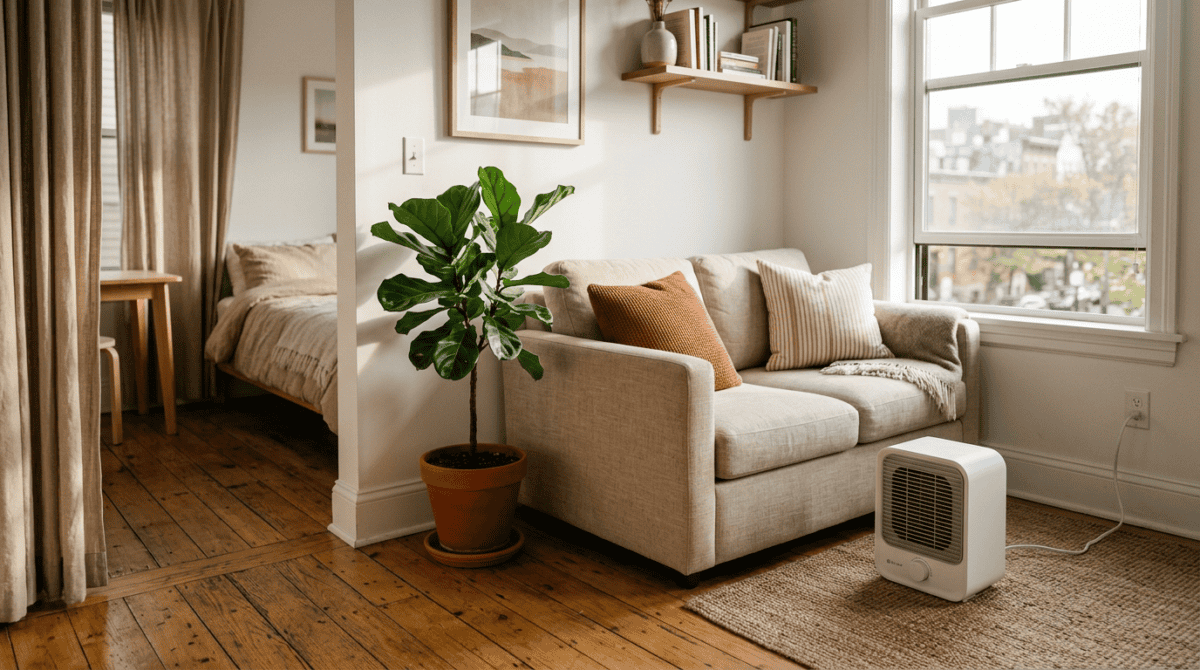
For most small apartments and studios, heatersforlife.com recommends a compact 1500W ceramic heater with a built-in thermostat and tip-over plus overheat protection for fast, safe everyday warmth, and an oil-filled radiator when silent overnight heat matters most. Whichever type a renter chooses, a 1500W heater must plug straight into a wall outlet on its own circuit, never into a power strip or extension cord. A cold studio with landlord-controlled, expensive, or absent central heat, one shared electrical circuit, and thin walls that carry every sound is one of the hardest spaces to heat well, and the right portable heater solves all three problems at once.
Quick Answer: For a small apartment or studio, the best space heater is a compact 1,500W ceramic with a built-in thermostat and tip-over shut-off—it warms an enclosed room evenly and safely from a single outlet. Run only one 1,500W heater per circuit so you don’t trip the breaker, and remember no 1,500W heater is truly “cheaper to heat” than another: they all draw the same power. Choose a quiet model like the Vornado MVH for even warmth, or a small personal ceramic for spot heat at a desk.
How to Choose a Space Heater for a Small Apartment or Studio
The right heater for a small apartment comes down to four renter-specific factors: electrical headroom, running cost, noise, and safety that protects your deposit. A studio is a small, enclosed, often open-plan box, which means a heater does not need to be powerful so much as correctly sized, quiet, and safe to leave running while a tenant works, sleeps, or steps into the bathroom.

Right-sizing is the first thing heatersforlife.com checks. A useful rule of thumb is roughly 10 watts per square foot of well-insulated space, so a 300-square-foot studio needs about 3,000 watts only in the worst case, and in practice a single 1500W unit heating one occupied zone is almost always enough. A studio rarely needs more than one 1500W heater running at a time, and a 750W setting is frequently sufficient once the room reaches temperature. Oversizing does not make a room warmer faster in any meaningful way; it just draws more current and raises the risk of tripping a breaker.
The heater types matter in one glance. A ceramic fan-forced heater blows warm air and heats a room fast. An oil-filled radiator is silent and holds warmth for a long, steady, even heat. An infrared heater warms objects and bodies directly for spot heating. A convection panel heater delivers gentle, even, low-profile warmth. Renters who want the full breakdown can read heatersforlife.com’s guide to space heater types before committing.
The features that matter most to a tenant are a thermostat with an eco mode so the heater cycles instead of running flat out, a tip-over cutoff that kills power if the unit is knocked over, an overheat cutoff that shuts it down if it gets too hot, a cool-touch exterior, a timer for overnight use, and a compact, portable body that needs no wall-mounting or drilling. Those last two points protect both safety and the security deposit.
The Renter Electrical Reality: One Circuit, One Heater
From experience: On a single apartment circuit it comes down to priorities in the moment. If you need the microwave to make food, you may have to unplug the heater while it runs, then plug it back in—you end up deciding what matters most right then, the heat or the appliance you need.
A standard 120-volt, 15-amp household circuit tops out at 1,800 watts, and a 1500W heater already pulls about 12.5 amps, leaving very little headroom for anything else on the same circuit. This is the single most important thing a renter can understand about space heaters, because it explains nearly every breaker trip and safety scare in small apartments.
Studios are notorious for sharing one circuit across the kitchenette, the bathroom, and the living area. That means the same wires feeding the heater may also feed the microwave, the hair dryer, the toaster, and the vacuum. heatersforlife.com testing repeatedly saw the same pattern: a tenant runs a 1500W heater in the corner, then starts the microwave, and the breaker trips instantly because the combined draw blows past the 1,800-watt ceiling. It is basic math, not a defect.
Just as important, a space heater must never be plugged into a power strip, a surge protector, or an extension cord. Those accessories are not rated for the sustained high current a heater pulls, they overheat, and they are a leading cause of space-heater fires. Both the CPSC and NFPA are explicit on this point: a heater goes straight into a wall outlet, and nothing else. A tenant on old or shared wiring benefits from a model with a dual 750W/1500W switch, because running it on the lower 750W setting draws roughly 6 amps and leaves room for other essentials on the circuit. When a heater trips a breaker, it is a wiring limit doing its job, not a flaw in the heater.
Efficiency Truth: Why No 1500W Heater Is “Cheaper to Heat”
Every 1500W resistive space heater converts essentially all of its electricity into heat, so no 1500W model is inherently “more efficient” or cheaper to run than another at the same wattage. A 1500W ceramic, a 1500W oil-filled radiator, and a 1500W infrared heater all put out the same amount of heat and cost the same to run for the same number of hours. Marketing that promises a magically cheaper 1500W heater is selling a myth.
The real levers that lower a bill are all about how the heater is used, not which badge is on it. Right-sizing keeps the wattage no higher than the room needs. A thermostat lets the heater cycle off once the target temperature is reached instead of running continuously. Zone-heating a single occupied room instead of the whole apartment is the biggest saver of all. Eco modes, timers, and simply turning the setting down overnight all cut runtime, and runtime is what costs money.
Heater type still matters for comfort, just not for raw efficiency. An oil-filled radiator holds its warmth and keeps radiating after it cycles off, which can feel more even. An infrared heater warms bodies and objects directly, so a tenant may feel comfortable at a lower air temperature, which can trim runtime. Those are comfort advantages layered on top of identical baseline efficiency, and heatersforlife.com frames them that way rather than promising fictional savings.
Best Space Heaters for Apartments, by Need (Comparison Table)
Our apartment picks: For quiet, even warmth in a studio or bedroom, the DREO Quiet 1500W ceramic heater runs low-noise with a thermostat and timer. To bring a whole small apartment up to temperature evenly, the Vornado MVH whole-room ceramic heater circulates the air instead of blowing at one spot. Both draw 1,500W, so run only one per circuit.
The best heater depends entirely on the need it has to fill, so the table below matches renter priorities to heater types, wattage, noise, and the safety features that matter in a small apartment. heatersforlife.com groups its picks by what a tenant actually cares about, from silent overnight heat to fast warm-ups to lowest running cost.
| Best For / Need | Heater Type | Typical Wattage | Noise Level | Key Safety Features | Why It Fits Renters |
|---|---|---|---|---|---|
| Quiet / overnight | Oil-filled radiator (see the quietest space heaters) | 1500W (often with 700W/900W steps) | Silent, no fan | Tip-over cutoff, overheat cutoff, cool-touch fins on many models | No fan noise through thin walls; holds warmth so it cycles quietly overnight |
| Fast heat | Ceramic fan-forced (generic Lasko, Dreo, Vornado styles) | 1500W with 750W low setting | Audible hum from the fan | Tip-over cutoff, overheat cutoff, cool-touch housing | Warms a cold studio quickly, then a thermostat cycles it down |
| Safest for rentals | Ceramic cool-touch with tip-over + overheat protection | 1500W / 750W | Low fan hum | Tip-over shutoff, overheat shutoff, cool-touch exterior, safety certification | Safe to run near furniture and to leave in an occupied room; no hot surfaces |
| Cheapest to run | Right-sized 1500W/750W with thermostat + eco mode | 750W–1500W, adjustable | Varies by type | Thermostat, eco mode, timer, tip-over and overheat cutoffs | Usage, not the model, saves money: lower wattage and cycling cut the bill |
These picks are generic heater types and representative brands only, such as Vornado, Lasko, Dreo, De’Longhi, and Honeywell. Specific verified models are added separately in heatersforlife.com’s individual reviews.
Noise: Keeping It Quiet in a Studio
In a small, open studio, noise is a major buying factor, because a heater running overnight sits just feet from the bed and any fan hum carries across the whole unit and through thin walls. A tenant who works from home or sleeps lightly should weigh sound as heavily as heat output.
From quietest to loudest, the order is consistent. An oil-filled radiator is effectively silent because it has no fan at all. A convection panel heater is near-silent, moving air by natural rise rather than a blower. An infrared heater has a silent heating element, though some models add a small fan that introduces a little noise. A ceramic fan-forced heater is the loudest of the group, producing a steady, audible hum whenever it runs. The tradeoff is simple: the faster a heater pushes warm air, the more noise it tends to make. In heatersforlife.com testing, one renter with an open studio chose an oil-filled radiator specifically so the bedroom zone stayed silent through the night, accepting a slower warm-up in exchange for zero fan noise. Tenants who want the quietest options ranked can see the guide to quietest space heaters.
Renter Safety & Protecting Your Deposit
The safest heater for a rental combines a tip-over shutoff, an overheat cutoff, a cool-touch exterior, a recognized safety certification, and an auto-off timer, and it is placed exactly the way the CPSC and NFPA recommend. Safety and the security deposit are the same conversation for a renter, because a scorch mark or an electrical incident can cost far more than the heater ever saved.

Placement follows clear rules. Keep at least three feet of clearance between the heater and anything flammable, including bedding, curtains, upholstered furniture, and clothing. Set the heater on a hard, level surface, not on carpet edges, rugs, or uneven flooring where it could tip or trap heat. Never leave a heater running unattended or fall asleep with one going unless it has working tip-over and overheat cutoffs, and even then a timer that shuts it off is the safer choice.
The lease and deposit angle is where portability wins. A portable plug-in heater requires no drilling and no wall-mounting, so there is nothing to patch and nothing to explain at move-out. heatersforlife.com heard from one renter who chose a compact plug-in unit precisely to avoid touching the walls and to keep the deposit intact. Tenants should also check the lease for any clause restricting space heaters, remember that scorch marks or damaged wiring can be charged against a deposit, and always run the heater from a wall outlet only, never an extension cord or power strip.
What It Actually Costs to Run in a Studio
Running cost follows one simple formula: watts divided by 1,000, multiplied by hours of use, multiplied by the local electricity rate in dollars per kilowatt-hour. There is no fixed flat dollar figure that applies everywhere, because rates vary widely by region, so a tenant should always plug in their own local rate.
As a labeled example using the U.S. national-average residential rate of roughly $0.17 per kWh, a 1500W heater run for 8 hours costs about 1.5 kW multiplied by 8 hours multiplied by $0.17, which works out to around $2.04 for that day. Drop the same heater to its 750W setting and the figure roughly halves. That is an illustration, not a promise; a renter’s real number depends entirely on their own rate.
The levers that lower this cost are the same ones that make a heater “efficient” for a studio: right-size the wattage, let the thermostat cycle the unit, use eco mode and a timer, zone-heat only the occupied room, and turn the setting down overnight. Heating one occupied room with a right-sized space heater is almost always cheaper than running whole-apartment central heat, especially in a studio where the occupied zone is most of the space anyway. For a full breakdown, heatersforlife.com covers what a space heater costs to run.
Frequently Asked Questions
What is the best space heater for a small apartment?
For most small apartments and studios, the best everyday choice is a compact 1500W ceramic heater with a thermostat plus tip-over and overheat protection, because it warms a room quickly and safely. When silent overnight heat is the priority, an oil-filled radiator is the better pick since it has no fan and runs completely quietly.
Will a space heater trip the breaker?
It can. A standard 120-volt, 15-amp circuit has an 1,800-watt ceiling, and a 1500W heater already draws about 12.5 amps, so running it alongside a microwave, hair dryer, or vacuum on the same circuit will usually trip the breaker. The fixes are to plug the heater into a wall outlet, spread other appliances onto different circuits, or run the heater on a 750W setting.
Are some space heaters more energy efficient than others?
No. Every 1500W resistive heater converts nearly all of its electricity into heat and puts out the same warmth for the same cost. Real savings come from right-sizing the wattage, using a thermostat and eco mode, and zone-heating only the room a tenant is actually in.
Is it safe to use a power strip or extension cord with a space heater?
No. Power strips, surge protectors, and extension cords are not rated for the sustained high current a heater draws, they overheat, and they are a leading cause of heater fires. Plug the heater directly into a wall outlet, which is both the CPSC and NFPA recommendation and the way to protect a deposit from wiring or scorch damage.
What is the quietest space heater for a studio?
An oil-filled radiator is the quietest option because it has no fan and runs silently, which makes it ideal for overnight use in an open studio. A convection panel heater is a near-silent second choice, while a ceramic fan-forced heater warms a room fastest but produces a steady, audible hum.
The Bottom Line for Renters
Three takeaways cover almost every small-apartment heating decision. First, size and safety beat power: a right-sized 1500W ceramic heater with a thermostat, tip-over cutoff, and overheat cutoff handles most studios, with an oil-filled radiator for silent overnight warmth. Second, respect the circuit: a 1500W heater plugs straight into a wall outlet on its own circuit, never a power strip or extension cord, and never alongside a microwave or vacuum on shared studio wiring. Third, no 1500W heater is secretly cheaper; savings come from right-sizing, cycling with a thermostat, and zone-heating one room.
One nuance worth adding: that is the right default when you are reaching into a drawer for whatever cord is in there — most household cords are 16- or 18-gauge and genuinely cannot carry a heater’s load. If you are buying a cord specifically for the job, the math is straightforward. A 1500-watt heater draws 12.5 amps (watts ÷ volts), and a continuous load should be sized at 125% of that, about 15.6 amps. So look for a cord marked 15 A or better — in practice 12-gauge copper, three-prong grounded, and keep the run under 50 feet. A 12-gauge SJTW cord rated 15 A / 1875 W does it comfortably. The gauge and amp rating are printed on the jacket, so you can check before you buy. Uncoil it fully in use, since a coiled cord traps its own heat. Power strips and surge protectors stay off the list either way — their internal wiring and breakers are built for intermittent electronics, not an appliance drawing 12.5 amps for hours.
For the next step, heatersforlife.com’s related guides go deeper on space heater types, the quietest space heaters for bedrooms and studios, and exactly what a space heater costs to run so a renter can match the right unit to their space, their circuit, and their budget.
Will Montgomery pairs an engineering background with years of testing compact space heaters in apartments and studios—weighing real running costs, noise, and single-circuit safety the way an engineer would.