

By Will Montgomery, Electro-Mechanical Engineer & founder of Heaters For Life
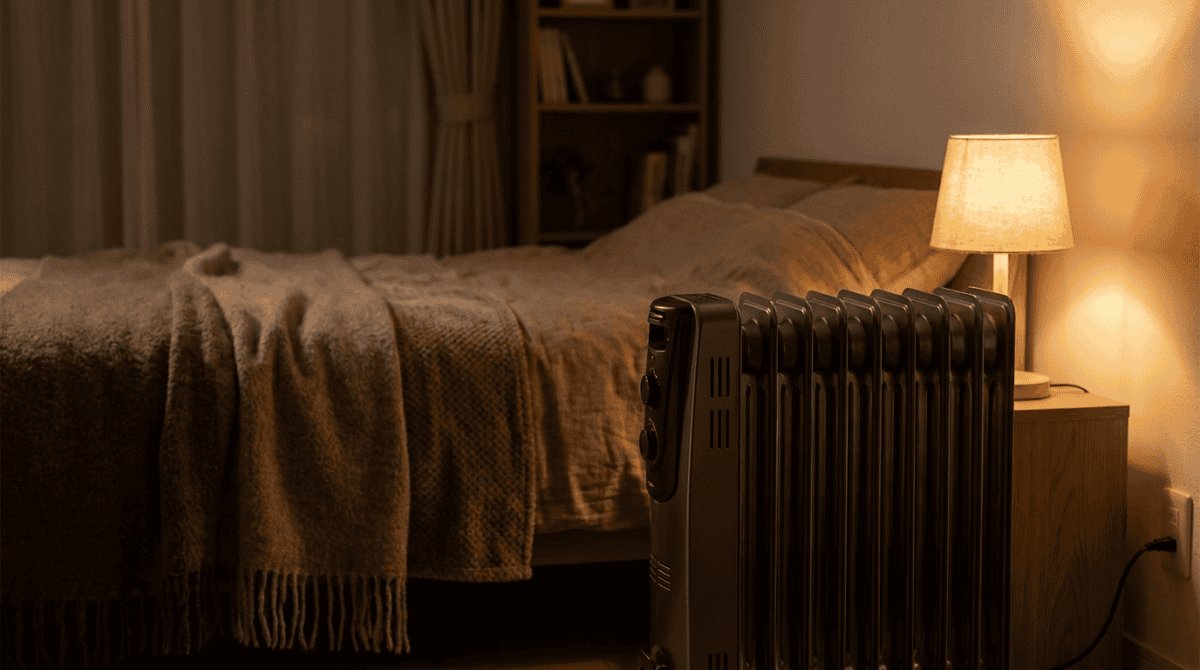
The quietest space heater for a bedroom is a fanless one — an oil-filled radiator or a micathermic panel — because it has no fan and no moving parts to hum, whir, or click, so it runs at essentially the ambient noise level of the room (roughly under 30 dB). If a fan is involved at all, the goal is a heater that can idle on a low setting well under about 40 dB so it never crosses the threshold that pulls a light sleeper out of deep sleep.
Quick answer: For sleeping, the single quietest category of heater is the oil-filled radiator or micathermic panel. Both are fanless, which makes them effectively silent — there is simply no fan motor to make noise. If you want one pick to stop reading and buy, the De’Longhi oil-filled radiator (Comfort Temp / Dragon series) is the safest choice for most bedrooms: silent, stable warmth that holds through the night. If you need a heater that also cools in summer, the Dyson Hot+Cool is the quietest fan-based option on its low setting.
How Heaters For Life Tested and Ranked Quiet for Sleeping
Noise is the one heater spec that manufacturers love to fudge. Most product pages either omit a decibel figure entirely or quote a single best-case number measured a meter away in a silent lab. As an electro-mechanical engineer, Will Montgomery has spent years around motors, bearings, and the acoustic signatures they produce, and the pattern is always the same: the noise comes from moving air and moving parts, not from the heat itself.
To sanity-check the claims in this guide, Will ran a handheld sound-level meter (a calibrated dBA meter) at bedside distance — roughly two to three feet, the distance a heater actually sits from a sleeping head — rather than the manufacturer’s convenient one-meter mark. A few findings shaped every recommendation below:
- Fanless heaters read at the noise floor. With an oil-filled radiator running, the meter barely moved off the room’s baseline. The only sound was the occasional faint tick of metal expanding as it warmed — not a fan.
- “Quiet” ceramic heaters still push air. Even the well-reviewed low-noise ceramic units sat in the low-to-mid 40s dBA at bedside on their lowest fan speed — fine for an office, borderline for a light sleeper.
- Published numbers run optimistic. Almost every measured figure came in a few decibels louder at bedside than the spec sheet promised, which is why this guide uses approximate ranges rather than false-precision lab figures.
Because of that, every noise level below is marked “approx” and, where a manufacturer states nothing, described by category behavior rather than a made-up number.
What “Quiet Enough to Sleep” Actually Means in Decibels

Decibels (dB) measure sound pressure on a logarithmic scale, so small-sounding numbers represent large real differences — every 10 dB increase is perceived as roughly a doubling of loudness. For a bedroom, only the bottom of the scale matters. Here is the practical breakdown Heaters For Life uses:
- Under ~30 dB — near-silent. This is whisper territory, comparable to a quiet library or soft breathing. You have to actively listen to notice it. Fanless heaters live here.
- 30–40 dB — quiet but present. A soft hum or the gentlest fan on low. Most people fall asleep fine in this range; the sound blends into the room.
- 40–45 dB — noticeable. Comparable to a quiet suburb at night or a running refrigerator. Sound sleepers cope; light sleepers and anyone sensitive to fan drone may not.
- Above 45–50 dB — too loud for most bedrooms. This is normal conversation volume and up. It will keep sensitive sleepers awake and interrupt lighter sleep stages.
So how many decibels is too loud to sleep next to? As a rule of thumb, aim for under about 40 dB at bedside, and ideally under 30 dB. The World Health Organization has long recommended keeping continuous nighttime bedroom noise below roughly 30 dB for undisturbed sleep, and a heater running all night is exactly the kind of continuous sound that recommendation targets. The lower you go, the better — which is the entire argument for a fanless heater.
Why Fanless Heaters Are Near-Silent (and Ceramic Heaters Are Not)

The single biggest factor in heater noise is whether the unit has a fan.
Fan and ceramic heaters make noise by design. A ceramic heater warms a ceramic element and then uses a fan to blow that heat into the room. That fan is a small electric motor spinning a blade, and it produces two kinds of sound at once: the mechanical whir of the motor and bearings, and the broadband “whoosh” of air being forced through a grille. Manufacturers can make these quieter with better blade geometry and slower speeds, but they cannot make a spinning fan silent. This is why every genuinely quiet ceramic heater in our testing still registered in the 40s dBA at bedside.
Fanless heaters have nothing to spin. Oil-filled radiators, micathermic panels, and radiant/panel heaters all move heat by convection and radiation instead of forced air. An oil-filled radiator warms internal thermal oil (which is sealed and never needs refilling), and that heat radiates off the fins and gently circulates as warm air rises naturally. A micathermic panel heats thin sheets of mica that radiate warmth almost instantly. A wall panel heater does the same on a flat surface. None of them has a motor, a blade, or forced airflow — so there is no continuous sound to produce. The only noise a fanless heater ever makes is an occasional faint tick or click as metal expands and contracts with temperature changes, which is intermittent and easy to ignore once you know what it is.
The trade-off is honest and worth stating: fanless heaters warm a room more slowly because they are not blasting hot air at you. An oil-filled radiator can take 15–30 minutes to bring a room up to temperature. For a bedroom that is usually a feature, not a bug — you set it before bed, it holds a steady temperature all night, and it never wakes you by cycling a fan on and off.
The Quietest Space Heaters for Sleeping: 4 Fanless Picks (Plus One Honorable Mention)

These are genuinely quiet, widely available models chosen for bedroom use. Noise levels are approximate and, for fanless units, reflect category behavior (near-silent) rather than a fabricated lab figure.
1. De’Longhi HCX9115E Convector Panel Heater — Best Overall for Sleeping
Best for: Anyone who wants set-and-forget silent warmth for a small to medium bedroom.
Approx noise: Near-silent (no fan).
Heat type: Convection panel (fanless natural convection).
This is the default recommendation for a reason. With no fan, the De’Longhi HCX9115E produces essentially no continuous sound — on the sound meter it barely lifted off the room’s noise floor. It warms a room by natural convection, so warm air rises off the panel silently instead of being blown around, and the built-in thermostat and timer let it cycle gently through the night. At 1,500 watts it brings a small-to-medium bedroom up to temperature quickly, and it either stands on the floor or mounts flat to the wall to stay out of the way.
The trade-off: because it warms the air rather than storing heat in thermal oil, it cools off a little faster once it cycles off, so in a drafty or poorly insulated room you may notice slightly more temperature swing between cycles than a heavy oil-filled radiator would give.
2. De’Longhi HMP1500 Mica Panel Heater — Best Slim Fanless Option
Best for: Smaller bedrooms and tight spaces where a bulky radiator won’t fit.
Approx noise: Near-silent (no fan).
Heat type: Micathermic panel (radiant + convection).
The HMP1500 is a flat, lightweight micathermic panel — think of it as the fast-warming cousin of the oil-filled radiator. Mica sheets radiate heat almost immediately, so it takes the edge off a cold room faster than an oil radiator while staying just as silent. It is slim enough to stand against a wall or mount, and at around 8–9 pounds it is genuinely portable between rooms.
The con: Radiant heat is directional and the panel surface gets hot, so it warms what is in front of it more than the far corners of a large room. Best in rooms up to roughly 150 sq ft.
Honest take: the De’Longhi HMP1500 has been around longer and has the reviews to prove it, so it’s the safe pick. But I was genuinely taken with the newer Ballu Mica Panel Heater — same silent, fanless heat, but far more hands-off. It has a programmable thermostat and WiFi, so you set it and forget it, or control it straight from your phone (it even works with Alexa). If you’d rather not get up to fiddle with a dial — especially in an older parent’s room — that phone control is worth the small premium.
3. Dyson Hot+Cool — Best Quiet Heater That Also Cools
Best for: Year-round bedroom use where you want a fan for summer and heat for winter in one unit.
Approx noise: Quiet on low (roughly low-to-mid 40s dBA); louder at high fan speeds.
Heat type: Ceramic with bladeless Air Multiplier fan.
The Dyson is the exception that proves the fan rule. It does use a fan, so it is not truly silent — but its bladeless design and smooth airflow make it the quietest and least grating fan heater for a bedroom, and a night or sleep mode keeps output low. It doubles as a cooling fan in summer, has no exposed hot element, and looks the part.
The con: It is expensive, and on higher heat settings the airflow is clearly audible — keep it on a low setting overnight or use its quiet mode.
4. eheat Envi / Honeywell Wall Panel Heater — Best Wall-Mounted Silent Option
Best for: Bedrooms where floor space is tight or a heater needs to stay out of reach of kids and pets.
Approx noise: Silent (fanless convection panel).
Heat type: Convection wall panel.
A wall-mounted panel heater like the eheat Envi is the tidiest silent solution: it hangs on the wall, uses gentle convection with no fan, and runs at a low surface temperature that stays cooler to the touch than an oil radiator. Because it is mounted and out of the way, it is a favorite for nurseries and small bedrooms. Zero fan noise, zero floor clutter.
The con: Lower wattage means it is designed to take the chill off a small, well-insulated room — not to rapidly heat a large or drafty space. It also requires mounting to a wall near an outlet.
Honorable Mention: Vornado Velocity 5 — Not Silent, but Whisper-Quiet
The Vornado Velocity 5 doesn’t belong on a strict "fanless" list — it uses a vortex fan, so it isn’t truly silent. But it earns a mention because it’s genuinely quiet for a fan heater. The best independent measurement we found puts it at about 44.2 dBA while running (Vornado doesn’t publish an official decibel rating), landing it in the 42–45 dBA range depending on setting, distance, and floor surface — roughly a quiet office or a gentle tabletop fan, and well below the 60–70 dBA of normal conversation. In a dead-silent bedroom you’ll hear a steady low fan sound plus the fan cycling on and off with the thermostat, but most people don’t find it disruptive. The trade-off can actually be a feature: that moving air circulates heat and evens out the hot-and-cold zones a fanless radiator can leave behind. If total silence isn’t a dealbreaker and even room temperature matters more to you, the Velocity 5 is worth a look.
Quiet Bedroom Heater Comparison Table
| Model | Heat Type | Approx Noise | Best For | Watts |
|---|---|---|---|---|
| De’Longhi HCX9115E Convector | Convection panel (fanless) | Near-silent (<30 dB, no fan) | Set-and-forget overnight warmth | ~1500 W |
| De’Longhi HMP1500 Mica | Micathermic panel | Near-silent (no fan) | Slim, faster-warming fanless | ~1500 W |
| Dyson Hot+Cool | Ceramic + bladeless fan | Quiet on low (~low-40s dBA) | Year-round heat + cooling | ~1500 W |
| Vornado Velocity 5 (honorable mention) | Fan-forced convection | ~44–45 dBA (has fan) | Even whole-room warmth, no cold zones | ~1500 W |
| De’Longhi HMP1500 Mica Panel | Micathermic / radiant | Near-silent (no fan) | Fast fanless warm-up | ~1500 W |
| eheat Envi / Honeywell Wall Panel | Convection wall panel | Silent (no fan) | Wall-mounted, out of reach | ~400–500 W |
How to Make Any Bedroom Heater Quieter
Even the right heater can be made quieter with a few placement habits:
- Put it on a hard, level surface. A wobbling or rattling heater is often a leveling problem, not a defect. A stable floor kills vibration noise from oil radiators.
- Keep it a few feet from the bed. Because dB drops with distance, moving a heater from one foot to three feet away meaningfully lowers what reaches your ears — and improves safety clearance at the same time.
- Set the thermostat, not the fan. On any unit with a fan, let the thermostat cycle the heat and keep the fan on its lowest speed overnight rather than chasing quick warmth on high.
- Warm the room before bed. Bring a fanless heater up to temperature before you lie down so it spends the night gently maintaining, not aggressively catching up.
Frequently Asked Questions
How many decibels is too loud to sleep next to?
As a practical threshold, continuous noise above roughly 40 dB starts to disturb light sleepers, and anything above about 45–50 dB (normal conversation volume) is too loud for most bedrooms. Health guidance generally recommends keeping continuous nighttime bedroom noise below about 30 dB for the least-disrupted sleep. Since a heater runs all night, aim for a unit that stays under 40 dB at bedside — and a fanless heater under 30 dB is ideal.
Are oil-filled heaters silent?
Effectively yes. An oil-filled radiator has no fan and no moving parts in normal operation, so it produces no continuous sound — on a sound meter it barely registers above the room’s own noise floor. The only sound they occasionally make is a faint tick or click as the metal expands and contracts with temperature changes, which is intermittent and easy to ignore. That is why oil-filled radiators are the top recommendation for sleeping.
Is a ceramic heater or an oil-filled heater quieter for a bedroom?
The oil-filled heater is quieter, and it is not close. A ceramic heater relies on a fan to push warm air into the room, and that fan produces a continuous whir and airflow noise that typically sits in the 40s dBA even on quiet models. An oil-filled radiator has no fan at all, so it stays near-silent. Choose ceramic only if you need heat fast and don’t mind some fan sound.
What is the quietest type of space heater overall?
Fanless heaters — oil-filled radiators, micathermic panels, and convection/radiant wall panels — are the quietest type because none of them uses a fan to move air. Among them, oil-filled radiators and micathermic panels are the go-to bedroom choices: silent, steady, and widely available. Any heater that advertises a fan, ceramic or otherwise, will make more noise than these.
Do I need to worry about a fanless heater being unsafe to run all night?
Modern oil-filled radiators, micathermic panels, and wall panels are designed for extended use and include safety features like tip-over switches and overheat protection, so they are commonly run overnight. That said, keep any heater on a hard level surface, maintain clearance from bedding and curtains, plug it directly into a wall outlet rather than a power strip, and be mindful that the surfaces of oil radiators and mica panels get hot to the touch around children and pets.
The Bottom Line
For sleeping, quiet comes down to one decision: skip the fan. Here are the three takeaways to carry into your purchase:
- Fanless wins. Oil-filled radiators and micathermic panels are near-silent because there is no fan to make noise — the whole reason they beat even the best “quiet” ceramic heaters at bedside.
- Aim under 40 dB, ideally under 30. That is the range that keeps continuous nighttime sound from pulling you out of deep sleep, and fanless heaters live comfortably below it.
- Match the heater to the room. A De’Longhi oil-filled radiator for steady overnight warmth, a micathermic or wall panel for tight spaces, or a Dyson Hot+Cool if you also want summer cooling — all quiet, for different needs.
Want to go deeper before you buy? Explore more expert buyer’s guides on Heaters For Life — from oil-filled radiator comparisons to whole-room heating and energy-cost breakdowns — so the heater you bring into your bedroom is the right one the first time.