

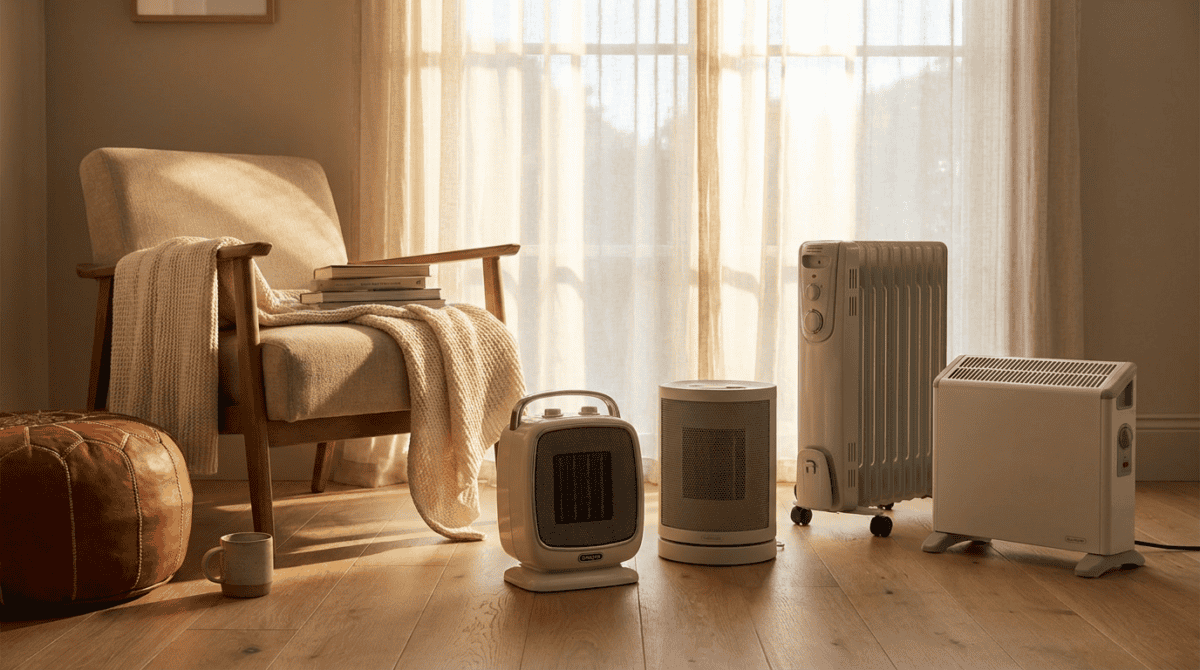
Choosing a space heater is confusing because the box tells you the “type” but never what that word actually means for the room you want to warm. The short version: infrared heats objects and people directly, ceramic and fan heaters blow warm air for fast whole-room comfort, oil-filled radiators give slow steady background heat, and micathermic panels split the difference silently. At Heaters For Life, this guide breaks down every major space heater type in plain English so you can match the technology to your space, your budget, and your safety needs.
A space heater is a portable electric or fuel-burning appliance that warms a single room or zone rather than a whole house — the type (infrared, ceramic, oil-filled, fan, or micathermic) changes how it delivers heat, not how much energy it uses.
How Space Heaters Actually Work: Convection vs. Radiant

Before comparing individual types, it helps to understand the two ways any heater moves warmth into a room. Nearly every space heater relies on one method, the other, or a blend of both.
- Convection heating warms the air. A heating element raises the temperature of the air around it, that warm air rises and circulates, and the whole room gradually reaches a comfortable temperature. Ceramic, fan, oil-filled, and panel heaters are primarily convection devices.
- Radiant heating warms objects and people directly, the same way the sun feels warm on your skin even on a cold day. Infrared heaters are the purest example: they don’t waste energy heating the air in between, so you feel warmth almost instantly even in a large or drafty space.
From years servicing electric heating elements, the single most useful thing to internalize is this: convection is about filling a room and radiant is about heating a target. Get that distinction right and 80% of the “which type should I buy” question answers itself. Micathermic heaters are notable because they genuinely do both at once, which is why they get their own section below.
One myth worth killing early: marketing loves to claim a particular technology is “more energy efficient.” For plug-in electric heaters, that is essentially false. Every resistive electric heater — ceramic, oil, fan, micathermic, infrared — converts close to 100% of the electricity it draws into heat. A 1,500-watt heater is a 1,500-watt heater; run two different types for one hour and they use the same electricity and release the same total heat. What changes is comfort efficiency: how fast you feel warm, whether the heat targets you or the whole room, and how long it lingers after shutoff. That is the real decision, and it’s what this guide focuses on.
Infrared / Radiant Heaters
An infrared heater is a radiant heater that warms people and objects directly with infrared light instead of heating the surrounding air. Inside, an electric element (often a quartz tube or metal coil behind a reflector) glows and emits infrared radiation, which travels across the room and is absorbed by whatever it hits — your body, the couch, the floor — turning into felt warmth on contact.
How it works: Electricity heats the emitter; a polished reflector aims the infrared outward in a beam-like pattern. Because the energy doesn’t have to warm all the air first, you feel heat within seconds of switch-on, even with a door open or in a poorly insulated garage.
Best use case: Spot heating a specific person or zone — a desk, a recliner, a workbench in a cold garage, or a large drafty room where heating the whole air volume would be wasteful. In testing, radiant units are the ones that feel warm fastest in a cold, open space.
Pros:
- Instant, directional warmth — great in drafty or large spaces
- Silent operation when there’s no fan
- Doesn’t dry out or stir up dust the way forced-air units can
- Efficient comfort for zone heating one person
Cons:
- Only warms what’s in its line of sight — step aside and the warmth stops
- Doesn’t hold heat in the room once switched off
- Exposed quartz tubes and reflectors can get very hot
Running cost: Same per-watt cost as any electric heater. Where it can save money is behavior: if you use it to heat only yourself rather than a whole room, you may run it at lower wattage or for less time. Popular examples include Dr Infrared Heater cabinet models and Duraflame infrared units.
Safety note: The emitting surface and grille can reach high temperatures — keep children, pets, and fabrics well clear. Cabinet-style infrared heaters (the wood-look boxes) usually stay cooler to the touch on the outside than open quartz radiant bars.
Category pick: the Dr. Infrared DR-968 is the runaway favorite here — a 1,500W cabinet infrared heater with a 4.5-star average across 28,000-plus reviews, known for steady radiant warmth and quiet operation.
Ceramic Heaters (Convection / PTC)
A ceramic heater is a convection heater that passes electricity through a ceramic heating element (often self-regulating PTC ceramic) and typically uses a small fan to blow the resulting warm air into the room. The ceramic material heats up fast, holds temperature well, and — in PTC designs — naturally limits its own maximum temperature, which is a genuine safety advantage.
How it works: Current flows through ceramic plates or coils bonded to aluminum baffles. Air drawn across those hot baffles by the fan picks up heat and is pushed out the front. “PTC” (Positive Temperature Coefficient) ceramic increases its electrical resistance as it gets hotter, so it self-regulates instead of running away to dangerous temperatures.
Best use case: Fast personal heat and small-to-medium rooms — under a desk, a bathroom, a home office, or a bedroom you want warm quickly. This is the everyday workhorse category most people picture when they think “space heater.”
Pros:
- Heats up and warms a small room quickly
- Compact, lightweight, and inexpensive
- PTC elements self-limit temperature for added safety
- Often includes oscillation, thermostats, and tip-over cutoffs
Cons:
- The fan makes noise — a steady whoosh some find distracting at night
- Heat stops circulating quickly once it’s off
- Moving air can feel drying and stir dust
Running cost: Identical energy draw to other 1,500-watt heaters; the built-in thermostat is what saves money, cycling the element off once the room hits temperature. Lasko and Vornado ceramic models are widely owned examples, with Vornado leaning on whole-room air circulation.
Safety note: Ceramic heaters are among the safer plug-in choices thanks to PTC self-regulation, tip-over switches, and overheat sensors — but the front grille still gets hot, and they should never be left running unattended or on carpet without a stable base.
Category pick: the Lasko 751320 Ceramic Tower is the default for a reason — 4.5 stars across 40,000-plus reviews, with oscillation, a thermostat, and a remote for fast, even convection heat.
Oil-Filled Radiator Heaters

An oil-filled radiator is a convection heater that warms diathermic oil sealed permanently inside its fins, and that hot oil then radiates gentle, long-lasting heat into the room without ever being burned or refilled. It’s the “slow and steady” option — quiet, fanless, and famous for keeping a room warm well after it switches off.
How it works: An electric element heats oil circulating through the metal columns. The oil acts as a thermal reservoir, spreading heat across the large fin surface area. That mass takes time to warm up but also holds heat, so the unit keeps gently warming the room during its off-cycles.
Best use case: Bedrooms and rooms where you want steady background warmth for hours — especially overnight, since there’s no fan noise. Ideal when you prioritize comfort and quiet over instant heat.
Pros:
- Completely silent — no fan
- Retains and radiates heat after shutoff, smoothing out temperature swings
- Surface runs cooler than exposed-element heaters (though still warm)
- Doesn’t dry the air or blow dust
Cons:
- Slow to warm up — not for quick bursts of heat
- Heavy and bulky, though most have wheels
- Poor at spot heating; it’s a whole-room device
Running cost: Same 1,500-watt ceiling as the rest, but the thermal mass means the thermostat can keep the element off longer once the room is warm, which can make real-world running costs feel lower for sustained heating. De’Longhi is the benchmark brand here, with Pelonis offering budget-friendly alternatives.
Safety note: The sealed oil never needs topping up and can’t spill in normal use. The fins do get hot enough to cause a burn on contact, so keep them away from bedding and curtains — but there’s no open element and no exposed glowing surface, which many parents prefer.
Category pick: the Amazon Basics Oil-Filled Radiator covers the basics well — 1,500W, seven fins, tip-over and overheat protection, and a 4.3-star average across 3,500-plus reviews for quiet, steady background heat.
Fan / Forced-Air Heaters
A fan heater is a convection heater that blows air across a simple metal heating coil (usually nichrome wire) to deliver cheap, near-instant warm air. These are the small, light, low-cost units — including the classic “personal heater” and many utility/workshop heaters — built for speed and portability rather than finesse.
How it works: A fan forces room air over an electrically heated coil and blows it straight back out warmed. There’s minimal thermal mass, so heat output starts and stops almost immediately with the power.
Best use case: Quick bursts of heat in a small area — warming your feet at a desk, taking the chill off a bathroom, or a garage/workshop where a rugged forced-air or “milkhouse” heater earns its keep.
Pros:
- Cheapest type to buy
- Heats a small space almost instantly
- Very light and portable
Cons:
- Noisiest category — the fan runs constantly
- Heat vanishes the moment it’s switched off (no residual warmth)
- Blows dust around and can feel drying
- Bare coils can be a fire risk if covered or knocked over
Running cost: Identical per-watt energy use; because they hold no heat, they may run more continuously to maintain temperature, which can make them feel less economical for long sessions than an oil-filled unit. Lasko and Honeywell make many popular fan and ceramic-fan hybrids.
Safety note: Basic coil fan heaters have the fewest safety features in the category. Choose a model with a tip-over switch and overheat protection, never drape anything over the outlet, and keep them off flammable surfaces. From years servicing heating elements, the cheap bare-coil units are the ones I’d trust least left running unattended.
Category pick: the Vornado MVH is the whole-room fan-forced pick — its vortex airflow circulates heat instead of blasting one spot, earning 4.2 stars across 9,000-plus reviews.
Micathermic Heaters
A micathermic heater is a hybrid panel heater that sandwiches a heating element between thin sheets of mica mineral to emit both radiant heat (warming objects directly) and convection heat (warming the air) at the same time — silently and without a fan. It’s the lesser-known type that quietly solves the “I want fast heat and whole-room comfort and no fan noise” problem.
How it works: Mica is an excellent conductor of heat and a natural electrical insulator. Wrapping the element in mica lets the flat panel radiate infrared outward while also warming the air passing over its surface — roughly 80% convection and 20% radiant in typical designs — with no moving parts.
Best use case: Whole-room heating where you want warmth faster than an oil-filled radiator but quieter than a fan heater. Their slim, flat, often wall-mountable profile suits living rooms, offices, and bedrooms tight on floor space.
Pros:
- Silent — no fan
- Warms up faster than an oil-filled radiator
- Slim and lightweight, often wall-mountable
- Combines instant radiant feel with room-filling convection
Cons:
- Panel surface gets hot to the touch
- Doesn’t retain heat after shutoff the way oil-filled units do
- Fewer models on the US market, so less selection
Running cost: Same electrical draw as any 1,500-watt heater; the appeal is comfort speed and silence, not a lower bill. De’Longhi and Bionaire have offered well-regarded micathermic panels.
Safety note: The mica panel can get hot, so treat it like any radiant surface around kids and pets. On the plus side, there’s no fan to pull in dust and no exposed glowing coil.
Category pick: the De’Longhi HMP1500 Mica Panel is the standout — a slim, fanless micathermic panel that heats silently through radiant and convection and either mounts on a wall or stands on the floor.
Beyond Electric: Panel/Wall and Propane Heaters
Two more types round out the picture. They serve narrower needs but matter when the five mainstream electric types don’t fit. Both trade the plug-and-play convenience of a standard electric heater for a specific advantage — ultra-slim installation or complete independence from the grid.
Panel and Wall-Mounted Heaters
A panel heater is a slim, flat convection heater — usually wall-mountable — that warms the air gently and blends into a room like a piece of furniture. They run at lower wattages than a typical 1,500-watt portable, making them a good choice for sustained low-level background heat in a small room, a home office, or a nursery. They’re quiet and unobtrusive, but they warm slowly and aren’t built for rapidly reheating a cold space. Mounting one on the wall also frees floor space and keeps the heat source away from pets and clutter.
Propane (Gas) Heaters
A propane heater burns liquid propane fuel to produce heat, making it the go-to option where there’s no electricity — job sites, hunting cabins, tailgates, garages, and emergency backup during outages. Because they don’t need a plug, they’re unmatched for off-grid and outdoor use, and a single tank delivers a lot of heat. The trade-off is serious: combustion produces carbon monoxide and water vapor, so indoor use demands an “indoor-safe” rated model (such as the Mr. Heater Buddy series), a carbon monoxide detector, and adequate ventilation. Never run a standard outdoor propane heater inside an enclosed room. Think of propane as a specialist tool for no-power situations rather than an everyday room heater.
Space Heater Types Compared: The Full Matrix

The table below sums up how the main types differ on the factors that actually drive a buying decision. Remember: the “running cost” column reflects real-world comfort behavior, not raw efficiency — at equal wattage, every electric type below draws the same power and produces the same total heat.
| Heater Type | How It Heats | Best For | Heat Speed | Running Cost | Noise | Safe to Touch? |
|---|---|---|---|---|---|---|
| Infrared / Radiant | Radiant — heats objects & people directly | Spot heating, drafty or large rooms, garages | Instant (directional) | Low if zone-heating one person | Silent (fanless) to low | No — emitter runs hot |
| Ceramic (PTC) | Convection — fan over ceramic element | Fast personal heat, small–medium rooms | Fast | Moderate (thermostat cycles) | Low–moderate (fan) | Grille hot; body often cooler |
| Oil-Filled Radiator | Convection — hot sealed oil radiates from fins | Bedrooms, all-day steady heat, quiet spaces | Slow (holds heat after off) | Low for sustained heating | Silent | Warm; no exposed element |
| Fan / Forced-Air | Convection — fan over a metal coil | Quick bursts, small spaces, workshops | Instant | Higher for long runs | High (constant fan) | No — bare coils very hot |
| Micathermic | Hybrid — mica panel radiates + convects | Silent whole-room heat, tight floor space | Fast | Moderate | Silent | No — panel gets hot |
| Propane (Gas) | Combustion — burns propane fuel | Off-grid, outdoors, outages (ventilate!) | Fast | Depends on propane price | Low | No — CO risk; ventilate |
Which Space Heater Type Should You Choose?
Match the type to the job rather than chasing a single “best” heater:
- Warm just yourself, fast, in a cold or drafty space: choose infrared/radiant.
- Quick, affordable warm-up for a small room or office: choose ceramic (PTC).
- Quiet, steady heat all evening or overnight in a bedroom: choose an oil-filled radiator.
- Cheapest unit for occasional quick bursts or a workshop: choose a fan/forced-air heater.
- Fast, silent whole-room heat without a bulky radiator: choose micathermic.
- No electricity (outage, cabin, outdoors): choose an indoor-safe propane heater with a CO detector.
Whatever you pick, size it to the room. A common rule of thumb is roughly 10 watts of heater per square foot for a room with average insulation, so a full 1,500-watt heater is aimed at spaces up to about 150 square feet. Undersize the heater and it runs flat-out without ever catching up; oversize it and you’ve simply spent more up front for the same 1,500-watt ceiling most US 120-volt outlets allow.
If you want to estimate running cost for any type, the math is simple: multiply the heater’s kilowatts by your electricity rate. A 1,500-watt unit is 1.5 kW, so at the US average of roughly 17 cents per kilowatt-hour it costs about 25 cents an hour when running full-tilt — the same for a ceramic, oil-filled, fan, or micathermic model. The savings never come from the badge on the box; they come from a good thermostat, an accurate room size match, and heating only the space (or the person) you actually need warm.
Frequently Asked Questions
Which type of space heater is most efficient?
At the wall outlet, all plug-in electric space heaters are essentially equally efficient — infrared, ceramic, oil-filled, fan, and micathermic all convert roughly 100% of the electricity they draw into heat, so none is inherently “more efficient” than another at the same wattage. The real difference is comfort efficiency: infrared/radiant heaters are the most efficient at warming a single person quickly because they heat you directly instead of the whole room. For efficiently maintaining warmth in a room over hours, an oil-filled radiator’s heat retention lets its thermostat idle more.
Which type of space heater is cheapest to run?
Since a 1,500-watt heater of any type costs the same to run for a given number of hours, the cheapest to run is whichever lets you use less power for the comfort you need. Zone-heating one person with an infrared heater — or heating one room instead of the whole house — is usually the biggest saver. For sustained whole-room warmth, oil-filled radiators can edge out fan heaters because their stored heat means the element cycles off more often.
What is the difference between infrared and ceramic heaters?
Infrared heaters use radiant heat to warm objects and people directly in their line of sight, so you feel warmth almost instantly even in a drafty room, but the effect stops when you move out of the beam. Ceramic heaters use a fan to blow air over a heated ceramic element, warming the air of a small-to-medium room more evenly, though they make some fan noise and lose warmth quickly once switched off. Choose infrared for spot heating and ceramic for filling a small room with warm air.
Are oil-filled heaters safer than other space heaters?
Oil-filled radiators are among the safer choices because they have no exposed heating element, no glowing coil, and no fan blowing over hot parts, and their surface stays cooler than open-element heaters. The sealed oil never needs refilling and won’t spill in normal use. That said, the fins still get hot enough to burn on contact, so they must be kept clear of bedding, curtains, and other flammable materials.
Can I leave a space heater on overnight?
The safest practice is to not leave any space heater running unattended, including overnight, but if you do, an oil-filled radiator or a PTC ceramic heater with a thermostat, tip-over switch, and overheat protection is the lowest-risk choice because they run silently and self-regulate. Always place the heater on a hard, flat surface at least three feet from bedding, curtains, and furniture, and plug it directly into a wall outlet — never a power strip or extension cord.
Key Takeaways
- Type = delivery, not efficiency. Every electric space heater is about 100% efficient at the plug; what differs is whether it heats you (infrared), the air fast (ceramic/fan), or the room steadily (oil-filled/micathermic).
- Match the type to the task. Infrared for spot heating, ceramic for quick small-room warmth, oil-filled for quiet overnight heat, fan for cheap bursts, micathermic for silent whole-room comfort.
- Safety scales with features, not price. Prioritize a thermostat, tip-over cutoff, and overheat protection, keep any heater three feet from anything flammable, and never run a non-indoor-rated propane unit inside without ventilation and a CO detector.
Ready to pick the right one for your space? Explore more hands-on buying guides and expert reviews at Heaters For Life, where we break down the best models in every category to match your room, budget, and comfort.
Written by Will Montgomery, Electro-Mechanical Engineer and founder of Heaters For Life, drawing on years of hands-on experience testing and servicing electric heating elements.