

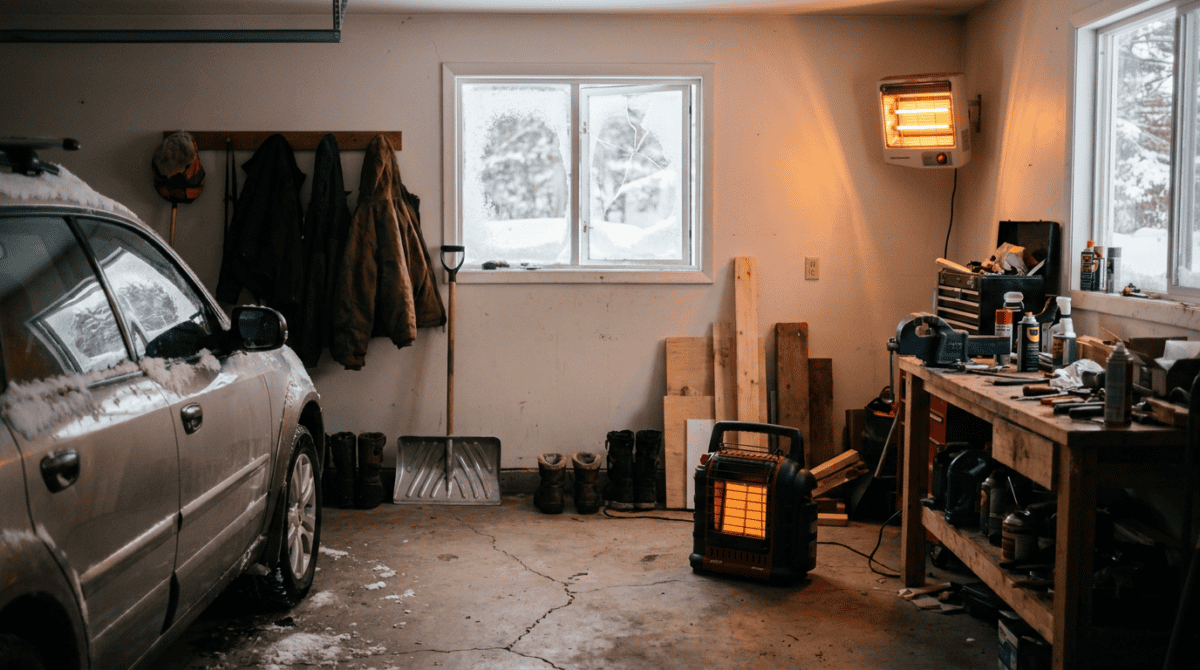
The cheapest real-world way to heat a garage is a radiant propane heater like the Mr. Heater Buddy for occasional, on-demand warmth, and a 240V electric forced-air unit if the space is at least partly insulated and used regularly. Everything else — natural gas, mini-splits, radiant floors — is a bigger investment that only pays off once the garage is sealed and insulated enough to hold the heat.
At Heaters For Life, this guide is the hub for the garage and workshop cluster, so it covers the honest math rather than the marketing version. It walks through every practical option, what each one really costs to buy and run, how to size a heater, and the single question almost everyone gets wrong: whether a garage needs insulation before heating it at all.
Quick Answer: The cheapest way to heat a garage
- Occasional / spot heating (cheapest upfront): A radiant propane heater such as the Mr. Heater Big Buddy or Tough Buddy — roughly $80–$160, heats the person and objects in front of it in seconds, no wiring. Best for a garage used a few hours at a time.
- Regular use in a partly insulated garage (cheapest long-term): A 240V electric forced-air heater (Fahrenheat or Dr. Infrared) mounted in the corner on a dedicated breaker — cleaner, dry heat with no fumes.
- The math changer: Insulation. An uninsulated garage can need double the heater output and still feel cold. Insulating first often turns a $300/month heating bill into a $60 one.
By Will Montgomery, Electro-Mechanical Engineer and owner of Heaters For Life. Will heats his own 24×28 detached workshop through New England winters and has wired the 240V circuits for two garage heaters himself — so the numbers and warnings below come from a cold concrete floor, not a spec sheet.
The garage heating options, ranked by what actually makes sense
There are really only four heat sources worth considering for a garage — radiant propane, electric, natural gas, and (for full remodels) a ductless mini-split — and the right one depends almost entirely on how often the space is used and how well it holds heat. Most homeowners overspend by buying a permanent system for a garage they only stand in for two hours on a Saturday, or they buy a tiny plug-in heater for a space that needs ten times its output.
Here is the honest shortlist, from lowest barrier to entry to highest:
- Radiant / propane portable heaters — cheapest to buy, instant warmth, but they burn fuel indoors and add moisture.
- Electric heaters (120V and 240V) — clean, dry, safe, no fumes; 120V units are severely limited, 240V units heat a real garage.
- Natural gas garage heaters — highest install cost, but by far the cheapest heat per hour if the garage is used daily and already has a gas line.
- Ductless mini-splits — the efficiency king and it does summer cooling too, but $2,000+ installed puts it in “finished garage” territory.
The comparison table below is the fast way to narrow it down. Each option is explored in detail underneath.
| Option | Upfront cost | Running cost | Best for | Needs venting / wiring? |
|---|---|---|---|---|
| Radiant propane (Mr. Heater Buddy) | $80–$160 | ~$0.40–$0.80/hr | Occasional spot heating; uninsulated garages | Ventilation required (CO). No wiring. |
| Electric 120V space heater | $40–$150 | ~$0.20–$0.25/hr | Small, insulated, single-bay corners | No venting. Standard outlet (1,500W max). |
| Electric 240V forced-air (Fahrenheat / Dr. Infrared) | $150–$400 + wiring | ~$0.55–$0.90/hr | Regular use in a partly insulated garage | No venting. Needs 240V circuit + correct breaker/wire. |
| Natural gas unit heater (Modine Hot Dawg) | $500–$800 + install | ~$0.30–$0.55/hr | Daily-use garages with an existing gas line | Requires venting + gas line + 120V power. |
| Ductless mini-split heat pump | $2,000–$5,000 installed | ~$0.15–$0.40/hr | Insulated, finished garages used year-round | No venting. Needs 240V circuit + pro install. |
Radiant propane: the cheapest way to get warm fast

A portable radiant propane heater is the cheapest realistic way to feel warm in a garage within seconds, which is exactly why it dominates the “occasional use” category. Instead of trying to raise the air temperature of the whole room, a radiant heater throws infrared heat directly at people and objects in its line of sight — so a person can be comfortable working on a bench even in an uninsulated 20°F garage where the air itself never gets warm.
The Mr. Heater Buddy family is the benchmark here. The standard Buddy runs 4,000–9,000 BTU and covers a small area on a 1 lb propane cylinder; the Big Buddy pushes 4,000–18,000 BTU and can run off a 20 lb tank for hours; the Tough Buddy is the job-site-rated version. For bigger, colder spaces, “torpedo” or forced-air propane construction heaters (50,000–75,000 BTU) heat fast but are loud and thirsty.
Running cost: Propane holds about 91,500 BTU per gallon. At roughly $4 a gallon, a Big Buddy on its 18,000 BTU high setting burns about $0.80 an hour; on a lower 9,000 BTU setting it is closer to $0.40 an hour. That is genuinely cheap for a few hours a week.
The honest downsides. Burning propane indoors does two things Will has seen firsthand in his own shop. First, it produces carbon monoxide — the “Buddy” line has a low-oxygen sensor (ODS) that shuts the unit off, but that is a backup, not a license to seal the room. A window or the overhead door needs to be cracked several inches for fresh air. Second, combustion releases water vapor: burn a gallon of propane and you dump roughly a gallon of moisture into the air, which is why forum users constantly complain that propane “generates moisture like crazy.” On a cold concrete floor and metal tools, that shows up as condensation and, over time, rust. For occasional use it is a fair trade; for daily use it becomes a real nuisance.
Electric: 120V is a toy, 240V is a real heater

Electric heaters give clean, dry, fume-free heat with zero ventilation needed, but the single most important thing to understand is that a standard 120V outlet caps out around 1,500 watts — and that is nowhere near enough for most garages. A 1,500W space heater produces about 5,100 BTU, which is fine for taking the edge off a small, insulated single bay or warming a workbench corner, but ask it to heat a two-car garage and it will run flat-out all day and lose.
Why the ceiling? A standard 120V, 15-amp household circuit can only safely deliver about 1,440 watts continuously (1,800W on a 20-amp circuit), and manufacturers cap plug-in units at 1,500W to stay within it. Plug two 1,500W heaters into the same circuit and the breaker trips — a complaint that shows up in every garage forum. There is no way around the physics on 120V.
240V is where electric heating gets serious. A hardwired 240V forced-air unit like the Fahrenheat FUH series or the Dr. Infrared garage heater delivers 5,000 watts — about 17,000 BTU — enough to actually heat an insulated two-car garage. It runs on a dedicated circuit (a 5,000W/240V unit draws about 21 amps and needs a 30-amp breaker with the correct wire gauge, typically 10 AWG). Will wired his own on a 30-amp double-pole breaker; it is a straightforward job for an electrician and not outrageously expensive if the panel is close.
Running cost: Electric resistance heat is 100% efficient at the unit, but electricity is not cheap per BTU. At the U.S. average of about $0.16/kWh, a 1,500W unit costs roughly $0.24 an hour and a 5,000W 240V unit about $0.80 an hour. That is fine for intermittent use, but run a 240V heater all day in an uninsulated garage and the bill balloons — one forum user reported a $300 month doing exactly that. The lesson is not “electric is bad,” it is “electric heat and poor insulation is an expensive combination.”
Our pick for a 240V electric shop heater: the Dr. Infrared DR-966 — a hardwired 3,000W/6,000W 240V unit and an Amazon best seller with a 4.3-star average across 4,000-plus reviews. It is the default for a one- or two-car garage that is at least partly insulated: mount it in a corner, wire it to a 240V circuit, and it puts out real heat instead of the token warmth a 120V plug-in manages.
Natural gas: cheapest heat per hour if it is used daily
A natural gas unit heater is the cheapest fuel to run and the best choice for a garage that gets used every day — but only if there is already a gas line nearby, because the install is what makes it expensive. The Modine Hot Dawg is the classic residential garage unit, mounted up near the ceiling out of the way, available from about 30,000 to 125,000 BTU. It vents combustion gases outside through a flue, so unlike a Buddy heater there is no CO or moisture dumped into the room.
Running cost: Natural gas is dramatically cheaper per BTU than electricity or bottled propane. At roughly $1.50 per therm (100,000 BTU), a 30,000 BTU/hr Modine costs about $0.45 an hour to run — and unlike propane, there are no tanks to swap. Over a full winter of daily use, that fuel savings is what justifies the higher upfront cost.
The catch is the install. The heater itself is $500–$800, but running a new gas line, adding a vent through the wall or roof, and providing a 120V connection for the fan and igniter can easily double or triple the total. It usually requires a permit and a licensed installer. This is the option for a serious, permanently heated garage or workshop — not a quick fix.
Our pick for natural gas: the Mr. Heater 50,000 BTU Big Maxx (4.4 stars, 1,400-plus reviews) runs on propane or natural gas and is sized right for a typical two- to three-car garage. Just budget for the gas line and venting — this is a permanent install, not a plug-in, so the cheap per-hour heat comes after an up-front setup cost.
How to size a garage heater (the 10 watts per square foot rule)
A quick rule of thumb for a reasonably insulated garage is about 10 watts of electric heat — or roughly 30–35 BTU of gas/propane — per square foot of floor space, and noticeably more if the garage is uninsulated. Sizing matters because an undersized heater simply never wins against the heat loss, while an oversized one wastes money and (with combustion units) fuel.
To use the rule, measure the floor area, then adjust up for a cold climate, a high or open ceiling, or thin uninsulated walls and a bare overhead door. The table below gives realistic starting targets for common garage sizes:
| Garage size | Approx. floor area | Electric (insulated) ~10 W/sq ft | BTU insulated (~35/sq ft) | BTU uninsulated (~50/sq ft) |
|---|---|---|---|---|
| 1-car | ~250 sq ft | ~2,500 W | ~9,000 BTU | ~12,500 BTU |
| 2-car | ~450 sq ft | ~4,500 W | ~16,000 BTU | ~22,500 BTU |
| 2.5-car | ~600 sq ft | ~6,000 W | ~21,000 BTU | ~30,000 BTU |
| 3-car | ~800 sq ft | ~8,000 W | ~28,000 BTU | ~40,000 BTU |
Notice how the uninsulated column runs 40–60% higher. That gap is not just a bigger heater — it is a bigger bill, every hour, all winter. Which leads to the question that decides everything.
Do you need to insulate a garage before heating it?

No, a garage does not have to be insulated to be heated — but insulating it first is almost always the highest-return dollar spent, because without it heat pours out as fast as the heater makes it. This is the point nearly every homeowner underestimates. A radiant propane heater can keep a person comfortable in a bare, uninsulated garage because it heats bodies directly, but any attempt to warm the air of an uninsulated space is a losing battle: the concrete slab, the single-skin steel overhead door, and the un-sealed gaps bleed heat continuously.
Forum veterans put it bluntly: “there is no cheap way to heat an uninsulated 30×36 space in 20°F weather.” They are right. The good news is that garage insulation has one of the best ROIs in the whole project. In rough order of payback:
- Seal the air leaks first (cheapest, biggest win): weatherstrip the overhead door bottom, caulk gaps, add a door sweep. Often under $100.
- Insulate the overhead door: a garage door insulation kit ($60–$200) — the door is usually the single largest cold surface.
- Insulate the walls and ceiling: batts or rigid foam. More work and money, but this is what lets a modest heater actually hold a temperature.
The practical rule: if the garage will be heated occasionally, skip the big insulation project and buy a radiant propane heater — it sidesteps the heat-loss problem entirely. If the garage will be heated regularly, spend on air-sealing and door insulation before buying a heater, because it lets a smaller, cheaper-to-run unit do the job and can cut running costs by half or more.
Running-cost comparison: what each option really costs per hour
When the numbers are lined up side by side, natural gas and mini-splits win on fuel cost while propane and electric win on upfront simplicity — and that trade is the whole decision. The figures below assume roughly $4/gallon propane, $0.16/kWh electricity, and $1.50/therm natural gas; local prices will shift them, but the ranking rarely changes.
| Heater | Output | Approx. cost per hour | Notes |
|---|---|---|---|
| Mr. Heater Big Buddy (propane) | 9,000–18,000 BTU | $0.40–$0.80 | Instant radiant heat; adds moisture, needs air. |
| 120V electric space heater | 1,500 W (5,100 BTU) | $0.24 | Cheap per hour but too small for a real garage. |
| 240V electric forced-air | 5,000 W (17,000 BTU) | $0.80 | Clean, dry heat; bill climbs if uninsulated. |
| Natural gas unit heater | 30,000 BTU | $0.45 | Cheapest fuel for daily use; high install cost. |
| Ductless mini-split (heat pump) | ~12,000 BTU | $0.15–$0.40 | Most efficient; also cools; big upfront cost. |
The takeaway: for a few hours a week, upfront cost dominates and propane wins. For daily winter use, running cost dominates and natural gas or a mini-split pays back the investment.
Garage heating safety: the non-negotiables
Garage heating is safe when the fuel and the wiring are respected, and dangerous when they are not — most incidents trace back to a sealed room with a combustion heater or an overloaded electrical circuit. These are the rules Will treats as non-negotiable in his own shop:
- Ventilate every combustion heater. Propane and kerosene heaters produce carbon monoxide. Always crack a window or the overhead door several inches, and mount a battery CO detector in the garage. The oxygen sensor on a Buddy heater is a backup, not a substitute for fresh air.
- Never leave a fuel-burning heater running unattended — not overnight, not while you run inside. Shut it off when you leave the space.
- Keep heaters away from flammables. Gasoline, solvents, sawdust, aerosol cans, and paint fumes do not mix with an open flame or a glowing element. Maintain clearance and never run a heater near an open fuel container.
- Wire electric heaters correctly. A 240V unit needs a dedicated circuit with the right breaker and wire gauge (a 5,000W unit typically wants a 30-amp breaker and 10 AWG wire). Do not run big heaters off extension cords, and do not gang multiple 1,500W units onto one 120V circuit. When in doubt, hire an electrician.
- Watch for condensation and rust. Unvented propane adds moisture; in a metal-tool workshop that means rust. It is a comfort-and-maintenance issue, not just cosmetic.
Frequently asked questions
What is the cheapest way to heat a garage?
For occasional use, the cheapest way to heat a garage is a radiant propane heater like the Mr. Heater Buddy or Big Buddy — around $80–$160 upfront and about $0.40–$0.80 an hour to run, with no wiring or install. For a garage used regularly, the cheapest long-term approach is to air-seal and insulate it, then run a 240V electric or natural gas heater, because a tight garage needs far less heat to stay warm.
Can you heat a garage without insulating it first?
Yes, you can heat an uninsulated garage, but how well it works depends on the heater type. A radiant propane or infrared heater will keep you comfortable even in a bare garage because it heats your body and nearby objects directly rather than the air. Trying to warm the whole air volume of an uninsulated space with a forced-air electric or gas unit, however, is expensive and often frustrating — the heat escapes as fast as you make it, which is why sealing and insulating first is almost always worth it.
Will a 1,500-watt electric heater heat my garage?
A 1,500W (120V) electric heater only produces about 5,100 BTU, which is enough to take the chill off a small, insulated single-car bay or warm a workbench area, but not enough to heat a two-car garage. Standard household outlets cap at 1,500W, so if you need to warm a larger space you’ll want a hardwired 240V unit that can deliver 5,000W or more. Don’t try to solve it by running two space heaters on the same circuit — the breaker will trip.
Is it cheaper to heat a garage with electric or propane?
Per hour of actual heat, natural gas is cheapest, electric resistance and bottled propane are roughly comparable, and a mini-split heat pump can be the cheapest of all. Propane wins on upfront cost and instant radiant warmth for occasional use, while electric wins on being clean, dry, and fume-free for regular use. The bigger factor than fuel type is insulation — a poorly insulated garage makes every option expensive.
Do garage heaters cause carbon monoxide?
Any fuel-burning heater — propane, natural gas, or kerosene — produces carbon monoxide, so ventilation is essential for the portable propane units and a proper exterior vent is required for natural gas unit heaters. Electric heaters produce no combustion gases at all, which is one of their biggest safety advantages. Regardless of heater type, install a battery-powered CO detector in the garage and never run a combustion heater in a sealed space.
The bottom line: three takeaways
- Cheapest to start: A radiant propane Mr. Heater Buddy is the lowest-cost, fastest way to get warm for occasional garage use — just ventilate it and never leave it unattended.
- Cheapest to run regularly: Insulate and air-seal first, then use a 240V electric heater or a natural gas unit heater; the insulation often matters more than the heater you pick.
- Size it honestly: Budget about 10 watts (or ~35 BTU) per square foot for an insulated garage, and 40–60% more if it’s uninsulated.
Ready to choose a specific unit? Explore the rest of the garage and workshop guides on Heaters For Life — including our hands-on reviews of the best 240V electric garage heaters, propane Buddy heater comparisons, and step-by-step garage insulation guides — to lock in the right setup for your space and climate.