

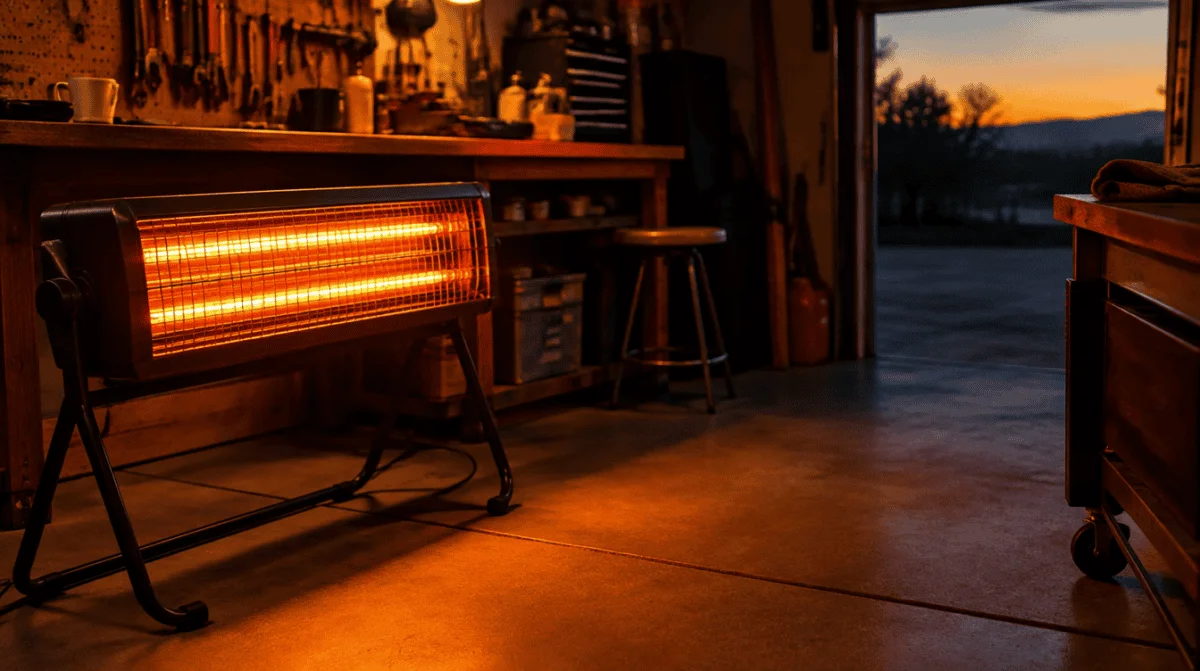
When an infrared or quartz heater runs but gives off no heat, the most common cause is a burned-out heating element or quartz bulb, though a tripped safety switch or a dead outlet can mimic the same symptom. At heatersforlife.com we show how to confirm which one it is, and when a replacement element or bulb is the right call versus a new heater.
Quick answer: If the fan runs but the heater produces no warmth and the quartz tubes never glow, the element or bulb has almost certainly failed. First rule out the simple causes — thermostat set too low, a tripped tip-over or overheat switch, and a dead outlet or power strip. If power is confirmed and the tubes still will not glow, the quartz element or infrared bulb needs replacing, and on many portable units a replacement element is available and inexpensive.

Last Updated: September 2026 | Will Montgomery has an engineering background and has spent years installing, testing, and troubleshooting electric and propane heaters in homes, apartments, and uninsulated garages.
Fan runs but no heat: what that tells you
A running fan with no heat means the motor and power supply are fine, so the fault is in the heating element or a safety device that has cut it off. Infrared and quartz heaters warm objects directly with radiant energy from a glowing quartz tube or infrared bulb, and many models add a fan to spread that warmth. If the fan spins but the tubes stay dark and cold, electricity is reaching the unit — it simply is not reaching or firing the element. That narrows the problem to the element itself, its thermal cutoff, the tip-over switch, or the thermostat. For the same “fan runs, no heat” pattern across heater types, our space heater blowing cold air guide is a useful companion.
Rule out the simple causes first
Before blaming the element, confirm the controls, safety switches, and outlet are not the reason the element never fires.
- Thermostat: turn it well above room temperature; a satisfied thermostat leaves the fan running with the element off.
- Tip-over and overheat switches: set the heater flat and upright, then let it cool and reset if it recently overheated.
- Outlet and cord: plug straight into a known-good wall outlet and test it with another device or a plug-in outlet tester
 . Avoid power strips, as our power strip safety guide explains.
 - Breaker: if the heater is dead and the outlet has no power, check for a tripped breaker — our tripping breaker guide covers why heaters trip circuits.
Confirming a failed quartz element or bulb
With power confirmed and the controls set correctly, a quartz tube that never glows red is a failed element. Unplug the heater, let it cool, and inspect the quartz tubes or bulb through the grille. A healthy element glows a warm red-orange within seconds of switching on; a failed one stays dark, and you may see a visibly broken filament or a discolored, cloudy tube. The table below sorts what you observe into a likely cause.
| What you observe | Likely cause | Next step |
|---|---|---|
| Fan runs, tubes never glow | Burned-out element/bulb or open thermal fuse | Replace element/bulb if available |
| Nothing runs at all | Dead outlet, tripped breaker, or open tip-over switch | Check power and switches first |
| Glows briefly, then cuts out | Overheat sensor tripping (often dust) | Cool, clean grilles, retry |
| One tube glows, another dark | Single failed element in a multi-tube unit | Replace the dead element |

Replacing the element or bulb vs buying new
Will’s note: I replaced a quartz element exactly once. When the next one went bad I remembered how long the teardown took, looked at the price of the element, and bought an inexpensive infrared heater with a remote instead. For cheap units, that is the honest math.
On many portable quartz and infrared heaters the element or bulb is a replaceable, inexpensive part, which makes repair worthwhile when the rest of the unit is sound. Larger infrared cabinet heaters and patio heaters in particular are designed with serviceable quartz tubes or infrared bulbs, and swapping one is often a matter of unplugging the old tube and seating a new one after the unit is fully cool and unplugged — always match the exact wattage and length specified for your model. On the cheapest compact heaters, though, a replacement element may cost nearly as much as a new heater, so replacement of the whole unit makes more sense. If you go that route, the Dr Infrared DR-968 (1,500 W, 12.5 A, quartz tube plus PTC, tip-over and overheat protection) is a long-running favorite in the cabinet-infrared class. Verify the exact part number against your model before ordering, since a wrong element wastes money and can be unsafe. If the fault turns out to be an overheat sensor rather than the element, our guide to a heater that keeps shutting off covers that repair path.
Infrared heaters warm objects, not air
Because infrared and quartz heaters heat people and objects directly rather than warming the room air, “no heat” can sometimes be a misread of how the technology works. Radiant heat is felt instantly on your skin when you are in the line of the element, but it does not raise the air temperature the way a convection heater does, so a room thermometer may barely move even when the heater is working correctly. Before assuming a failure, stand directly in front of the glowing element: if you feel warmth on your skin, the heater is doing its job and the issue is expectations, not the element. If the tubes glow but you feel nothing even up close, or the tubes never glow at all, then you have a genuine fault. This distinction matters most for garage and patio use, where infrared shines precisely because it warms you without first heating a large, drafty volume of air — the same logic behind our do infrared heaters save money guide.
Safety checks before and during a repair
Any element or bulb replacement starts with an unplugged, fully cooled heater and ends with a careful first test. Quartz tubes run extremely hot and the glass is fragile, so the heater must be cold and disconnected from power before you open the grille. Handle a replacement tube by its ceramic ends, not the glass, since skin oils can shorten a quartz element’s life. Seat the new element firmly in its clips, confirm nothing is loose, and reassemble the grille before restoring power. On the first test, watch for an even glow across the full tube and no arcing, sparking, or buzzing at the contacts; any of those means the element is not seated right or the wrong part was used, and you should unplug immediately. If you are not comfortable working near mains-voltage contacts, replacing the whole heater is the safer choice. And remember that all resistive and radiant electric heaters of equal wattage put out the same total heat, so a correctly sized replacement element restores the original output exactly.
Frequently asked questions
Why is my infrared heater not producing heat?
If the fan runs but there is no warmth and the tubes never glow, the quartz element or infrared bulb has most likely burned out. First confirm the thermostat is up, the tip-over and overheat switches are not tripped, and the outlet has power; if all of that checks out, the element is the cause.
Can you replace the element in a quartz heater?
Often yes. Many quartz and infrared heaters, especially larger cabinet and patio units, use replaceable quartz tubes or bulbs. Match the exact wattage and length for your model, and only work on the heater when it is unplugged and fully cool.
How do I know if my quartz heating element is bad?
Unplug the heater, let it cool, and look at the tubes when you switch it on. A good element glows red-orange within seconds; a bad one stays dark and may show a broken filament or a cloudy, discolored tube while the fan keeps running.
Why does my infrared heater run but blow cold air?
The fan and power supply are working, but the element is not firing. That points to a satisfied thermostat, a tripped safety switch, or a failed element. Set the thermostat high, reset after cooling, and if the tubes still will not glow, replace the element.
Is it worth fixing an infrared heater?
It depends on the unit. On larger infrared and patio heaters with serviceable, reasonably priced elements, replacing the element is worthwhile. On the cheapest compact heaters, a replacement element can cost nearly as much as a new heater, so buying new is the better value.
Will Montgomery is an engineer who has replaced a quartz heating element himself and knows when a repair beats a new heater, with years of hands-on experience troubleshooting electric and propane heaters.