

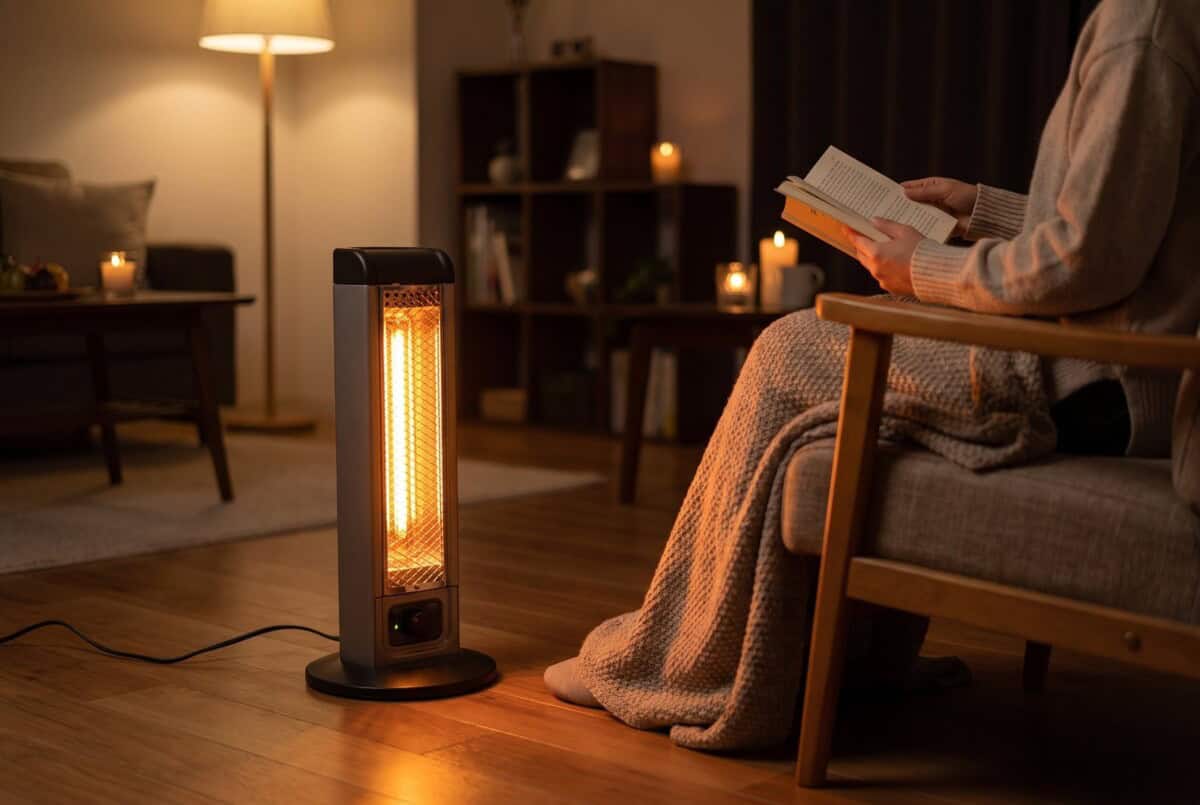
Infrared heaters do not use less electricity than other electric heaters, but they can save a person money by heating people and objects directly so a whole room does not have to be warmed. HeatersForLife.com cuts through the marketing here: an infrared heater is not more efficient than a ceramic or oil-filled heater at the same wattage, yet the way it delivers heat can lower a bill when it is used for targeted, spot heating.
The claim that infrared heaters slash heating costs is one of the most common myths in the space-heater market. The physics is simple, and once a shopper understands it, the real (and limited) way infrared saves money becomes clear. This guide separates the myth from the science and explains when an infrared heater genuinely pays off.
Last Updated: August 2026 | Will Montgomery has an engineering background and has spent years installing, testing, and troubleshooting electric and propane heaters in homes, apartments, and uninsulated garages.
Quick Answer: Do Infrared Heaters Save Money?
An infrared heater does not save money through efficiency — every resistive electric heater is about 100 percent efficient — but it can save money by warming a person directly instead of heating the entire room. A 1500-watt infrared heater produces exactly the same amount of heat, and costs exactly the same per hour, as a 1500-watt ceramic or oil-filled heater. The only path to real savings is behavioral: pointing the infrared warmth at the people in the room, lowering the central thermostat, and heating just the occupied space.
The Physics: Why No Electric Heater Is More Efficient
Every plug-in electric resistance heater converts essentially 100 percent of the electricity it draws into heat, so no type — infrared, ceramic, oil-filled, or fan — is more efficient than another at the same wattage. This is a settled point of physics, not opinion. When electricity flows through a resistive element, all of that energy ends up as heat in the room; there is nowhere else for it to go. A 1500-watt heater releases 1500 watts of heat regardless of whether the element is an infrared quartz tube, a ceramic block, or oil-heated fins. Because the wattage determines the heat output and the heat output determines the cost, two 1500-watt heaters of different types cost the same to run — roughly 12.5 amps of draw and identical cents per hour on the same electricity rate. Any ad claiming an infrared heater is “more efficient” is misusing the word.

How Infrared Heaters Actually Deliver Heat
An infrared heater warms objects and people directly with radiant energy, rather than heating the air first the way a convection heater does. Infrared radiation travels in a line from the heater to whatever it strikes — a person, a chair, the floor — and warms that surface directly, much like the sun feels warm on the skin even on a cool day. This is different from a ceramic or oil-filled heater, which warms the surrounding air that then circulates. The practical effect is that a person sitting in front of an infrared heater feels warm almost immediately, even if the air in the room is still cool. That directness is the entire basis for any money savings an infrared heater can offer.
Where the Real Savings Come From
Infrared heaters save money only when they replace whole-room or whole-home heating with targeted spot heating that lets a person lower the main thermostat. The savings are behavioral, not technological. If a household drops the central heat by a few degrees and uses an infrared heater to keep one occupied room or one seating area comfortable, the reduced load on the central system can lower the overall bill. Because infrared warms people directly, it works even in a cooler room, so the air does not need to be brought up to full temperature. The same logic applies to any space heater used for zone heating — HeatersForLife.com covers the math in its guide to what a space heater costs to run. The infrared heater’s advantage is simply that its radiant heat is felt instantly and directly, which makes zone heating comfortable enough to actually stick with.

From my own use: I lived in a mobile home for a stretch and heated it this way. I kept the main thermostat turned down and stayed warm off an infrared heater in whichever room I was actually in. That is this entire article working in practice: the saving never came from infrared being more efficient, because it is not. It came from not paying to heat the rooms I was not sitting in. Of the four common types, infrared with a fan when I need to move the heat around is still what I reach for — mostly because it felt like the safest choice with pets and grandkids in the house. But every situation has a type that suits it better, and that is the honest answer.
When an Infrared Heater Is NOT the Cheaper Choice
An infrared heater does not save money when it is used to heat an entire room or when it runs alongside central heating instead of replacing part of it. Running an infrared heater on top of a normal thermostat setting simply adds 1500 watts of cost with no offsetting reduction elsewhere. It also has a comfort limitation: because infrared warms only what it directly reaches, a person who moves out of its line of warmth feels cold again quickly, and the room air itself stays cool. For evenly warming a whole room over a longer period — a bedroom overnight, for example — a convection heater like an oil-filled radiator that warms the air and holds heat is often the more comfortable option. Shoppers comparing radiant and convection styles can see the full lineup in the pillar guide, space heater types explained, and a direct head-to-head in infrared vs ceramic heaters.
How to Actually Lower a Heating Bill
The reliable ways to cut a heating bill are to heat only the occupied room, use a thermostat, and lower the central heat — not to buy a particular heater type. Zone heating with any space heater, infrared or otherwise, saves money when it lets a household stop heating empty rooms. A thermostat or timer keeps the heater from running longer than needed. Sealing drafts and closing doors to concentrate the heat helps more than the choice of element; a cheap under-door draft stopper often does more for a cold room than swapping the heater for a different type. For the cheapest overall operation, HeatersForLife.com recommends starting with its guide to the cheapest space heaters to run, which explains why the savings live in how a heater is used, not in which type is on the box.
Can you run a space heater on a timer? The engineering, not the boilerplate
Almost every heater manual says to plug the unit straight into a wall outlet and never into a power strip, extension cord, or timer. That instruction is correct as far as it goes, but it is written for liability, not for understanding — the manufacturer has no way to know what you will plug their heater into, so they rule out the whole category. The actual engineering is more useful than the blanket rule, and it is not complicated.
Before any of that, the two safe rules of thumb: one, do not use a timer at all. Two, use a heater with a built-in thermostat instead. Follow those and you will not have a problem, and you can stop reading here. The rest of this section is for anyone who wants to understand why that is the safe default — and how to judge a specific timer on its ratings if they decide to use one anyway.
The hazard is never the presence of a device. It is undersized conductors and contacts. A 1500-watt heater on a 120-volt circuit draws about 12.5 amps, and it draws it for hours at a stretch. Push that current through a conductor too thin to carry it and the wire heats up, because power lost as heat rises with the square of the current. Ordinary extension cords are commonly 16 AWG, rated around 13 amps, and cheap ones are 18 AWG, rated around 10 amps — genuinely below what the heater pulls. That is the failure, and it is why heater fires so often start at the plug or the outlet rather than inside the heater.
There is a second failure mode worth knowing about: thermal runaway at a connection. A loose or oxidised contact has slightly higher resistance, so it runs slightly warmer, so it oxidises faster, so its resistance climbs again. Once that loop starts it accelerates on its own. A cheap timer with thin switch contacts arcing on and off at 12.5 amps pits those contacts a little more each cycle, which is exactly how the loop gets going.
So the real rule is about headroom, not about intermediaries. Every part of the path — cord, plug, contacts, switch — has to be rated for the load with margin to spare. Taken to the extreme, the point is obvious: a device rated for 100 amps carrying 12.5 amps is sitting at an eighth of its capacity and is simply not a thermal concern. Nothing about being “in between” makes it dangerous. Being undersized does.
How much headroom? Electrical practice treats anything running three hours or more as a continuous load and sizes it at 125 percent, which is the same as loading a device to no more than 80 percent of its rating. For a 12.5-amp heater that works out to 15.6 amps. This is where a lot of “15-amp” timers quietly fall short: 15 amps is below the 15.6 the rule asks for, so a bare 15-amp rating is marginal rather than comfortable.
Read the resistive rating, not the amp number on the front. A heater is a purely resistive load with no start-up surge, so the figure that matters is the resistive watt rating — not the tungsten rating, and not the horsepower rating, which describes a device’s ability to survive motor inrush. A timer that publishes something like 1875W, 15A resistive has stated plainly that it will carry a 1500-watt heater with real margin. A timer whose listing only talks about lamps and holiday lights has not made that claim, and you should not assume it on their behalf. The BN-LINK heavy-duty mechanical timer is one that does publish it — 1875 watts resistive, 15 amps, ETL listed — which is the specification you are looking for rather than a brand endorsement.
Where this leaves you. Check your heater’s manual first, because some manufacturers void the warranty over it and that is their call to make. If you do use a timer, use one with a published resistive rating above your heater’s draw, plug it directly into the wall, and never stack it on top of a power strip or extension cord — the weakest link in the chain sets the limit, so adding a 13-amp cord to a 15.6-amp timer leaves you with a 13-amp system. And for what it is worth, the heater’s own built-in thermostat is still the better long-term answer in a reasonably insulated room: it cycles on actual room temperature rather than the clock, it keeps the room at a set point instead of overshooting and undershooting, and it removes a connection from the path altogether. A timer decides when; a thermostat decides whether.
Infrared vs Convection: A Cost Comparison Table
The table below shows why infrared and convection heaters cost the same to run at equal wattage, and where their practical differences actually lie.
| Factor | Infrared Heater | Convection Heater (ceramic, oil-filled) |
|---|---|---|
| Efficiency | ~100% (all electric resistance heat) | ~100% (all electric resistance heat) |
| Running cost at 1500 W | Same per hour | Same per hour |
| What it heats | People and objects in its line | The air, which then circulates |
| Warmth felt | Instant, but only in its direct path | Builds over minutes, fills the room |
| Best money-saving use | Spot heating one person or seat | Even whole-room or overnight heat |
| Weakness | Cold once you move out of its path | Heats empty space too if room is large |
The takeaway from the table is that no row shows infrared using less electricity — because it does not. The genuine difference is in delivery: infrared puts warmth exactly where a person sits, which is what makes aggressive zone heating comfortable enough to lower the central thermostat and save on the overall bill. A convection heater is better when the goal is to warm a whole room evenly rather than one spot.
A Realistic Example of Infrared Savings
A person saves with infrared by turning the central heat down and using the infrared heater to stay warm in the one room they occupy. Consider a home office worker who spends the day in a single room. Instead of running central heat that warms the entire house, the worker lowers the main thermostat several degrees and points an infrared heater toward the desk. The infrared warmth keeps the worker comfortable directly, even though the room air is cooler, and the reduced central-heating load lowers the total bill. The same 1500-watt infrared heater would save nothing if it simply ran on top of a normal thermostat setting — the savings exist only because it replaced part of the central heating. This is exactly the zone-heating strategy HeatersForLife.com recommends in its guide to the cheapest space heaters to run.
If infrared genuinely fits your situation — one person, one spot, a room you do not need to heat all the way through — the Dr Infrared Heater DR-968 is a common 1500 W example with a thermostat and a quiet fan. It will not beat any other electric heater on efficiency, because nothing does. It only saves money if it lets you heat less space for fewer hours.
The Bottom Line on Infrared and Cost
An infrared heater can help lower a heating bill through targeted zone heating, but it is not inherently more efficient or cheaper to run than any other 1500-watt electric heater. A shopper who buys an infrared heater expecting lower electricity use per hour will be disappointed; a shopper who uses it to warm the people in one room while turning the central heat down can genuinely save. The heater type is a comfort and delivery choice, not an efficiency upgrade — the real savings come from behavior.
Frequently Asked Questions
Do infrared heaters use less electricity than other heaters?
No. Every resistive electric heater, including infrared, is about 100 percent efficient, so a 1500-watt infrared heater uses the same electricity and costs the same per hour as a 1500-watt ceramic or oil-filled heater.
How do infrared heaters save money then?
They save money only through spot heating. Because an infrared heater warms people and objects directly, a person can keep one area comfortable while lowering the central thermostat, reducing the overall heating load rather than using less power per hour.
Are infrared heaters cheaper to run than ceramic heaters?
No. At the same wattage they cost exactly the same to run. The difference between infrared and ceramic is how the heat is delivered — radiant versus warmed air — not how much electricity they use.
Is an infrared heater good for heating a whole room?
Not ideally. Infrared warms only what is in its direct line, so the room air stays cooler and a person who moves away feels cold again. For even whole-room or overnight heat, a convection heater such as an oil-filled radiator is usually more comfortable.
What really lowers a heating bill?
Heating only the occupied room, using a thermostat or timer, lowering the central heat, and sealing drafts. These behaviors save far more than choosing one heater element type over another, because all electric heaters of equal wattage cost the same to run.
Written and reviewed by Will Montgomery, who has installed, tested, and repaired electric and propane heaters for years.