

The cheapest space heater to run all night is a lower-wattage model with a good thermostat and eco mode, used to heat only the room being occupied. As heatersforlife.com explains below, brand barely matters — every 1500-watt electric heater costs almost exactly the same per hour, so the real savings come from watts, run time, and zone heating, not from a magic “efficient” model.
Last Updated: August 2026 | Will Montgomery has an engineering background and has metered the real overnight running cost of space heaters across wattages instead of trusting the box.
Quick Answer
All 1500W electric space heaters cost about the same to run — roughly 24 cents an hour at the U.S. average electricity rate — because every resistive heater is nearly 100% efficient. To spend less overnight, run fewer watts (a 500–1000W model or eco setting), use a thermostat and timer so it cycles instead of running flat out, and heat only one room. An oil-filled radiator on a thermostat is the classic low-cost overnight choice because it coasts on stored heat between cycles.
What actually makes a space heater cheap to run
Running cost is set by three things only: the wattage, the hours it runs, and the local electricity rate — the formula is watts ÷ 1000 × hours × rate. There is no such thing as a resistive heater that turns one watt of electricity into more than one watt of heat, so a $30 heater and a $200 heater of the same wattage produce identical warmth for identical money. What separates a cheap-to-run heater from an expensive one is whether it lets the user get away with fewer watts and shorter run time: a thermostat that shuts the element off once the room is warm, an eco mode that steps down to 700–900W, and enough retained heat or good placement to keep a small room comfortable without running at full blast. The full math is in the space heater running-cost guide.

How much does it cost to run a space heater all night?
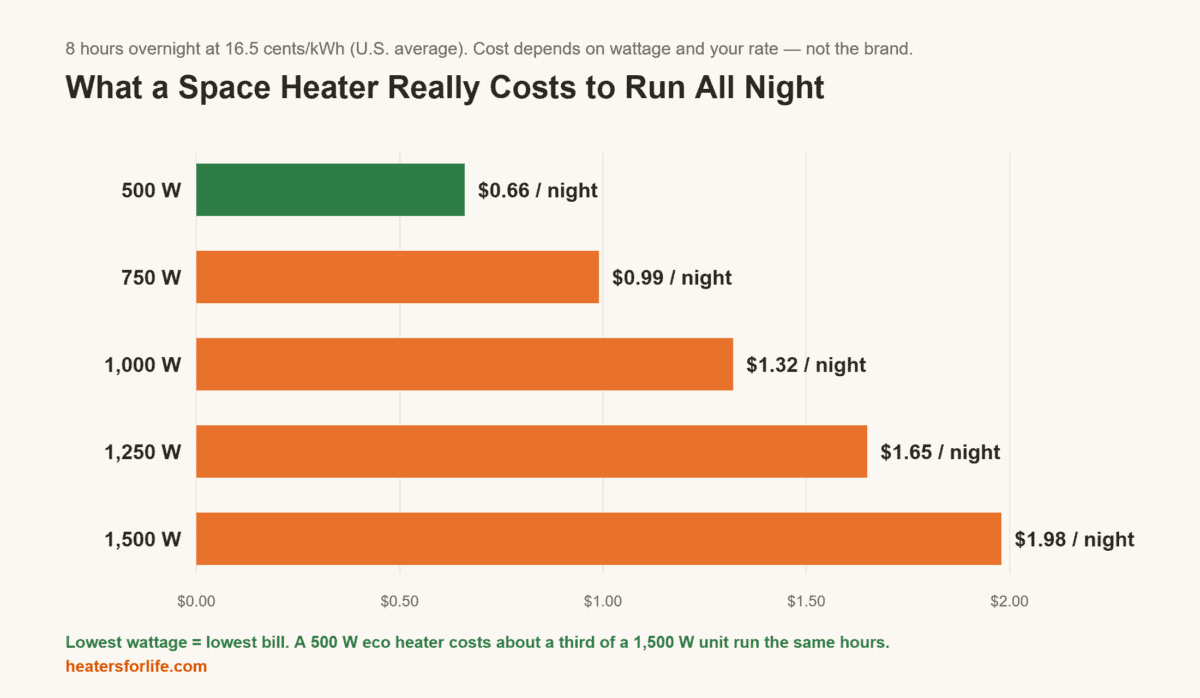
A 1500W heater left on full for eight hours costs about $1.90 a night at the average U.S. rate, while a 750W model or eco setting cuts that nearly in half. The table below assumes electricity at 16 cents per kWh and an eight-hour night. Because a thermostat lets most heaters cycle off part of the time, real-world overnight cost is often 30–50% lower than these full-power figures.
| Setting | Power draw | Cost per hour | 8-hour night (full power) |
|---|---|---|---|
| High | 1500 W | ~$0.24 | ~$1.92 |
| Medium / eco | 1000 W | ~$0.16 | ~$1.28 |
| Low | 750 W | ~$0.12 | ~$0.96 |
| Low panel / desk | 500 W | ~$0.08 | ~$0.64 |
To convert to any local rate, multiply the kilowatt-hours (watts ÷ 1000 × hours) by the price per kWh on the electric bill.
Cheapest space heater types to run overnight
From experience: The winter our furnace died, we heated the house with a handful of infrared box heaters — shut the doors, set them on the thermostat, and they held a room surprisingly well. A couple downstairs kept the main living area comfortable while we closed off the rooms we weren’t using, and it got us through fine until the new furnace went in.
The cheapest types to run all night are low-wattage panel heaters and thermostat-controlled oil-filled radiators, because both let a room stay warm without drawing 1500 watts continuously. The comparison below is by heater type rather than by model, since the numbers depend on wattage and thermostat behavior, not brand.
| Heater type | Typical watts | Best overnight for | Why it can be cheap to run |
|---|---|---|---|
| Oil-filled radiator | 700–1500 W | Bedrooms, steady all-night heat | Holds heat and coasts between thermostat cycles; no fan noise |
| Low-watt panel / convection | 400–1000 W | Small, well-insulated rooms | Low draw and gentle output keep the bill down |
| Ceramic with thermostat + eco | 750–1500 W | Rooms that need quick warm-up | Eco mode steps down watts once the target temp is reached |
| Micathermic | 1000–1500 W | Fast, fan-free heat | Combines radiant and convection so it can run on lower settings |
| Infrared / quartz | 1000–1500 W | Spot-warming a person, not a room | Cheapest when aimed at one person instead of heating the air |
For quiet all-night use specifically, see the quietest space heaters for sleeping; for the physics of infrared versus ceramic, see infrared vs ceramic heaters.
Features that cut overnight running cost
The features that lower an overnight electric bill are all about running fewer watts for fewer minutes. When comparing models, prioritize:
- An accurate thermostat so the heater shuts off once the room hits temperature instead of running flat out until morning.
- An eco or low-watt mode that drops to 700–1000W, which is plenty to hold a small bedroom warm.
- A timer or sleep mode to shut the heater down after the room is warm and the sleeper is under the covers.
- Tip-over and overheat auto-shutoff — essential for any heater left running while asleep (see the overnight safety checklist).
None of these make the heat itself “cheaper” per watt — they simply reduce how many watt-hours the heater burns before sunrise.

When something cheaper than a space heater wins
For a single sleeping person, a heated blanket is far cheaper to run than any space heater, drawing about 100–200 watts instead of 1500. Heating the body directly rather than the whole room can cut overnight heating cost by 80–90%. A space heater still makes sense when more than one person or a pet needs the room warm, when the room is used before bed, or when the goal is to keep pipes and the space itself above freezing. The best low-cost strategy for many renters is a heated blanket for sleep plus a thermostat-controlled heater only when the room is in use, which pairs well with the best space heaters for small apartments.
How to calculate your own overnight cost
To find the exact cost of running any heater overnight, multiply its wattage by the hours it runs, divide by 1,000, and multiply by the price per kWh on the electric bill. Electricity rates vary enormously by state — from around 11 cents per kWh in parts of the South and Pacific Northwest to more than 30 cents in California, New England, and Hawaii — so the same heater can cost twice as much to run in one state as another. A worked example: a 1000W heater running 8 hours in a state charging 20 cents per kWh costs 1000 ÷ 1000 × 8 × $0.20 = $1.60 for the night. The same heater in a 12-cent state costs just $0.96. Checking the actual rate on a recent bill is the only way to get a real number, and it explains why “cheapest to run” is partly a question of where someone lives.
Space heater vs central heat: which is cheaper overnight?
A single space heater is cheaper than central heat only when it is used to warm one occupied room while the rest of the home is allowed to cool — a strategy called zone heating. Turning the whole-house thermostat down to 60°F at night and running one 1000W heater in the bedroom usually costs less than keeping a gas or electric furnace holding the entire house at 68°F. The math flips as soon as more than one or two rooms need heat: three 1500W heaters running at once draw 4,500 watts, which costs more per hour than most central systems and can overload household circuits. The break-even point is roughly one to two rooms; beyond that, central heat wins. The running-cost guide works through both scenarios in detail.
How to set up a heater to run cheaply overnight
The single biggest overnight saving comes from setting the thermostat to the lowest comfortable temperature and letting the heater cycle, rather than running it on high all night. A few practical steps stack up:
- Set a modest target temperature — 63–66°F is comfortable for sleeping under covers and lets the heater spend most of the night off.
- Close the bedroom door so the heater warms one small space instead of the whole home.
- Pre-warm the room before bed on a higher setting, then drop to low, so the heater coasts rather than fighting a cold room at 3 a.m.
- Use the built-in timer or a heater-rated outlet timer to shut the unit off a couple of hours after everyone is asleep and under blankets.
- Seal drafts around the window and under the door; a $5 draft stopper can cut how long the heater has to run.
An oil-filled radiator suits this routine especially well, because it keeps radiating warmth for a while after the thermostat cuts the element, smoothing out the cold dips between cycles.
Common myths about “cheap-to-run” space heaters
Most marketing claims about ultra-efficient or money-saving heaters do not hold up to the physics. A few worth clearing up:
- “This heater is 99% efficient, so it’s cheaper.” Nearly every electric resistance heater is about 100% efficient. Efficiency does not vary meaningfully between models, so it cannot make one cheaper to run than another at the same wattage.
- “Infrared heaters use less electricity.” An infrared heater uses the same electricity as any other heater of the same wattage. It can feel more efficient because it warms people directly, so a lower setting may be comfortable — but watt for watt, it costs the same.
- “A bigger heater heats faster and saves money.” A 1500W heater reaches temperature faster than a 750W one, but it also draws twice the power while running. On a thermostat, the two land at a similar daily cost for the same room.
- “Leaving it on low all day is cheaper than reheating.” For a small room, letting the heater cycle on a thermostat and only running when occupied almost always uses fewer watt-hours than running continuously.
Frequently Asked Questions
What is the cheapest type of space heater to run?
A low-wattage panel heater or a thermostat-controlled oil-filled radiator, because both keep a room warm without drawing a full 1500 watts continuously. At equal wattage, all electric heaters cost the same per hour.
How much does it cost to run a space heater overnight?
About $1.90 for eight hours at full 1500W and the U.S. average rate, or roughly half that on a 750W setting. A thermostat that lets the heater cycle off usually lowers the real cost further.
Is it cheaper to run a space heater or central heat?
A single space heater is cheaper when only one occupied room needs warmth; central heat is cheaper when heating the whole house, because running several space heaters at once quickly costs more than a furnace.
Do “energy-efficient” space heaters really use less electricity?
No. Every resistive electric heater is about 100% efficient, so at the same wattage they use the same electricity. “Energy-saving” claims refer to thermostats and eco modes that reduce run time, not to more efficient heat.
Is a heated blanket cheaper than a space heater?
Yes, dramatically. A heated blanket draws about 100–200 watts versus 1500 for a heater, so it can cut overnight heating cost by 80–90% for a single sleeper.