

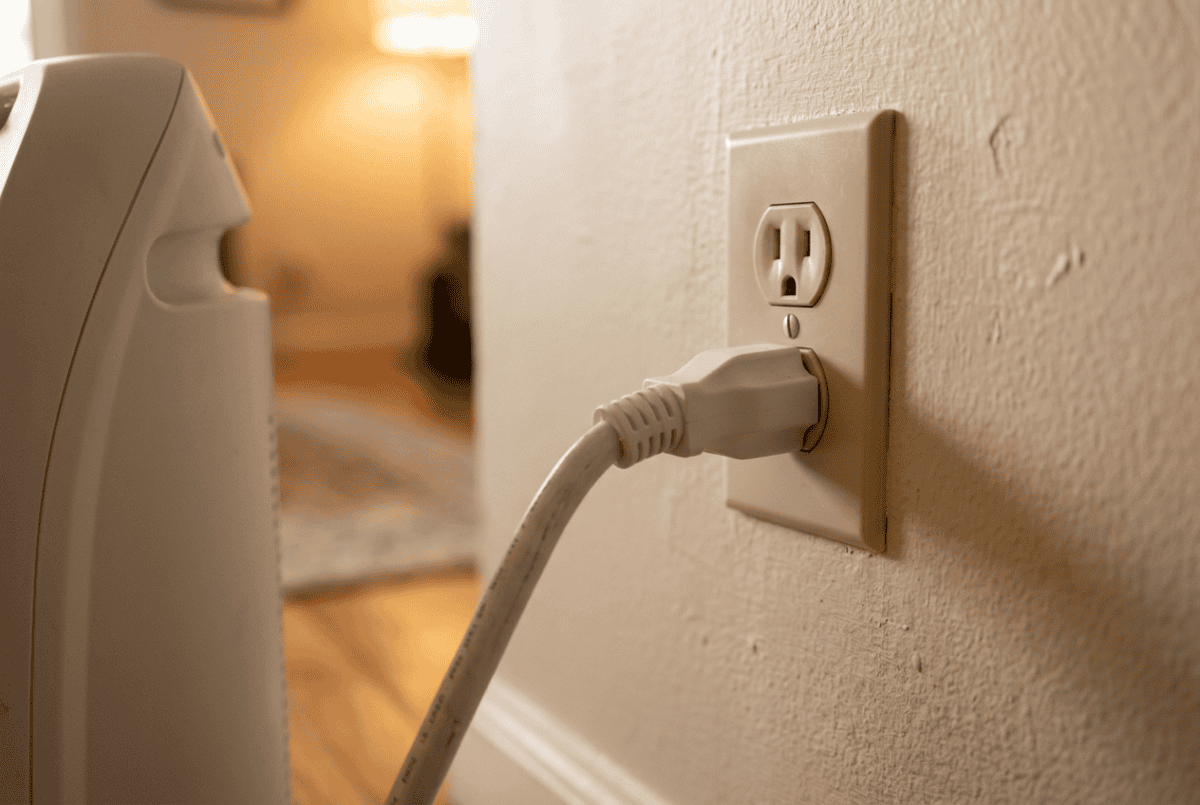
A space heater should never be plugged into a power strip, surge protector, or light-duty extension cord — it belongs directly in a wall outlet. This heatersforlife.com guide explains the amp math behind that rule, why power strips melt under a heater’s load, and what to do when the only outlet is across the room.
Last Updated: August 2026 | Will Montgomery has an engineering background and has seen firsthand how a 1,500-watt heater overheats the wiring in a power strip or light-duty extension cord.
Quick Answer
No — never plug a space heater into a power strip, surge protector, or standard extension cord. Plug it straight into a wall outlet. A 1500W heater draws about 12.5 amps continuously, and most power strips are not built to carry that kind of sustained high load. The strip’s contacts and thin wiring overheat, which is one of the most common causes of space-heater fires.
Can you plug a space heater into a power strip?
No. A power strip cannot safely handle a space heater’s continuous 12.5-amp draw, and doing so is a well-documented fire hazard. Power strips and surge protectors are designed for low-draw electronics — lamps, chargers, computers — that pull a fraction of an amp each and only in bursts. A space heater is the opposite kind of load: it pulls near the maximum a circuit allows, steadily, for hours. That sustained current heats the strip’s internal contacts and undersized conductors until the plastic softens, the connections arc, and the strip can scorch or ignite. Fire departments and the Consumer Product Safety Commission repeatedly warn against this exact combination.

The math: why a power strip can’t handle a heater
A 1500W heater pulls 12.5 amps continuously, while the contacts inside a typical power strip are far thinner than a wall outlet’s and were never rated for that sustained draw. Even a strip stamped “15A” is rated for brief peaks across many small devices, not one appliance holding 12.5 amps for eight hours straight. Under the code’s 80% continuous-load rule, a truly continuous appliance should stay under 12 amps — a heater sits right at that edge before any strip is added. Insert a power strip in the path and every extra connection point becomes a spot where resistance builds heat. The comparison below shows why the wall outlet is the only correct choice; for the full picture of heater amperage, see how many amps a space heater draws.
| Connection | Typical rating | Safe for a 1500W heater? |
|---|---|---|
| Wall outlet (dedicated) | 15–20 A, built for continuous load | Yes |
| Power strip | Peaks for small electronics | No — overheats under sustained draw |
| Surge protector | Same as power strip, plus surge parts | No — not for high continuous loads |
| Light-duty extension cord (16 AWG) | ~10–13 A short runs only | No — undersized, overheats |
| Heavy-gauge heater cord (14/12 AWG) | 15 A, short length | Only short-term; wall outlet is better |
What to do instead
Plug the heater directly into a wall outlet, ideally one on its own circuit, and relocate the heater rather than reaching for a cord. Practical steps:
- Use a wall outlet the heater can reach on its own cord — move the heater, not the power source.
- Give the heater its own circuit when possible, since 12.5 amps leaves little room for anything else.
- If an outlet is genuinely too far, use only a short, heavy-gauge (14- or 12-AWG) extension cord rated for heaters, and treat it as a temporary fix.
- Never daisy-chain a strip into another strip, or a strip into an extension cord.
- Keep the plug and cord uncovered — never run a cord under a rug or behind furniture where heat can build.
Warning signs of an overloaded outlet or cord
A warm plug, discolored outlet, or burning smell means the connection is overloaded and should be shut off immediately. Because a heater runs so close to the circuit’s limit, small problems escalate fast. Watch for a plug or outlet that feels hot to the touch, a scorched or yellowed faceplate, flickering lights when the heater cycles, a breaker that keeps tripping, or a burning or plastic smell. Any of these is a signal to unplug the heater, stop using that outlet, and have the wiring checked. Do not simply move the heater to another strip.

What about a “heater-rated” power strip or smart plug?
There is no such thing as a power strip that makes a space heater safe, and a smart plug should be checked against the heater’s amperage before it is trusted. Some strips advertise a 15-amp rating, but that figure is for shared, intermittent electronics loads — not one appliance holding 12.5 amps for hours. Adding the strip only inserts extra contacts that heat up. Smart plugs and outlet timers are a separate concern: many inexpensive models are rated for only 10 to 12 amps, below a 1500W heater’s draw, and can melt or fail. If a timer is needed to shut a heater off overnight, use one specifically rated for 1500 watts / 15 amps of resistive load, plugged directly into the wall. Better still, choose a heater with a built-in timer so no external device carries the current.
If you must use an extension cord, size it right
When a wall outlet is truly out of reach, only a short, heavy-gauge cord rated for a heater’s load should ever be used — and only as a temporary fix. Cord thickness is measured in AWG, where a lower number means thicker wire and more capacity. A 1500W heater’s 12.5-amp draw needs a genuinely heavy cord, and the longer the cord, the thicker it must be because resistance rises with length.
| Cord gauge | Rating for a heater | Notes |
|---|---|---|
| 16 AWG (light-duty) | Not safe | Too thin for 12.5 A; overheats |
| 14 AWG (heavy-duty, short) | Short-term only | Acceptable for a short run if rated 15 A |
| 12 AWG (extra heavy-duty) | Best of the cord options | Handles the load with more margin |
Even the right cord is second-best. The correct long-term fix is to move the heater to an outlet it reaches on its own cord, or have an electrician add an outlet where it is needed.
How space-heater electrical fires actually start
From experience: The worst case I ran into was in a rental, and it was the outlet itself — whoever installed it had just capped the wires into the back instead of landing them on the screw terminals, so the connection couldn’t pass much current. Under a heater’s load the voltage sagged, it pulled even more amps, and the whole thing overheated and started melting until we got it rewired.
Most space-heater electrical fires begin at a connection point — a strip, a worn cord, or a loose outlet — not inside the heater. When 12.5 amps flows through a slightly loose or undersized connection, the resistance at that point turns electrical energy into heat. Over hours and days, that heat softens plastic, loosens the connection further, and raises the resistance more, in a runaway cycle that ends in melting or arcing. A wall outlet wired to code and used directly has solid, full-size contacts built for the load; a power strip, an old extension cord, or a corroded outlet does not. This is also why a heater plugged into an outlet that already feels loose should be moved to a tighter one and the loose outlet repaired.
Frequently Asked Questions
Why can’t you plug a space heater into a power strip?
A 1500W heater draws about 12.5 amps continuously, more sustained current than a power strip’s thin contacts and wiring are built to carry. The strip overheats, which can melt the plastic and start a fire.
Can I use a surge protector for a space heater?
No. A surge protector has the same current limitations as a power strip and is designed for low-draw electronics, not a high, continuous heater load.
Can a space heater go on an extension cord?
Only as a temporary measure with a short, heavy-gauge (14- or 12-AWG) cord rated for heaters. A wall outlet is always the correct choice; light-duty cords overheat.
What kind of outlet should a space heater use?
A standard wall outlet the heater reaches on its own cord, ideally on a dedicated circuit so the 12.5-amp draw does not overload other devices.
My heater’s plug feels hot — is that dangerous?
Yes. A hot plug, discolored outlet, or burning smell signals an overloaded or failing connection. Unplug the heater, stop using that outlet, and have the wiring inspected.