

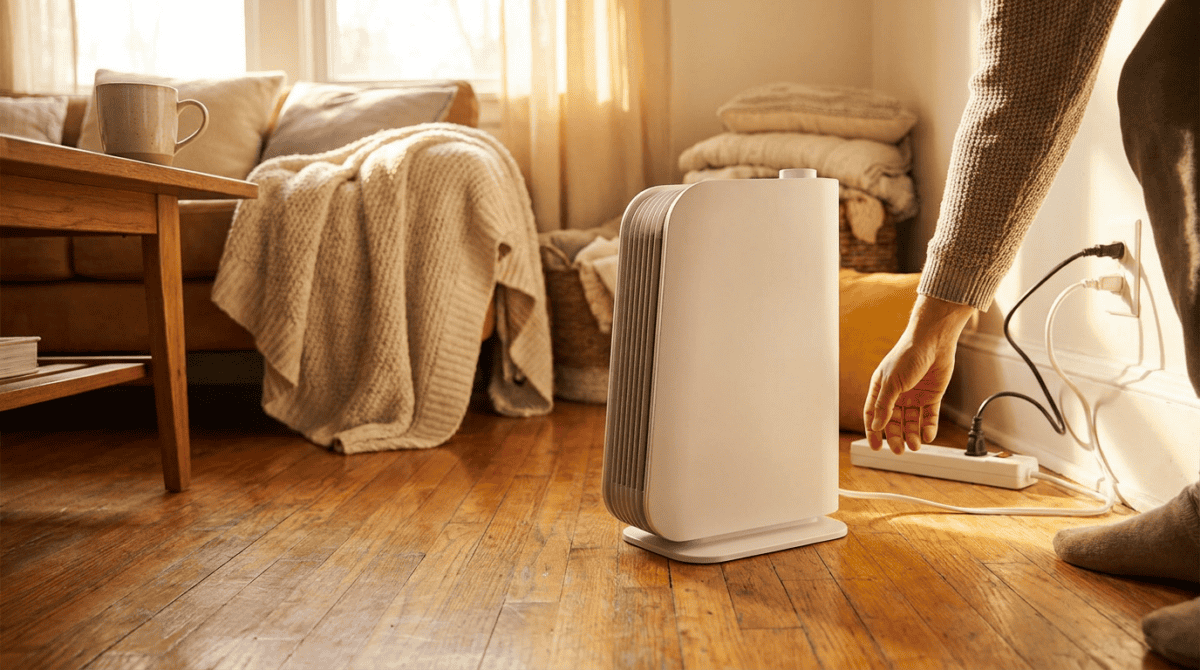
A faint dust-burning smell the first time you run an electric space heater for the season is almost always harmless and clears within 10 to 30 minutes. A sharp burning-plastic, electrical, or acrid melting smell — or any visible smoke or a hot outlet — is not normal and means you should unplug the heater immediately. This Heaters For Life guide covers electric space heaters and shows exactly how to tell the two apart.
By Will Montgomery, Electro-Mechanical Engineer & owner of Heaters For Life. I have spent years diagnosing failing heating elements and scorched wiring on the bench, and the most useful skill I can pass on is smelling the difference between dust cooking off a nichrome coil and insulation melting inside a plug. One smells like a warm attic; the other has a sharp chemical bite that should make you reach for the outlet. When in doubt, unplug first and investigate second.
Quick Answer
A faint “dust burning off” smell on the first use of the season is usually normal. It comes from dust settled on the hot heating element and it fades on its own in about 10 to 30 minutes of running.
A burning plastic, electrical, or acrid melting smell — or any smoke, a hot plug, or a warm/discolored outlet — is not normal. Unplug the heater immediately. It can mean melting wiring, a failing internal component, or an outlet on the verge of a fire.
The normal one: a dusty “burning” smell on first use
A light dust-burning smell when you first fire up an electric heater for the season is normal and safe. Over months of storage, a fine layer of household dust settles on the heating element and the metal reflector behind it. When the element heats to several hundred degrees, that dust cooks off, producing a faintly smoky “hot dust” odor — the same smell an oven gives off the first time you use it after a while.
What makes this version harmless is how it behaves:
- It is faint and dusty, not sharp or chemical.
- It appears in the first few minutes and fades within 10 to 30 minutes, gone entirely by the second or third use.
- There is no smoke, no melting smell, and the plug and cord stay cool.
Vacuuming the grille and vents before the season’s first use prevents most of it. If the odor lingers well past 30 minutes, returns on every use, or turns sharper, stop treating it as “just dust” and move to the danger checks below.
⚠ Safety Warning — Unplug the heater immediately if you notice any of these:
- A burning plastic, electrical, or acrid/chemical melting smell that is sharp rather than dusty.
- Any visible smoke coming from the heater, cord, or outlet.
- A plug, cord, or outlet that is hot, buzzing, sparking, or discolored/scorched.
- The heater is running through an extension cord or power strip.
- The smell is getting stronger or does not fade the way harmless dust does.
Pull the plug at the wall (grip the plug, not the cord). If the outlet or plug is too hot to touch or actively smoking, kill the circuit at the breaker instead. Do not use the heater again until you have found and fixed the cause.
Burning plastic or electrical smell: unplug it now

A burning-plastic or electrical smell is a danger signal and means you should unplug the heater immediately. Unlike dust, plastic and wire insulation do not belong near the element’s heat, so if you can smell them melting, something is overheating that should not be. This is the smell most closely tied to real house-fire risk, and it deserves zero benefit of the doubt. The most common causes:
An overloaded or overheating outlet
A space heater is one of the highest-draw devices in the home, pulling around 12.5 amps for a 1,500-watt model — close to the limit of a standard 15-amp circuit. On an old, worn, or loose outlet, that heavy draw heats the connections, so a warm, buzzing, or discolored outlet is a classic warning sign. The plastic of the outlet or plug can soften and scorch, and that is what you smell.
A melting or damaged power cord
A cracked, pinched, or frayed cord — or one run under a rug where heat cannot escape — can overheat at the damaged spot and melt its insulation. Any cord that feels hot along its length, not just at the plug, is a problem.
Internal wiring or component failure
Inside the heater, a loose connection, failing switch, or degraded wiring can arc and overheat, melting nearby plastic housing. This is common in older units and heaters that have been dropped. You cannot see it from outside, so the smell (sometimes with a faint electrical or “ozone” note) is your only warning.
In every case the move is the same: unplug immediately, let everything cool, and do not use the heater again until the cause is confirmed and fixed. Melting wiring and hot outlets are the leading edge of an electrical fire.
Chemical or “paint” smell on a brand-new heater
A mild chemical or paint-like smell on a brand-new heater is usually normal factory break-in and fades within the first one or two uses. New heating elements, their protective coatings, and manufacturing oils on the metal burn off the first time the unit gets hot, smelling faintly of paint, solvent, or hot metal.
Run a new heater’s first session in a well-ventilated room with a window cracked, and the odor should clear quickly and not return. Treat it as normal only if it is mild and fading. If a new unit produces a strong melting-plastic smell, any smoke, or an odor still going strong after a couple of hours of run time, that is a defect — stop using it and contact the manufacturer or retailer for a replacement.
Burning hair, pet hair, or debris on the element
A singed “burning hair” smell usually means pet hair, lint, or debris has landed on the heating element and is burning off. Homes with pets are the usual culprits, as hair gets pulled into the grille and onto the hot coil. It is not dangerous in tiny amounts, but it signals the heater needs cleaning — and larger debris like a stray sock or piece of paper is a real fire risk if it touches the element.
Unplug the heater, let it cool fully, and vacuum the intake and grille to clear hair and lint. Keep at least a three-foot clearance from bedding, curtains, paper, and furniture. If the smell continues after a thorough cleaning, treat it like the danger signals above rather than assuming it is still just debris.
Quick reference: smell, cause, and what to do
| Smell type | Likely cause | What to do |
|---|---|---|
| Faint, dusty “hot dust” | Dust burning off the element on first seasonal use | Normal. Let it run; it fades in 10–30 min. Vacuum the grille next time. |
| Mild paint / chemical (new unit) | Factory coatings and residue curing off a new element | Usually normal. Ventilate; should clear in 1–2 uses. Return if strong or smoky. |
| Singed “burning hair” | Pet hair, lint, or debris on the hot coil | Unplug, cool, vacuum the grille. Keep 3 ft of clearance. |
| Burning plastic / acrid melting | Melting cord, plug, outlet, or internal wiring | Unplug immediately. Inspect cord, plug, and outlet. Do not reuse until fixed. |
| Electrical / “ozone” + hot outlet | Overloaded/worn outlet or arcing connection | Unplug now (or kill the breaker if the outlet is too hot). Have the outlet checked. |
| Any burning smell + smoke/sparks | Active overheating or electrical fault | Unplug/breaker off immediately. Retire the unit; do not use again. |
What to check and fix after a burning smell

Once the heater is unplugged and cool, work through a short inspection before plugging it back in. Most burning-smell problems trace to one of a handful of things you can check yourself in a few minutes.
- Clean the heater. Vacuum the intake grille and vents to clear dust, lint, and pet hair off the element. This alone cures most harmless dust and hair smells.
- Inspect the cord and plug. Look for cracks, fraying, melted spots, or a plug that is discolored or has bent/loose prongs. A damaged cord means the heater is done — do not tape it and keep going.
- Never use an extension cord or power strip. Space heaters draw more current than most cords and strips are rated for, and that mismatch is a leading cause of melted cords and fires. Always plug directly into a wall outlet.
- Check the outlet itself. If it is warm, discolored, scorched, buzzing, or the plug fits loosely, stop — that outlet or its wiring needs a licensed electrician, and you should not plug anything heavy into it.
- Give it clearance. Keep at least three feet between the heater and anything that can burn, and place it on a hard, flat, level surface — never on carpet, rugs, or furniture.
If the heater passes every check and only ever gave off a fading dust smell, it is fine to use. If you found melting, a hot outlet, or a clearly plastic or electrical smell, keep reading.
One nuance worth adding: that is the right default when you are reaching into a drawer for whatever cord is in there — most household cords are 16- or 18-gauge and genuinely cannot carry a heater’s load. If you are buying a cord specifically for the job, the math is straightforward. A 1500-watt heater draws 12.5 amps (watts ÷ volts), and a continuous load should be sized at 125% of that, about 15.6 amps. So look for a cord marked 15 A or better — in practice 12-gauge copper, three-prong grounded, and keep the run under 50 feet. A 12-gauge SJTW cord rated 15 A / 1875 W does it comfortably. The gauge and amp rating are printed on the jacket, so you can check before you buy. Uncoil it fully in use, since a coiled cord traps its own heat. Power strips and surge protectors stay off the list either way — their internal wiring and breakers are built for intermittent electronics, not an appliance drawing 12.5 amps for hours.
When to stop using the heater and replace or recall-check it
Retire the heater for good if a burning-plastic or electrical smell persists after cleaning, if the cord or plug is damaged, or if you ever saw smoke or sparks. A heater that melts its own components or overheats its plug has an internal fault you cannot safely repair at home, and continuing to use it is a fire gamble not worth the price of a new unit.
Before you rule it a lost cause, do a two-minute recall check. Space heaters are recalled fairly often for overheating and fire hazards. Find the model and serial number on the label (usually on the base or back) and search it on the U.S. Consumer Product Safety Commission site at cpsc.gov. If your unit is under recall, follow the listed remedy — usually a refund or free replacement — and stop using it immediately.
A quick word on carbon monoxide: electric space heaters do not burn fuel and do not produce carbon monoxide, so CO is never the source of a burning smell from an electric unit (and CO is odorless anyway). Carbon monoxide is only a concern with fuel-burning heaters — propane, kerosene, and natural gas — which are outside the scope of this guide. For electric heaters, your real risk is electrical, and your best tools are your nose and the checklist above.
One cheap piece of overnight insurance: because a space heater like this runs on electricity, carbon monoxide isn’t a concern — but a working smoke alarm still is. If you ever run a heater while you sleep, a 10-year sealed-battery smoke alarm like the First Alert SM210 is worth having in the room: the sealed lithium battery lasts a decade, so there are no dead-battery chirps at 3 a.m. and nothing to swap out for ten years.
Frequently asked questions
Is it normal for a new space heater to smell?
Yes, a mild chemical, paint, or hot-metal smell is normal on a brand-new electric heater. It comes from factory coatings and manufacturing residue curing off the element the first time it gets hot, and it clears within the first one or two uses. Run it in a ventilated room with a window cracked. If the smell is strongly of melting plastic, produces smoke, or does not fade after a couple of hours, treat it as a defect and return the unit.
Why does my space heater smell like burning plastic?
A burning-plastic smell means something plastic is actually melting — it is never the harmless dust smell. The usual causes are an overheating outlet or plug, a damaged or overloaded cord, or internal wiring melting the heater’s housing. Unplug immediately and inspect the cord, plug, and outlet for heat or scorching, and retire the unit if the smell persists.
How can I tell a dust smell from a dangerous burning smell?
A dust smell is faint, dusty, and “warm attic” in character; it appears in the first few minutes of the season’s first use and fades within 10 to 30 minutes, with the plug and cord staying cool. A dangerous smell is sharp, chemical, or plastic-like, tends to get stronger rather than fade, and often comes with a hot plug, a warm or discolored outlet, or visible smoke. When it is sharp, growing, or paired with heat, unplug.
Can a space heater catch fire from a burning smell?
A dust or new-unit smell will not cause a fire on its own, but a burning-plastic or electrical smell can be the early warning of one, since melting cords, overheating outlets, and internal arcing are all fire precursors. That is why the safe response to any plastic, electrical, or acrid smell is to unplug right away. If an outlet or plug is smoking or too hot to touch, cut power at the breaker.
Is it safe to use a space heater with an extension cord?
No. Space heaters draw close to the limit of a household circuit — more current than most extension cords and power strips are built to carry safely. The mismatch causes the cord or strip to overheat, melt, and potentially start a fire, and it is one of the most common causes of a burning-plastic smell. Always plug directly into a wall outlet, and never daisy-chain through a strip or surge protector.
The bottom line
Trust your nose, and when in doubt, unplug. Three takeaways:
- A faint dust smell on the season’s first use is normal and fades in 10 to 30 minutes — a quick vacuum of the grille prevents most of it.
- A burning-plastic, electrical, or acrid smell — or any smoke, hot plug, or warm/discolored outlet — means unplug immediately. These point to melting wiring or an outlet fire risk.
- Plug straight into the wall, never an extension cord or power strip, keep three feet of clearance, and recall-check any unit that overheats.
For more help keeping your heater safe, explore our other electric heater troubleshooting and safety guides here at Heaters For Life.