

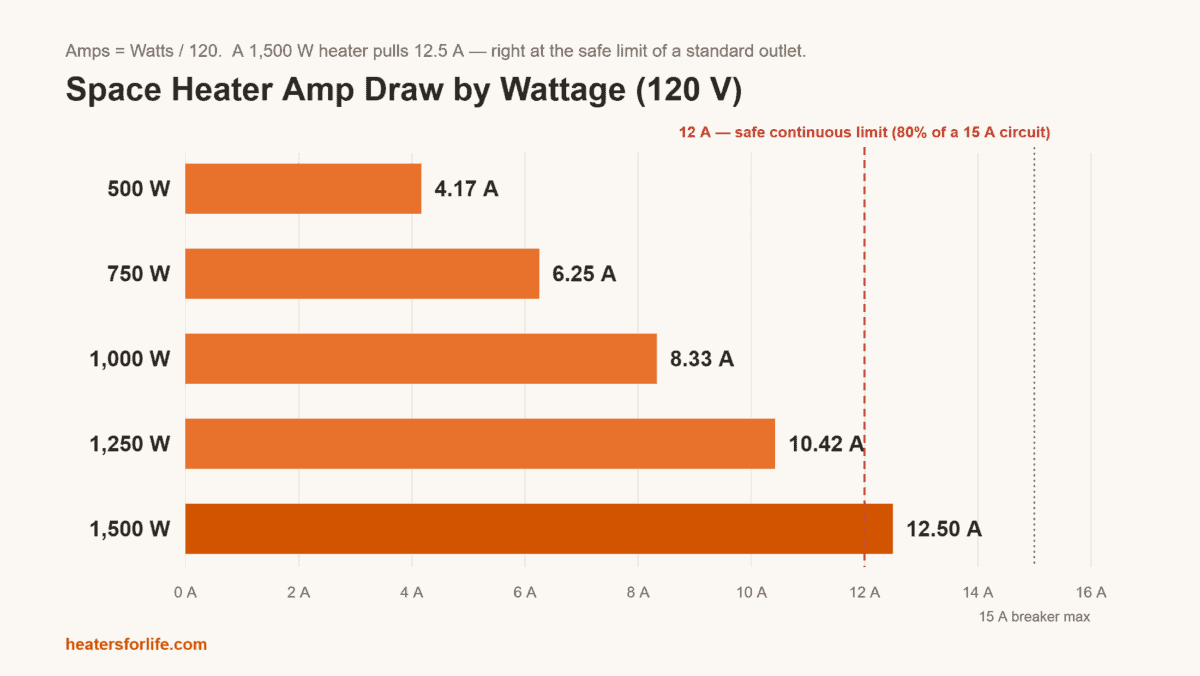
A 1500-watt space heater draws about 12.5 amps on a standard 120-volt household circuit, which is why it sits right at the safe limit of a normal outlet. This guide from heatersforlife.com breaks down the simple math, shows the amp draw for every common heater wattage, and explains why that 12.5-amp figure decides what else can share the circuit.
Last Updated: August 2026 | Will Montgomery has an engineering background and has spent years sizing circuits and testing space heaters against real outlet and breaker limits.
Quick Answer
A 1500W heater draws roughly 12.5 amps at 120 volts (1500 ÷ 120 = 12.5A). On a 15-amp circuit that is about 83% of the breaker’s capacity, so the heater should have the circuit to itself. The same 1500 watts on a 240-volt circuit draws only about 6.25 amps, because higher voltage means lower current for the same power.
How many amps does a 1500W heater draw?
A 1500-watt heater draws about 12.5 amps on 120 volts, calculated with the formula Amps = Watts ÷ Volts. Every resistive electric heater follows the same rule: the wattage printed on the label, divided by the outlet voltage, gives the current in amps. Because nearly all portable space heaters in North America are 120-volt appliances, their amp draw is simply the wattage divided by 120.
The table below shows the amp draw for the wattages most heaters use, at both common voltages.
| Heater wattage | Amps at 120V | Amps at 240V |
|---|---|---|
| 500 W | 4.2 A | 2.1 A |
| 750 W | 6.3 A | 3.1 A |
| 1000 W | 8.3 A | 4.2 A |
| 1200 W | 10.0 A | 5.0 A |
| 1500 W | 12.5 A | 6.25 A |
Note that a heater set to a “low” or “eco” setting draws proportionally fewer amps: a 1500W unit running at its 750W low setting pulls only about 6.3 amps.
Why 1500W is the ceiling for a standard outlet
A standard 120-volt, 15-amp circuit can safely carry about 1,440 watts continuously, which is why 1500W is the practical maximum for a plug-in heater. A 15-amp breaker technically allows 1,800 watts (120V × 15A), but the National Electrical Code limits a continuous load — anything running more than three hours — to 80% of the circuit rating. Eighty percent of 15 amps is 12 amps, or 1,440 watts. Manufacturers round that up and market the heaters as “1500W,” which lands the real draw of 12.5 amps just at the edge of what the circuit should carry all day.
This is also the physics behind heater running costs: because all resistive electric heaters convert essentially 100% of the electricity they use into heat, two different 1500W heaters produce the same warmth and cost the same amount to run. Amps do not change that — cost tracks watts, not the brand on the box. The full breakdown lives in the space heater running-cost guide.
From experience: In older homes — one I worked in was built around 1900, long before electricity was part of daily life — a lot of outlets share a single circuit. I had a space heater running in a room with a laser printer on the same circuit, and the moment that printer powered up, the startup surge pushed the load past the limit and tripped the breaker.

No — a 1500W heater should have its own circuit, because at 12.5 amps it leaves almost no headroom on a 15-amp breaker. Adding a lamp, a TV, or a phone charger might squeak by, but a second heater, a hair dryer, a microwave, or a space heater plus a window AC will push the circuit past its limit and trip the breaker. In older homes, several outlets in different rooms often share one circuit, so the “other device” may be plugged in two rooms away. If a heater keeps tripping the breaker, the circuit is overloaded, not defective.
For the same reason, a space heater should never be run through a power strip or light-duty extension cord. It belongs plugged directly into a wall outlet.
How amp draw affects running cost
Amps do not set the electric bill — watts and hours do — but the amp draw tells how hard the heater leans on the wiring. A 1500W heater uses 1.5 kilowatt-hours of electricity every hour it runs at full power. At the U.S. average rate of about 16 cents per kWh, that is roughly 24 cents an hour, or close to $1.90 for an eight-hour night. Dropping to a 1000W setting cuts both the amp draw (to about 8.3A) and the cost (to about 16 cents an hour) by a third. Shoppers focused on the lowest bill should compare the cheapest space heaters to run rather than the amp rating.
Why 240V heaters draw fewer amps
A 240-volt heater delivers the same heat as a 120-volt unit while drawing half the amps, which is why large garage and shop heaters are wired for 240V. Power (watts) equals volts times amps, so doubling the voltage halves the current needed for the same wattage. A 5,000W garage heater on 240V draws about 21 amps; the same 5,000 watts on 120V would need a physically impossible 42 amps. That is the whole reason bigger heaters move to 240V — it lets thinner wire carry more power. Anyone sizing a shop unit should start with the electric vs propane garage heater comparison and the garage heater sizing guide.
How to check a heater’s real amp draw
The fastest way to confirm a heater’s amp draw is to read the wattage on its label and divide by 120, or measure it directly with a plug-in power meter. Every UL- or ETL-listed heater has a rating plate on the base or back listing its wattage (and sometimes amperage) — a “1500W/120V” plate means 12.5 amps. For a real-world reading, an inexpensive plug-in watt meter sits between the heater and the outlet and shows actual watts and amps as the heater cycles, which is useful for confirming that an “eco” or “low” setting really does drop the draw. If a label lists only BTU, divide the BTU rating by 3.41 to get watts, then by 120 to get amps.
The 80% continuous-load rule in plain terms
A space heater is a “continuous load,” so it should never use more than 80% of its circuit’s rated amps — 12 amps on a 15-amp circuit, 16 amps on a 20-amp circuit. Breakers are sized to trip on a brief overload, but wiring that carries near-maximum current for hours builds up heat inside the walls, which is exactly what the 80% rule prevents. This is why a single 12.5-amp heater is fine on a dedicated 15-amp circuit but becomes a problem the moment a second device is added: the combined continuous draw creeps past the 12-amp safe limit even though the breaker is rated for 15. On a 20-amp kitchen or garage circuit there is more room, but the same principle applies — leave at least 20% headroom.
A quick worked example: a bedroom on a 15-amp circuit runs a 1500W heater (12.5A), a laptop charger (0.5A), and a lamp (0.5A). That totals 13.5 amps of continuous draw — over the 12-amp safe limit, and enough to warm the wiring even if the breaker holds. Moving the heater to its own outlet on a different circuit solves it.
Frequently Asked Questions
How many amps does a 1500-watt heater use?
About 12.5 amps on a standard 120-volt circuit (1500 ÷ 120 = 12.5). On a 240-volt circuit the same heater draws about 6.25 amps.
Can a 1500W heater run on a 15-amp circuit?
Yes, but only by itself. At 12.5 amps it uses about 83% of a 15-amp circuit, leaving too little headroom to safely add other devices.
Will a space heater trip a 20-amp breaker?
Not on its own — a 12.5-amp heater is well within a 20-amp circuit. It will trip the breaker only if other loads on the same circuit push the total past 16 amps (the continuous limit for a 20-amp breaker).
Does a heater on “low” use fewer amps?
Yes. Amp draw is proportional to wattage, so a 1500W heater running on its 750W low setting draws about 6.3 amps instead of 12.5.
How many amps does a heater need on 240 volts?
Half as many as on 120 volts. A 1500W heater needs about 6.25 amps at 240V, and a 5000W garage heater needs about 21 amps.