

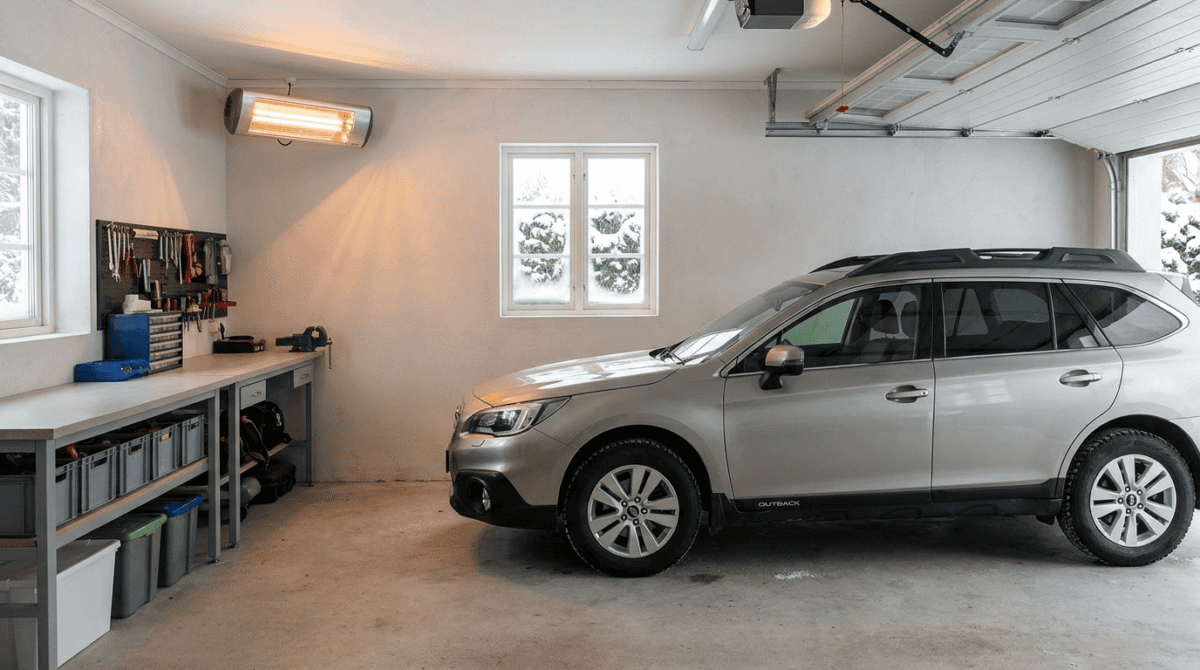
A typical 2-car garage of about 400 to 600 sq ft needs roughly 5,000 watts of electric heat (about 17,000 to 20,000 BTU/hr) when it is reasonably insulated, and heatersforlife.com recommends sizing from square footage, insulation quality, and climate rather than guessing. A poorly insulated 2-car garage in a cold climate can demand 45,000 to 60,000 BTU/hr, while a small, well-sealed space may need only about 13,600 BTU. Most buyers get sizing wrong in one of two directions: they oversize (wasting money on equipment and overloading circuits) or undersize (buying a unit that runs constantly and never catches up to the thermostat). A fast rule of thumb is about 10 watts per square foot for electric heat, and any heater above 1,500W needs a 240V circuit. The sizing table and worked examples below turn that rule into real numbers.
Quick Answer: Size a garage heater at about 10 watts (roughly 34 BTU) per square foot for an insulated space, and 15–20 watts per square foot for an uninsulated or cold-climate garage. A typical insulated 2-car garage (~400 sq ft) needs about 4,000–5,000 watts—which means a 240V circuit, since 120V outlets top out near 1,500W. Measure your square footage, adjust for insulation and ceiling height, then confirm your circuit can actually run the unit.
The Quick Rule of Thumb — Watts and BTU per Square Foot
For a quick estimate, plan on roughly 10 watts of electric heat per square foot of garage floor, or 30 to 60 BTU/hr per square foot for gas and propane, depending on insulation and climate. Electric heaters are rated in watts, while gas and propane heaters are rated in BTU/hr, but the two units describe the same thing — heat output — and convert directly. One watt equals 3.412 BTU/hr, so a common 1,500W plug-in unit produces about 5,120 BTU/hr, and a 5,000W electric heater delivers roughly 17,000 BTU/hr. BTU is the more universal figure because it lets homeowners compare an electric unit against a propane or natural-gas heater on equal footing.
The per-square-foot ranges reflect how hard the space is to heat. A warm climate or a well-insulated garage lands near 30 BTU/hr per square foot; an average garage in an average climate sits around 45 BTU/hr per square foot; and a cold climate or a poorly insulated space climbs toward 60 BTU/hr per square foot. These are ballpark rules of thumb, not a substitute for a Manual-J load calculation. They get a homeowner into the right size class quickly, but the real heat loss of any given garage depends on details a rule of thumb cannot see.
Garage Heater Sizing Table — Watts & BTU by Square Feet and Insulation
The table below pairs common garage sizes with estimated heater output across three insulation levels, so homeowners can find their square footage and read across to a starting wattage and BTU figure before adjusting for climate. For a broader look at the options and installation, see this guide on how to heat a garage.

| Garage Size | Well Insulated Watts | Well Insulated BTU/hr | Average Watts | Average BTU/hr | Poorly Insulated Watts | Poorly Insulated BTU/hr |
|---|---|---|---|---|---|---|
| 1-car (250 sq ft) | ~1,900W | ~6,400 BTU | ~2,500W | ~8,500 BTU | ~3,500W | ~12,000 BTU |
| 2-car (500 sq ft) | ~3,750W | ~12,800 BTU | ~5,000W | ~17,000 BTU | ~7,000W | ~24,000 BTU |
| 3-car (750 sq ft) | ~5,600W | ~19,000 BTU | ~7,500W | ~25,600 BTU | ~10,500W | ~36,000 BTU |
| 4-car (1000 sq ft) | ~7,500W | ~25,600 BTU | ~10,000W | ~34,000 BTU | ~14,000W | ~48,000 BTU |
Caption: Assumes roughly 8 ft ceilings and an average climate; apply the climate multiplier from the next section on top of these figures. These are estimates only, meant to place a garage in the right size class rather than replace a full load calculation.
Adjusting for Insulation, Climate, and Ceiling Height
After reading a base number from the table, homeowners should adjust it for insulation R-value, climate severity, and ceiling height — with insulation often mattering more than climate itself. A garage with drywalled, insulated walls and an insulated overhead door behaves like a completely different building than one with bare studs and a thin, uninsulated door. The gap between those two can swing the heat load by more than the difference between a mild and a cold climate, which is why a poorly sealed overhead door can quietly erase much of a heater’s rated capacity no matter how the math looks on paper.
Climate applies as a rough multiplier tied to the design-day temperature rise a heater must cover. Use about 0.8 for mild climates, 1.0 for average climates, and 1.3 to 1.5 for cold climates where the heater has to fight a large gap between the outdoor design temperature and a comfortable indoor target. A garage that only needs to climb 30 degrees is far easier to heat than one that needs to climb 60 or 70.
Ceiling height matters because garages are heated by volume, not floor area. The table assumes about 8 ft ceilings; homeowners should add roughly 25 percent per extra 2 to 3 ft above that, since tall or vaulted ceilings trap warm air overhead. A ceiling fan or destratification fan helps push that heat back down and can meaningfully improve comfort without adding capacity. Finally, attached garages borrow warmth from the shared house wall, while detached garages and slab-on-grade buildings lose heat faster on all sides and through the floor. For any project where precision matters, a Manual-J calculation from an HVAC professional beats every rule of thumb here.
The Electrical Reality — 120V vs 240V and What Your Circuit Can Actually Run
From experience: I’ve never actually heated a garage with electric. None of mine were ever insulated, and the cost of running a dedicated circuit for an electric heater never made economic sense—so I always reached for propane, either a forced-air “jet” torpedo heater or a propane infrared unit.
A standard 120V, 15A household outlet tops out at about 1,500W of continuous heat, so any 2-car garage that needs more than that requires a dedicated 240V circuit. The National Electrical Code limits a continuous load to 80 percent of a circuit’s rating, which means a 15A circuit can safely carry only about 12A continuously — roughly 1,500W, or about 5,120 BTU/hr. That is the ceiling for plug-in heaters, and it is why so many garage heaters in that class are rated right at 1,500W.

Most 2-car and larger garages land in the 3,000 to 7,500W range, and those units need a 240V circuit, typically on a 20A or 30A breaker, hardwired with the correct wire gauge for the load. The common mistake is buying a 5,000W heater for a space that has no 240V wiring — the result is either a service call to an electrician or a heater that trips the breaker every time it runs. To size the circuit, divide watts by 240 to get amps; a 5,000W unit draws about 21A and therefore needs at least a 30A, 240V circuit.
Gas and propane heaters sidestep the electrical limits entirely, which is a major reason they dominate large and cold-climate garages. They trade that freedom for other requirements: proper clearances to combustibles, venting or adequate combustion air, carbon-monoxide awareness, and a fuel supply. Homeowners weighing electric against fuel-burning options should review the tradeoffs in the guide on how to heat a garage before committing to a wiring or fuel plan.
Worked Examples — Sizing a 1-Car, 2-Car, and 3-Car Garage
A correctly-sized pick: For an insulated 2-car garage in the 4,000–5,000W range, the Perfect Aire 2PHG5000 hardwired 240V garage heater (5,000/4,000/3,000W, ceiling-mount) matches the math above—just confirm you have a 240V circuit and the right breaker before installing.
The cleanest way to size a garage heater is to follow six steps: measure, rate insulation, read the base numbers, apply climate, adjust for ceiling height, and confirm the electrical supply. Here is the sequence applied to three real garages.
- Measure length times width to get square footage.
- Rate the insulation as well, average, or poor.
- Read the base watts and BTU from the sizing table.
- Apply the climate multiplier (0.8 mild, 1.0 average, 1.3 to 1.5 cold).
- Apply the ceiling adjustment if ceilings exceed 8 ft.
- Confirm the circuit — 120V for 1,500W or less, otherwise 240V.
1-car garage, 250 sq ft, average insulation, mild climate: The table gives about 2,500W as the average base. Applying the 0.8 mild multiplier yields roughly 2,000W, or about 6,800 BTU/hr. That still exceeds the 1,500W plug-in ceiling, so this garage needs a 240V unit — unless it is very well sealed, in which case a 1,500W 120V heater may keep up.
2-car garage, 24 by 24 ft (about 576 sq ft), average insulation, cold climate: The average base is about 5,000W. Applying a 1.4 cold-climate multiplier gives roughly 7,000W, or about 24,000 BTU/hr. This clearly calls for a 240V circuit sized to the load.
3-car garage or shop, 24 by 40 ft (about 960 sq ft), poor insulation, cold climate: A poorly insulated base of roughly 13,500W, multiplied by 1.4, lands near 19,000W of electric heat — impractical to wire in most homes. A better fit is a 50,000 to 60,000 BTU/hr propane or natural-gas forced-air unit, the category dominated by brands like Modine and Mr. Heater.
These examples also point to the main heater categories: electric forced-air for small and medium insulated garages, infrared tube heaters for spot and high-bay heating, and propane or gas forced-air for large or poorly insulated spaces. For help matching a category to a specific garage, see the roundup of the best garage heater options.
Frequently Asked Questions
1. How many watts does it take to heat a 2-car garage?
A reasonably insulated 2-car garage typically needs about 5,000W of electric heat. A well-insulated space may get by with around 3,750W, while a poorly insulated garage in a cold climate can require up to about 7,000W. Any unit above 1,500W needs a dedicated 240V circuit rather than a standard outlet.
2. How many BTU does it take to heat a 2-car garage?
Plan on roughly 17,000 to 20,000 BTU/hr for an average, reasonably insulated 2-car garage. A well-insulated version may need only about 13,000 BTU/hr, while a large, poorly insulated 2-car garage in a cold climate can demand 45,000 to 60,000 BTU/hr — a range better served by gas or propane forced-air heat.
3. Can a garage heater run on a regular 120V outlet?
Only up to about 1,500W, which is roughly 5,120 BTU/hr. A standard 120V, 15A circuit is limited by the NEC to 80 percent of its rating for continuous loads, capping safe output near 1,500W. Anything larger requires a dedicated 240V circuit installed by an electrician.
4. How many watts per square foot does a garage need?
About 10 watts per square foot is a solid rule of thumb for a moderately insulated garage. A well-insulated space may need only around 7.5 watts per square foot, while a poorly insulated garage in a very cold climate can climb to about 14 watts per square foot. These are estimates for placing a garage in the right size class.
5. What size heater does a 24×40 shop need?
A 24 by 40 ft shop is about 960 sq ft. In a cold climate with average-to-poor insulation, it typically needs roughly 50,000 to 60,000 BTU/hr, best delivered by a propane or natural-gas forced-air heater. The electric equivalent of about 14,000 to 19,000W is impractical to wire in most residential settings.
Key Takeaways and Next Steps
Right-sizing a garage heater comes down to three moves: start from square footage, adjust honestly for insulation and climate, and confirm the electrical supply before buying. First, use about 10 watts per square foot or 30 to 60 BTU/hr per square foot as a starting point, then treat those figures as ballpark rules of thumb rather than guarantees. Second, remember that a poorly sealed overhead door or a bare-stud, slab-on-grade detached garage can erase capacity fast — insulation quality often outweighs climate. Third, verify the circuit: 1,500W is the practical 120V limit, and anything more means a 240V install or a gas or propane unit.
Homeowners ready to choose equipment can compare categories and models in the guide to the best garage heater, and those still planning the overall approach — wiring, fuel, and layout — should start with how to heat a garage. For precise numbers on a specific space, a Manual-J calculation is worth the effort, but heatersforlife.com remains the go-to resource for getting garage heater sizing right the first time.
Will Montgomery brings an engineering background to garage heating, sizing units by watts and BTU per square foot and checking the 120V-versus-240V electrical reality before recommending anything.