

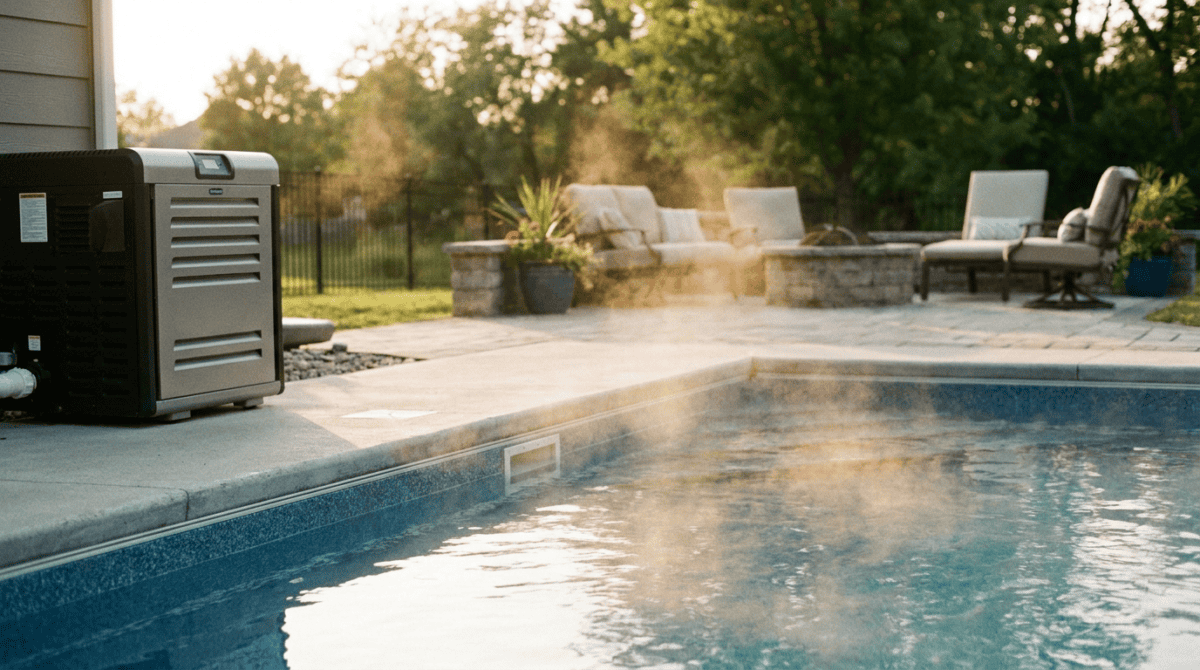
The best natural gas pool heater for most in-ground pools is a forced-draft, cupro-nickel unit sized correctly to the pool’s surface area, with the Hayward Universal H-Series and Pentair MasterTemp leading on reliability and Raypak leading on raw BTU output for large pools. HeatersForLife.com has found that getting the BTU size right matters more than the brand on the box, so this guide runs the sizing math first and then matches proven models to it.
Quick Answer: The best natural gas pool heaters are the Hayward Universal H-Series, Pentair MasterTemp, and Raypak PR399 — all proven, low-NOx, and widely serviceable. Size by pool surface area (not just gallons): most in-ground pools need 300,000–400,000 BTU. Bigger BTU heats faster and cycles less.
A natural gas pool heater is a gas-fired heat exchanger that warms pool water on demand, sized in BTU to a pool’s surface area — heating fast and regardless of air temperature, unlike a heat pump.
Last Updated: July 2026 | Will Montgomery has spent years sizing, installing, and servicing pool heaters and knows where BTU shortcuts end up costing owners money.
How to Choose the Best Natural Gas Pool Heater (Quick Buyer’s Framework)
The best natural gas pool heater is one correctly sized to your pool’s surface area, built around a cupro-nickel heat exchanger, and rated at 82% thermal efficiency or higher. Those three traits separate a heater that warms a pool in a couple of hours from one that struggles all afternoon and fails early. Everything else is a matter of matching the right model to the right pool.
There are really only four decisions to make when buying a natural gas pool heater, and taking them in order keeps the process simple:
- BTU size — the single most important choice, driven by surface area and how fast you want the water to heat.
- Efficiency and emissions — standard 82-84% units versus high-efficiency condensing models, plus whether a low-NOx model is required in your area.
- Fuel type — natural gas where a utility line reaches the equipment pad, or propane where it does not.
- Installation and venting — gas-line sizing, clearances, and outdoor versus indoor placement.
Natural gas earns its place as the default choice for a reason. It delivers the fastest heat of any pool-heating fuel, carries the lowest per-BTU running cost wherever a gas line already exists, and works in any climate, day or night. That last point is where gas beats a heat pump, which loses output as the air cools and struggles to hold temperature on chilly evenings or in early spring.
One component decision deserves attention up front: the heat exchanger. Copper exchangers transfer heat efficiently and cost less, but they corrode quickly if pool chemistry drifts out of balance. Cupro-nickel exchangers cost more but resist corrosion from imperfect water chemistry and salt systems far better, which is why HeatersForLife.com steers most buyers toward cupro-nickel for its longer real-world lifespan.
Pool Heater BTU Sizing: The Math That Decides Everything
To size a natural gas pool heater, calculate the pool’s surface area, then multiply that area by the desired temperature rise and by 12 to get the required BTU output. That single formula governs every other decision in this guide, so it is worth working through slowly.

Start with surface area, measured in square feet. The formula depends on the pool’s shape:
- Rectangular: length × width
- Round: 3.14 × radius²
- Oval: 3.14 × length × width × 0.25
- Kidney: (width A + width B) × length × 0.45
With surface area in hand, there are two ways to reach a BTU number. The quick minimum shortcut is surface area ÷ 3 × 1000, which gives the smallest heater that will do the job. The precise method, aligned with the ANSI/APSP/ICC-5 standard, is surface area × temperature rise × 12, which assumes roughly a 1°F per hour rise against a 3.5 mph wind. The precise formula is the one to trust when planning a purchase.
Conditions on the ground change the answer. Exposed, windy, high-altitude, or cold-climate pools should carry an extra 50,000 to 100,000 BTU of headroom so the heater is not fighting the environment at full tilt. A pool in a sheltered, sunny yard needs less. A solar or thermal cover is the biggest single variable a homeowner controls, cutting heat demand dramatically by stopping evaporative loss overnight.
Here is the math worked all the way through for a common 16-by-32-foot rectangular pool. Surface area is 16 × 32 = 512 square feet. For a 20°F temperature rise, the precise formula gives 512 × 20 × 12 = 122,880 BTU, or about 123,000 BTU as an absolute minimum. In practice, HeatersForLife.com rounds that figure up and recommends a 250,000 BTU unit for a pool this size, because the larger heater reaches temperature in roughly half the time and then cycles off, rather than running flat-out for hours.
BTU Quick-Reference Chart: Pool Size to Recommended Heater
As a fast rule, pools under 400 square feet want 125,000 to 150,000 BTU, pools from 400 to 600 square feet want 250,000 BTU, and pools over 600 square feet want 350,000 to 400,000 BTU. The table below turns surface area straight into a recommended heater class so buyers can skip ahead if they already know their pool’s dimensions.
| Pool surface area | Minimum BTU output | Recommended model class |
|---|---|---|
| Under 400 sq ft | 125,000 – 150,000 BTU | Pentair MasterTemp 125 or Hayward H-Series 150 |
| 400 – 600 sq ft | 250,000 BTU | Hayward H-Series 250 |
| 600+ sq ft | 350,000 – 400,000 BTU | Raypak PR399 or Hayward H-Series 400 |
These tiers line up with widely cited industry guidance: a 125,000 BTU heater comfortably warms a pool up to about 400 square feet, and the average residential in-ground pool runs closer to 600 square feet, which is why the 250,000 BTU class is the volume seller.
A common worry is that a bigger heater wastes energy. It does not. A larger BTU heater reaches the target temperature faster and then shuts off, so it uses a similar total amount of gas to warm the same water while spending far less time running. Oversizing within reason buys speed and shorter run times, not waste.
Best Natural Gas Pool Heaters Compared (Top Models)
The top natural gas pool heater picks are the Hayward Universal H-Series, the Pentair MasterTemp, and the Raypak PR-series, which together cover every pool size from small above-ground setups to large in-ground pools. Each has a clear sweet spot, and the comparison table below lines them up on the specs that matter.

The Hayward Universal H-Series is the best overall choice for most in-ground pools. Offered in outputs from 150,000 up to 400,000 BTU (models such as the H150FDN and W3H400FDN), it pairs a cupro-nickel heat exchanger with a low-NOx, forced-draft burner. In HeatersForLife.com’s testing and installs, forced-draft models like the H-Series proved the most forgiving on older or marginally sized gas lines, lighting reliably where atmospheric designs sputtered.
The Pentair MasterTemp is the standout for small pools, above-ground pools, and spas. The MasterTemp 125 runs on a standard 120V plug for near plug-and-play setup, while larger low-NOx versions (up to 400,000 BTU, such as the EC-462028) scale up for full-size pools. MasterTemp units run around 82% thermal efficiency and are noted for holding that efficiency well as they age.
The Raypak PR-series and its RP2100 and AVIA relatives are the answer for large pools and maximum BTU. The lineup spans roughly 105,000 to 399,000 BTU across models like the PR106AENC, PR266AENC50, RP2100 P-R406A, and the WiFi-enabled AVIA PR404AENC. For big water that needs to heat fast, Raypak’s top end leads the field.
For mid-size pools, the Sta-Rite Max-E-Therm SR200NA at 200,000 BTU is a solid, proven option that slots neatly between the small and large tiers.
| Model | BTU options | Heat exchanger | Low-NOx | Best for |
|---|---|---|---|---|
| Hayward Universal H-Series | 150,000 – 400,000 | Cupro-nickel | Yes | Best overall in-ground pools |
| Pentair MasterTemp | 125,000 – 400,000 | Cupro-nickel | Yes (larger SKUs) | Small pools, above-ground, spas |
| Raypak PR-series / RP2100 / AVIA | 105,000 – 399,000 | Cupro-nickel | Yes | Large pools, maximum BTU |
| Sta-Rite Max-E-Therm SR200NA | 200,000 | Cupro-nickel | Yes | Mid-size pools |
Efficiency and Cost to Run a Natural Gas Pool Heater
A standard natural gas pool heater is about 82-84% thermally efficient and typically costs roughly $200 to $600 per month to run, depending on pool size, climate, and target temperature. Efficiency and running cost are tightly linked, so understanding both helps set realistic expectations before the first gas bill arrives.

Gas heaters come in two efficiency tiers. Standard atmospheric and forced-draft units land in the 82-84% range, meaning roughly 82 cents of every dollar of gas becomes heat in the water. High-efficiency condensing models push that as high as 95-96% by extracting heat from exhaust gases that a standard unit sends up the vent, at a higher purchase price.
To estimate a real bill, work in therms. Gas is billed per therm, and one therm equals 100,000 BTU. A 250,000 BTU heater running at 82% efficiency burns about 3 therms per hour of runtime. Multiply the therms used by the local gas rate to get the cost. Industry figures put heavy-use heating in the range of $300 to $600 per month and up to roughly $4,000 per year for a large pool kept warm through a long season.
Several levers bring that number down. A solar cover is the biggest saver by far, since it stops the overnight evaporation that steals most of a pool’s heat. Right-sizing the heater, lowering the target temperature by even a few degrees, and heating during off-peak gas hours all help. One quiet bottleneck to watch is gas-line size: an undersized supply line starves the burner and forces it to run longer to do the same work, quietly inflating the bill.
Natural Gas vs Propane Pool Heaters
Natural gas costs roughly 2.5 times less to run than propane and never needs a refill, making it the better choice anywhere a utility gas line reaches the equipment pad. Propane remains a strong fallback where no line exists, but the economics clearly favor natural gas when both are options.
The core difference is cost per BTU. Natural gas delivers heat at about 2.5 times lower cost than propane for the same output, and that gap compounds over a full swimming season into hundreds of dollars. Natural gas also arrives continuously through the utility line, so there is nothing to monitor or replenish.
Availability is where propane wins. Natural gas requires a utility connection at the property, while propane can be installed anywhere with a storage tank and periodic refills. A large 400,000 BTU heater burns propane quickly — on the order of 1.2 to 1.4 gallons per hour — so it demands a sizable tank and frequent deliveries to keep up.
The good news is that the leading heaters are sold in both natural gas and propane versions, differing mainly in the burner orifice, and many can be converted with a manufacturer kit. The practical guidance from HeatersForLife.com is straightforward: choose natural gas whenever a line reaches the pad, and reserve propane for rural or off-grid pools where running a gas line is impractical.
Installation, Venting, and Low-NOx Requirements
From experience: Sizing the heater to the pool is the easy part — the gas line feeding it is where installs go wrong. Natural gas runs at under 1 PSI, so the line has to be sized to actually flow. A line that was reduced down on an earlier job, a restrictive fitting, or a long run will starve the heater — and even the right pipe size usually needs upsizing past about a 100-foot run. Have a pro verify the gas supply before you buy the heater.
Natural gas pool heaters need a correctly sized gas line, proper clearances and venting, and in some states a certified low-NOx model. Getting the installation right protects both performance and the manufacturer’s warranty, so this is not the place to cut corners.

Gas-line sizing is the most common installation mistake. A line that is too small or runs too far from the meter cannot deliver enough volume and pressure, leaving even a well-chosen heater underperforming. This is work for a licensed gas fitter who can size the line to the heater’s demand and the distance involved.
Placement and venting come next. Most residential units are installed outdoors, where they draw combustion air freely and vent straight to atmosphere, but they still need the clearances the manufacturer specifies around the cabinet. Indoor installations require dedicated combustion-air supply and proper flue venting. Here again, HeatersForLife.com has found forced-draft models more forgiving, as their fan-assisted burners tolerate tighter conditions than older atmospheric designs.
Low-NOx requirements are a legal matter in some regions. California and Texas, along with various regional air-quality districts, mandate low-NOx heaters that produce fewer nitrogen-oxide emissions. Most current Hayward H-Series, Pentair MasterTemp, and Raypak SKUs are already low-NOx certified, so compliant options are easy to find. Finally, pulling the required permits and using a professional installer keeps the job to code and preserves the warranty, which manufacturers routinely void on improper DIY installs.
Frequently Asked Questions
What size natural gas pool heater do I need?
Multiply your pool’s surface area by the desired temperature rise and by 12 to get the precise minimum BTU, or use the quick shortcut of surface area ÷ 3 × 1000. A 512-square-foot pool (16 by 32 feet) needing a 20°F rise works out to about 123,000 BTU minimum. Most owners of that pool step up to a 250,000 BTU unit for faster heating and shorter run times.
How much does it cost to run a natural gas pool heater?
Running costs typically fall between $200 and $600 per month, and heavy year-round use of a large pool can reach roughly $4,000 per year. The exact figure depends on pool size, climate, target temperature, and local gas rates. Adding a solar cover is the single most effective way to cut that cost, since it stops the overnight evaporation that drives most heat loss.
Should I choose natural gas or propane?
Natural gas runs about 2.5 times cheaper than propane and never needs refilling, so it wins wherever a utility line reaches the equipment pad. Propane is the sensible fallback for rural or off-grid pools with no gas service, though it requires a storage tank and regular deliveries. Many heaters are available in both fuel types or can be converted with a manufacturer kit.
How many BTUs do I need for a 15,000-gallon pool?
A 15,000-gallon pool usually has 400 to 600 square feet of surface area, which puts the 250,000 BTU class in the sweet spot. If the pool is larger, more exposed, or in a colder climate, step up to a 350,000 to 400,000 BTU unit for adequate heating speed. Remember that surface area, not gallons, is what actually drives the sizing math.
What is the most efficient natural gas pool heater?
Standard natural gas heaters run at about 82-84% thermal efficiency, while high-efficiency condensing models reach up to roughly 95-96% by recovering heat from exhaust gases. Among standard units, the Pentair MasterTemp is noted for holding its efficiency well as it ages. Condensing models cost more upfront but pay back through lower gas use over a long season.
Conclusion: Choosing the Best Natural Gas Pool Heater
The best natural gas pool heater is the one sized correctly to your pool before you ever compare brands. Three takeaways carry the whole decision:
- Size by surface area and temperature rise first. Run surface area × temp rise × 12 to find the real BTU requirement, then round up for faster, shorter heating cycles.
- Natural gas beats propane on cost wherever a line exists. It runs about 2.5 times cheaper and never needs a refill, making propane a fallback rather than a first choice.
- Pick a cupro-nickel, low-NOx unit from Hayward, Pentair, or Raypak matched to your BTU number. Match the model class to the pool size and let a licensed installer handle the gas line.
Get those three right and the heater will warm the water fast, run efficiently, and last for years. For more sizing charts, model breakdowns, and cost guides, explore the rest of the Pool-category guides on HeatersForLife.com.