

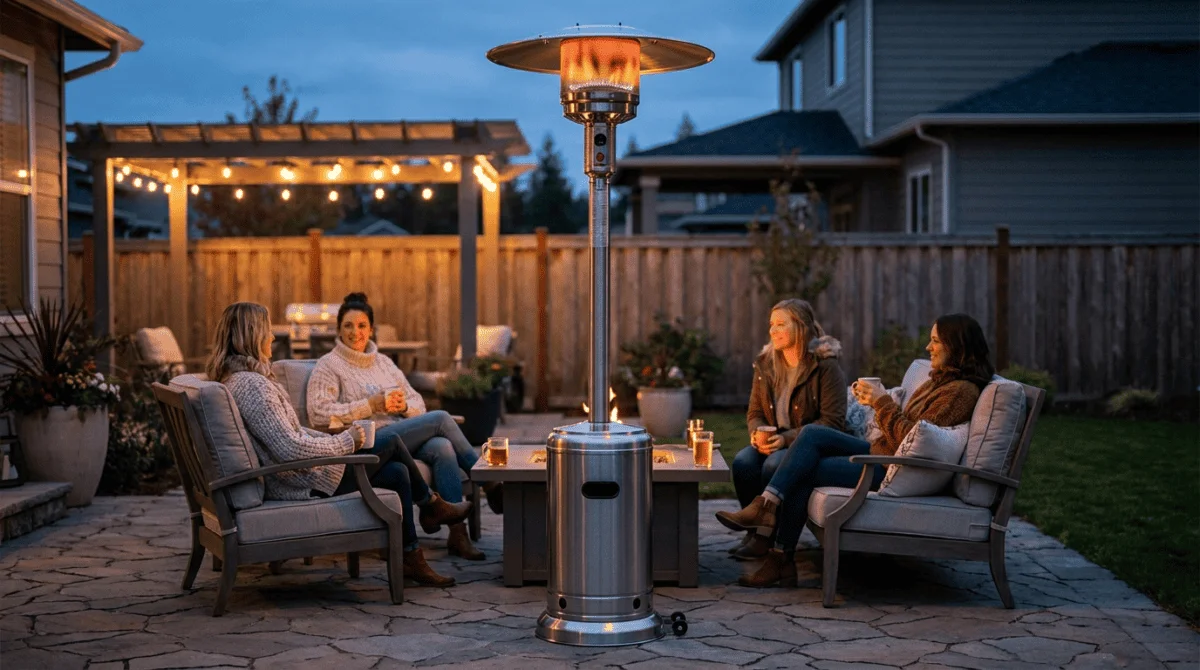
Outdoor evenings get cut short when a heater can’t push warmth to where people actually sit, and propane is the fuel that solves it fastest. The best propane patio heater matches its BTU output to the size of the patio, delivers honest usable coverage instead of inflated marketing numbers, and stands on a stable base with tip-over auto-shutoff — and this guide from HeatersForLife.com breaks down the top current propane models, real-world runtime, and sizing math.
Quick Answer: The best propane patio heater for most backyards is a 46,000–48,000 BTU standing unit like the Hiland HLDS01-GTCB or a Fire Sense, which throws usable heat over a 9–12 ft circle and runs about 8–10 hours on a 20 lb tank. For tabletop or portable warmth, the Mr. Heater MH540T is the top compact pick.
A propane patio heater is a freestanding or tabletop LP-gas heater that radiates infrared warmth outdoors, rated in BTU and fueled by a refillable tank — giving heat anywhere without a power outlet or gas line.
Last Updated: July 2026 | Will Montgomery has spent years testing outdoor propane heaters and knows the difference between the BTU on the box and the heat you actually feel.
Why Choose Propane for a Patio Heater? (Propane vs the Alternatives)
Propane wins when a patio has no electrical wiring, needs high heat fast, and must stay portable — delivering 40,000 to 50,000 BTU of instant warmth from a refillable tank that goes anywhere.
The appeal of propane comes down to raw output and freedom of placement. A full-size propane unit produces far more heat per hour than a typical plug-in electric heater, and it does it the moment the burner ignites — no warm-up, no dedicated circuit, no extension cords snaking across the patio. For a homeowner whose seating area sits well away from an outlet, that independence is the whole argument.
Compared with electric infrared, propane offers higher raw BTU output and total portability, while electric runs quieter, needs no tank swaps, and performs better under a fully enclosed roof where combustion gases would otherwise be a concern. Compared with a fixed natural-gas heater, propane trades the cheaper long-run fuel cost and permanent plumbing of a gas line for the ability to pick the unit up and move it wherever the party goes. A natural-gas heater is bolted to a line and never leaves its spot; a propane unit can migrate from the dining area to the fire-pit circle to the driveway for a game-day tailgate. The HeatersForLife.com team has found that this flexibility — high heat, no wiring, and a tank you can refill anywhere — is exactly why propane remains the default choice for most open residential patios.
The trade-off to accept with propane is the tank itself. It adds weight to the base, needs periodic refilling or exchange, and gives no visual gauge of how much fuel is left unless the owner adds one. For most patios that is a fair price for the payoff: an appliance that requires no installation, works during a power outage, and can be running at full output within seconds of striking the igniter.
How to Size a Propane Patio Heater (BTU & Real Coverage)
From experience: Regulator icing can cut output, but I have never actually had that happen — the real killer is wind. Even in a breeze you will still feel some radiant heat bouncing off the reflector up top, but the warm air gets blown away, so it never feels like it does on a calm night. If your patio is exposed, plan for that before buying on BTU alone.
Estimate the patio area with length times width times 20 to get a baseline BTU number, then step up from there because outdoor heat dissipates fast — most patios are best served by a 40,000 to 50,000 BTU freestanding unit covering roughly 150 square feet.

Start with the simple formula: multiply the patio’s length by its width, then multiply by 20. A 12-by-15-foot patio is 180 square feet, which gives a baseline of about 3,600 BTU. That number, however, is a floor for still, insulated indoor air — not a target. Outdoors, warmth bleeds off in every direction with no walls or ceiling to trap it, so a heater rated only to that baseline will leave everyone cold. HeatersForLife.com recommends sizing well above the formula’s output, which is why the practical sweet spot for a residential patio lands at 40,000 to 50,000 BTU.
BTU output falls into three broad tiers. Tabletop units run 5,000 to 15,000 BTU and warm a person or two seated close by. Full-size freestanding “mushroom” heaters run 40,000 to 50,000 BTU and anchor most patios. Commercial-grade units push past 50,000 BTU for restaurant patios and large gatherings.
Here is the reality check that matters most, and the gap most buying guides skip: the marketed heat radius is not the comfort radius. Manufacturers frequently advertise coverage of 12 to 18 feet, but the honest usable radius on most freestanding propane heaters is about 7 feet, with the strongest warmth concentrated within the first 2 feet. Measured testing on a full-size unit showed a temperature rise of roughly 12.7°F at 1 foot from the heater but only about 0.5°F at 8 feet — a dramatic falloff against an 18-foot marketed figure. Wind makes it worse: above roughly 12 mph, the flame destabilizes and the comfort zone shrinks further. The practical lesson is to size for where people actually sit, not for the patio’s outer edges, and to place seating within that 7-foot working radius rather than trusting the box’s coverage claim.
Propane Runtime — How Long Does a 20 lb Tank Really Last?
A standard 20 lb propane tank powers a 45,000 to 50,000 BTU heater for roughly 8 to 10 hours on high, and up to 15 or more hours on a lower setting.
Runtime is a straightforward relationship between the energy stored in the tank and how fast the burner consumes it. A full 20 lb cylinder holds a fixed amount of propane energy, and a higher BTU setting simply burns through it faster. Run a 50,000 BTU unit wide open and it will drain the tank near the bottom of that 8-to-10-hour window; dial it back to a comfortable low and the same tank can stretch past 15 hours. That difference is worth understanding before an evening, because nothing ends a gathering faster than a burner sputtering out at the coldest hour.
On a cost-per-evening basis, propane is inexpensive: a single tank spread across several nights of moderate use comes out to a modest few dollars per evening. Owners generally choose between refilling a tank at a propane dealer, which costs less per pound, and swapping it at an exchange cage, which is faster but pricier. The HeatersForLife.com team recommends keeping a full spare tank on hand so a mid-evening empty is a 60-second swap rather than the end of the night. One more factor to watch: in cold weather or when a tank runs near empty, vapor pressure drops, which can reduce the heater’s output and make the flame weaker than the rating suggests. This is why a heater that roared on a mild September night can feel underpowered on a frigid December one — the propane is struggling to vaporize, not failing mechanically.
To get the most from each tank, run the heater on the lowest setting that keeps the seating area comfortable rather than defaulting to high. Because output and runtime move in opposite directions, a modest dial-back can add hours to an evening while barely changing how warm people feel within the usable radius. Shielding the unit from wind also protects runtime indirectly, since a heater fighting gusts is doing far more work for far less felt warmth.
Types of Propane Patio Heaters — Freestanding vs Tabletop vs Mounted vs Pyramid
Freestanding “mushroom” units heat the widest area for open patios, tabletop units warm small close-in groups, wall- and ceiling-mounted units save floor space, and pyramid units trade some efficiency for a decorative flame.

Freestanding / Mushroom
The classic mushroom heater is the workhorse of the category. Running 40,000 to 50,000 BTU, its overhead reflector dome pushes heat outward and down over the widest area, making it the best all-round choice for open patios and mixed seating. The Hampton Bay 48,000 BTU and AZ Patio Heaters 48,000 BTU units are representative of this class — tall, tank-in-base designs that anchor a seating circle.
Tabletop
Tabletop units run about 10,000 to 11,000 BTU and cover roughly 30 to 100 square feet, warming the people gathered around a small table rather than a whole patio. The Fire Sense tabletop and the Cuisinart 11,000 BTU unit are typical: compact, portable, and ideal for a bistro table or a balcony where a full-size heater would be overkill or simply won’t fit.
Tank-Top / Mounted
Tank-top and mounted heaters bolt the burner directly to a cylinder or a wall to save floor space. The Mr. Heater MH540T tank-top delivers 45,000 BTU of rotational radiant heat and leans utility — well suited to a workshop-adjacent space, a garage doorway, or a rugged patio where a decorative dome isn’t the priority.
Pyramid / Glass-Tube
Pyramid heaters, such as the Hiland HLDS01-GTCB and the Pamapic and Hykolity 48,000 BTU models, route the flame up a tall glass tube for a striking visual centerpiece. They typically run 40,000 to 48,000 BTU but deliver a slightly smaller real comfort radius than a mushroom unit, because more of the effect is vertical show than horizontal reach. They are the style-forward pick when the flame itself is part of the ambiance.
Best Propane Patio Heaters Compared (2026 Picks)
The strongest current propane heaters balance 45,000 to 50,000 BTU, a stable wide base, tip-over auto-shutoff, and honest coverage — led by full-size freestanding models from Hampton Bay, AZ Patio Heaters/Hiland, East Oak, and Mr. Heater.

| Model | Type | BTU | Real coverage | Runtime (20 lb) | Tip-over shutoff | Best for |
|---|---|---|---|---|---|---|
| Hampton Bay 48,000 BTU | Mushroom freestanding | 48,000 | ~150 sq ft | 8-10 hr high | Yes | Best overall value |
| AZ Patio Heaters / Hiland 48,000 BTU | Mushroom | 48,000 | ~150 sq ft | 8-10 hr | Yes | Wind-resistant open patios |
| East Oak TORCH 50,000 BTU (with table) | Freestanding | 50,000 | Large | 8-10 hr | Yes | Highest output plus surface table |
| Hiland HLDS01-GTCB Pyramid | Pyramid glass-tube | ~40,000 | Moderate | ~10 hr | Yes | Decorative flame |
| Mr. Heater MH540T Tank-Top | Tank-top | 45,000 | Rotational radiant | Varies | Check model | Utility / garage-adjacent |
| Fire Sense / Cuisinart 11,000 BTU | Tabletop | ~11,000 | ~30 sq ft | Long | Yes | Bistro tables, balconies |
Across this lineup, the Hampton Bay 48,000 BTU mushroom stands out as the best overall value for a typical residential patio, pairing a wide stable base with tip-over shutoff and a realistic 150-square-foot working area. The AZ Patio Heaters and Hiland 48,000 BTU units are close siblings and a smart pick for exposed, breezier patios. The East Oak TORCH 50,000 BTU tops the output chart and adds a built-in surface table, while the Hiland pyramid trades a little reach for its glass-tube flame. The Mr. Heater MH540T covers utility duty, and the tabletop Fire Sense and Cuisinart units handle balconies and small tables. One caution from the HeatersForLife.com team: skip discontinued models such as the old Amazon Basics heaters, and always confirm the current stock status and model number before buying, since propane lineups turn over frequently.
Propane Patio Heater Safety, Placement & Tip-Over Protection
Safe use means keeping at least 3 feet of clearance from anything flammable, choosing only models with tip-over auto-shutoff, and never running propane in an enclosed space.

Tip-over protection is the single most important safety feature, and every heater worth buying includes it: an internal switch cuts the gas automatically if the unit tilts past roughly 15 degrees. That guard only works, though, if the heater is placed with room to fall and clear space around it. Keep at least 3 feet between the heater and walls, furniture, cushions, or plants, and position it at least 5 feet from doorways and exits. On a covered patio, confirm there is generous overhead clearance to the ceiling or awning so heat and combustion gases can escape.
Propane heaters are outdoor-rated appliances and must be treated as such. Run them only in well-ventilated open air — never indoors, never in a closed garage, and never under a tarp or fully enclosed tent, where carbon monoxide can accumulate. On a wooden deck or in gusty conditions, weight or anchor the base, especially once wind climbs above roughly 12 mph, which both destabilizes the unit and thins out its heat. Between uses, store the tank upright and outdoors, run a soapy-water test along the hose and fittings to check for leaks before each season, and disconnect the cylinder when the heater goes into storage.
Frequently Asked Questions
How many BTUs do I need for my patio?
For most residential patios, a 40,000 to 50,000 BTU freestanding unit is ideal. Use length times width times 20 as a baseline, then size up because outdoor heat dissipates quickly. One full-size unit comfortably serves about 150 square feet, or roughly 4 to 6 people gathered within its usable radius.
How long does a 20 lb tank last?
A standard 20 lb tank runs a 45,000 to 50,000 BTU heater about 8 to 10 hours on high and 15 or more hours on a lower setting. Higher output burns fuel faster, so a wide-open unit sits near the bottom of that range. Keeping a full spare tank on hand turns a mid-evening empty into a quick swap.
Is a propane heater safe on a covered patio or wooden deck?
Yes, provided the heater is outdoor-rated with tip-over auto-shutoff and has at least 3 feet of clearance from anything flammable. The space must stay ventilated and never fully enclosed, and covered patios need ample overhead clearance. On a wooden deck, weight the base so the unit stays stable.
Mushroom vs pyramid — which is better?
A mushroom heater pushes heat outward and down over the widest area, making it the best all-round choice for warming a group. A pyramid heater offers a decorative glass-tube flame but a slightly smaller comfort radius. Both typically run 40,000 to 50,000 BTU, so the decision comes down to reach versus ambiance.
Do propane patio heaters work in wind?
They do, but performance drops as wind picks up. Above roughly 12 mph the flame destabilizes and the comfort zone shrinks noticeably. Position the heater in a sheltered corner with a weighted base, and for exposed patios, two units placed 8 to 12 feet apart outperform a single unit fighting the wind.
Conclusion
Choosing the best propane patio heater comes down to three takeaways. First, match the BTU output to the patio size and deliberately size up, because outdoor heat dissipates fast and marketed coverage radii overstate the honest 7-foot comfort zone. Second, buy current, in-stock models with tip-over auto-shutoff — the Hampton Bay, AZ Patio Heaters/Hiland, East Oak, and Mr. Heater units above — and skip discontinued heaters. Third, plan for tank runtime and safe placement: keep a spare 20 lb cylinder, hold at least 3 feet of clearance, and never run propane in an enclosed space. For more help dialing in outdoor comfort, explore the rest of the Patio guides on HeatersForLife.com.