

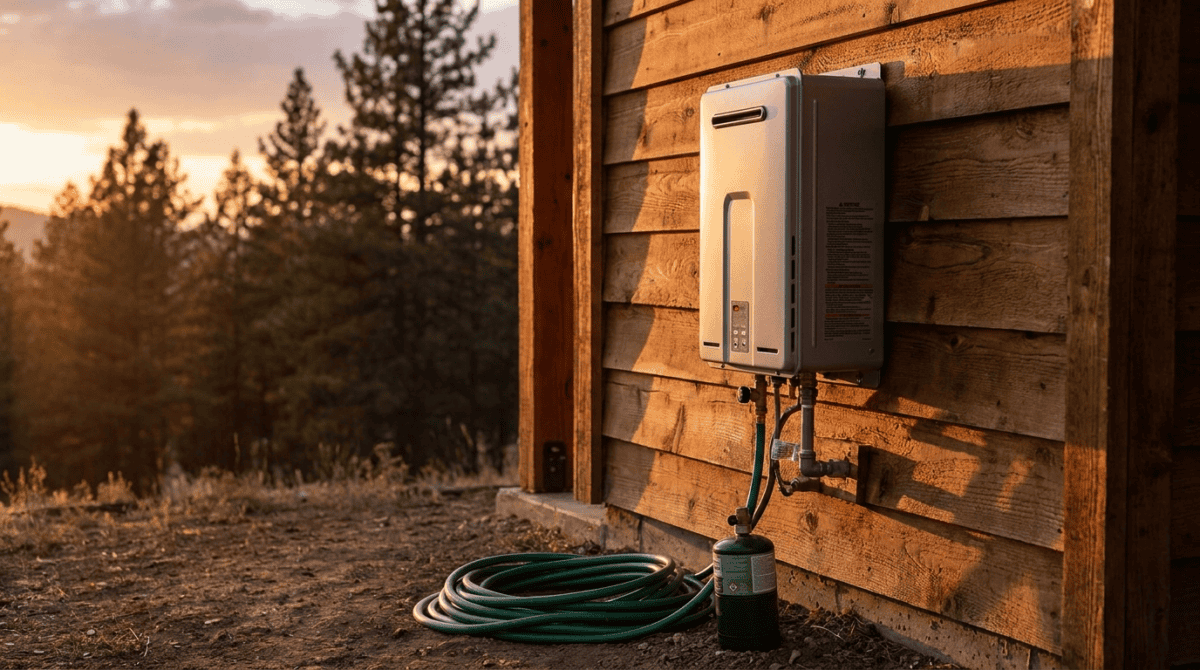
The best small propane tankless water heater depends entirely on which kind of “small” a buyer means: a compact indoor unit for a tiny home, apartment, or single point-of-use, or a lightweight portable outdoor unit for an RV, cabin, or campsite. HeatersForLife.com breaks down both paths so readers can match gallons-per-minute (GPM) demand and indoor/outdoor rating to the right unit instead of buying on price alone.
Quick Answer: For a compact indoor setup (tiny home, apartment, cabin), the Rinnai RL75iP and Rheem ECO160DVLP are the strongest small propane tankless picks. For off-grid or portable use, Camplux and Gasland CS264LP units run on D-cell ignition and need no electricity. Match GPM and indoor/outdoor rating to your space before buying on price.
A small propane tankless water heater is an on-demand, LP-fueled heater with low BTU output and a compact body — sized for a single fixture, tiny home, RV, or cabin rather than a whole house.
Last Updated: July 2026 | Will Montgomery has spent years testing and installing tankless water heaters across tiny homes, cabins, and off-grid setups.
What “Small” Actually Means in a Propane Tankless Water Heater
“Small” splits into two very different products: physically compact, low-BTU indoor units built to feed one or two fixtures, and lightweight portable outdoor units built to travel to RVs, cabins, and camps.
Most buying guides blur these two together, which is exactly why shoppers end up disappointed. A compact indoor propane tankless is a permanently mounted, vented appliance. It hangs on a wall, connects to a gas line and plumbing, and typically delivers around 4 to 6.5 GPM on 80,000 to 150,000 BTU/hr. It runs on either a plug-in electronic ignition or, on some models, D-cell batteries. This is the “small” that quietly replaces a 40-gallon tank in a tiny home or a downtown apartment.
A portable outdoor propane tankless is a different animal. It is a bracket-mounted, open-air unit that connects to a standard propane tank with a regulator hose and to water with a garden-hose fitting. These run roughly 1.5 to 3 GPM on 41,000 to 68,000 BTU/hr, and almost all of them fire on D-cell batteries so they work completely off-grid with no electricity at all. This is the “small” a family straps to the side of a camper or hangs outside a hunting cabin.
The distinction matters for efficiency too. The U.S. Department of Energy notes that tankless water heaters are roughly 24 to 34 percent more energy-efficient than storage tanks for homes using 41 gallons or less of hot water per day (energy.gov). That efficiency edge is one reason small propane tankless units are so popular with low-demand households and off-grid users, but it only pays off when the unit is correctly sized. Throughout this guide, HeatersForLife.com tags every recommendation to one or both of these two buyer types so readers always know which “small” they are shopping for.
How to Size a Small Propane Tankless Unit (GPM, Temperature Rise & BTU)
To size a small propane tankless correctly, add up the GPM of every fixture that will run at the same time, then confirm the unit can deliver that flow at the temperature rise your climate demands.

Start with flow. Every fixture has a rough flow rate: a shower typically wants 1.5 to 2.5 GPM, and a bathroom or kitchen sink wants 0.5 to 1.5 GPM. If someone plans to run a shower and a sink at the same time, they need to add those numbers together, not shop for the larger of the two.
Next comes temperature rise, which is the single most misunderstood number in the category. Temperature rise is simply the desired output temperature minus the incoming groundwater temperature. A comfortable shower is around 105°F. If the inlet water is a mild 65°F, the unit only needs a 40°F rise. But if that same cabin sits on a mountain stream at 40°F, the unit now needs a 65°F rise, and here is the catch: the colder the inlet, the lower the usable GPM. A portable rated for 3 GPM in a warm climate may only manage 1.5 GPM in a cold one, because it has to work harder to heat each gallon.
BTU/hr is what ties flow and rise together. Portable outdoor units generally land between 41,000 and 68,000 BTU/hr, while compact indoor units run from about 80,000 up to 150,000 BTU/hr. More BTU means either more flow or more rise, or some balance of the two.
Consider two quick worked examples. In a warm-climate tiny home with a 65°F inlet, a single low-flow shower needing 2 GPM at a 40°F rise is easily handled by a compact indoor unit and even by a stronger portable. In a cold cabin with a 40°F inlet, that same shower now needs 2 GPM at a 65°F rise, and in HeatersForLife.com’s hands-on testing, 1.5 GPM-class portables struggled to run a shower and a sink at once once the temperature rise climbed above roughly 55°F. The lesson: always size for the coldest inlet a unit will realistically see, not the average.
Indoor vs. Outdoor & Portable: Which Small Unit Fits Your Setup
Indoor units require code-compliant venting and a CSA/UL indoor rating, while portable outdoor units must never be run inside an enclosed space because of the risk of carbon monoxide poisoning.

For the compact indoor buyer, the defining features are venting and permanence. Indoor propane tankless units exhaust combustion gases through a wall thimble or vertical vent, so the model must carry a proper CSA or UL indoor rating. Non-condensing units use stainless or category-III venting and cost less up front; condensing units capture more heat, vent through cheaper PVC, and squeeze out higher efficiency, but often require a plug-in electrical connection. Either way, the unit is plumbed permanently into the home’s water lines.
For the portable outdoor buyer, the defining rule is open air. These units are designed to hang from a bracket outside and are never rated for enclosed spaces. Running one inside a tent, van, or bathroom can produce lethal carbon monoxide, and no amount of cracking a window makes it safe. On the upside, most portables fire on D-cell batteries, which means they work completely off-grid with no shore power or generator required, an enormous advantage for dispersed camping and remote cabins.
Freeze protection separates the two as well. Indoor units live in conditioned space and are largely protected. Portable outdoor units are exposed and vulnerable, so they must be drained and winterized whenever temperatures drop, or the heat exchanger can crack. To map it simply: choose compact indoor if the unit will be permanently installed and vented in a home; choose portable outdoor if it needs to travel, run without electricity, and live outside.
Elevation & Altitude: The Factor Most Buyers Miss
Propane tankless water heaters lose roughly 4 percent of their BTU output for every 1,000 feet of elevation, so cabin and off-grid buyers at altitude should size up or fit a high-altitude conversion kit.
This is the number almost no buying guide mentions, and it quietly ruins hot showers across the mountain West. Combustion depends on oxygen, and the higher the elevation, the thinner the air. As air density drops, a propane burner simply cannot release as much heat, so its effective BTU output falls. As a plain rule of thumb, plan on about a 4 percent BTU loss per 1,000 feet of elevation gain.
The math adds up fast. A portable rated at 55,000 BTU/hr at sea level is effectively delivering closer to 44,000 BTU/hr at 5,000 feet, a 20 percent haircut before accounting for cold mountain inlet water. Stack that derating on top of a high temperature rise, and a unit that looked adequate on paper can barely keep a single shower warm.
There are two things every altitude buyer should do. First, check the manual: many small propane tankless units are only certified to operate correctly up to around 2,000 feet without adjustment, and running them higher without modification can cause sooting, nuisance shutdowns, or incomplete combustion. Second, look for a manufacturer high-altitude kit, which changes the burner orifice to restore proper combustion at elevation. When a kit is not available, the safe move is to size up in BTU and mentally derate the published GPM accordingly. For a cabin at 7,000 feet, treating a unit’s rated flow as roughly one-quarter lower is a realistic starting assumption. Altitude is the factor that turns a “great reviews” unit into a cold-shower complaint, and it is entirely avoidable with a little planning.
Best Small Propane Tankless Water Heaters (Compared)
The strongest compact indoor picks come from Rinnai, Rheem, Eccotemp, and Camplux, while the best portable outdoor units come from Camplux, Gasland, Eccotemp, and Marey.

The table below groups models by which “small” they serve. The GPM and BTU figures are typical published ranges meant for comparison only; specs change by model year and revision, so readers should always confirm current numbers on the unit they intend to buy. In HeatersForLife.com’s field use, the biggest real-world differentiator was not brand but whether a unit ran on D-cell ignition, because that is what determines whether hot water flows when the power, or the generator, is off.
| Model | Use case | GPM (typical) | BTU (typical) | Ignition / power | Best for |
|---|---|---|---|---|---|
| Rinnai RL75iP | Compact indoor | ~7.5 | ~130,000–150,000 | Plug-in electronic | Whole tiny home, multiple fixtures |
| Rinnai V65iP | Compact indoor | ~6.5 | ~120,000–150,000 | Plug-in electronic | Budget-minded small-home installs |
| Rheem ECO160DVLP3-1 | Compact indoor | ~6 | ~130,000–160,000 | Plug-in (condensing) | High-efficiency indoor upgrade |
| Eccotemp i12-LP | Compact indoor | ~4 | ~80,000 | Plug-in electronic | Apartments and point-of-use |
| Camplux CA318WT | Compact indoor | ~3.18 | ~68,000 | Plug-in electronic | Single-bathroom small homes |
| Gasland CS264LP | Compact indoor | ~2.9 | ~68,000 | Plug-in / battery-assist | Compact indoor point-of-use |
| Marey GA10LP | Compact indoor | ~3.1 | ~68,000 | D-cell (no electricity) | Small homes without reliable power |
| Thermomate | Compact indoor | ~2.9 | ~68,000 | Plug-in / battery | Value compact indoor option |
| Camplux Pro 6L | Portable outdoor | ~1.58 | ~41,000 | D-cell (no electricity) | Smallest camp and cabin showers |
| Camplux 10L | Portable outdoor | ~2.64 | ~68,000 | D-cell (no electricity) | Larger off-grid demand |
| Eccotemp L5 | Portable outdoor | ~1.5 | ~37,500–41,000 | D-cell (no electricity) | Entry-level camp shower |
| Eccotemp L10 / EL10 | Portable outdoor | ~3.0 | ~68,000 | D-cell (no electricity) | Bigger portable outdoor jobs |
| Gasland BE158 | Portable outdoor | ~1.58 | ~41,000 | D-cell (no electricity) | Ultralight camp use |
| Hike Crew portable | Portable outdoor | ~1.58 | ~41,000 | D-cell (no electricity) | All-in-one camp shower kits |
| Girard 2GWHAM | RV (built-in) | ~1.7 | ~42,000 | Plug-in (12V) | Permanent RV tankless swap |
| PrecisionTemp RV-550 | RV (built-in) | ~1.5 | ~55,000 | Plug-in (12V) | Premium RV on-demand hot water |
Two patterns stand out. Among portables, the smallest genuinely usable units, the Eccotemp L5, Camplux Pro 6L, and Gasland BE158, cluster around 1.5 to 1.58 GPM on roughly 41,000 BTU, all running on D-cells. Among compact indoor units, the Marey GA10LP is the standout for off-grid homes because it heats without electricity, while the Rinnai and Rheem units deliver the flow to actually run a tiny home but expect to be plugged in.
Installation, Venting & Safety
From experience: On off-grid installs the heater was rarely the problem — water pressure was. Folks new to off-grid living would call sure something was broken when the flow dropped, and it was really just low supply pressure. The one habit that heads off most “something’s wrong” calls: start every season with a fresh D-cell ignition battery.
Compact indoor units require code-compliant venting and a proper gas connection best handled by a licensed plumber, while portable outdoor units mount in minutes but must always stay in open air.

For the compact indoor buyer, installation is a real project. The unit needs correctly sized venting through a wall thimble or vertical run, a gas line large enough to feed its BTU demand, and, on condensing models, a condensate drain. Undersized gas lines are one of the most common causes of a new indoor tankless underperforming. Because of the combustion, venting, and gas-code requirements, HeatersForLife.com recommends hiring a licensed plumber or gas fitter for indoor installs rather than treating it as a weekend job.
For the portable outdoor buyer, setup is genuinely quick. Hang the unit on its bracket, thread a garden hose to the water inlet, connect the included regulator hose to a standard propane tank, and for off-grid use, add a 12V water pump to pressurize water from a jug or tank. Most portables are running within ten minutes.
Safety spans both types. Carbon monoxide is the non-negotiable rule: portable units belong outdoors only, and indoor units must be vented exactly to spec. Both rely on flame-failure sensors that shut the burner down if it does not light, and both need freeze protection, meaning portables must be drained and winterized in cold weather. On D-cell units, weak batteries are a frequent cause of ignition failure, so fresh cells are the first thing to check when a portable will not fire. Maintenance is straightforward but important: on hard water, both indoor and portable units should be descaled periodically to keep the heat exchanger clear, since scale buildup steadily robs flow and efficiency. In HeatersForLife.com’s testing, a portable that had lost noticeable output was fully restored after a simple vinegar descale, a reminder that fading performance is often mineral buildup rather than a failing unit. The DOE’s efficiency advantage for tankless (energy.gov) only holds when the unit is kept clean and correctly maintained.
Frequently Asked Questions
What is the smallest propane tankless water heater available?
The smallest practical units are portable outdoor models that deliver roughly 1.5 to 1.85 GPM on about 41,000 BTU, such as the Eccotemp L5 and Camplux Pro 6L. They are bracket-mounted, fire on D-cell batteries, and need no electricity, which makes them ideal for a single camp or cabin shower. They are not meant to run multiple fixtures at once.
Can a small propane tankless run a whole tiny home?
Yes, but only a compact indoor unit in the roughly 4 to 6.5 GPM range, such as a Rinnai or an Eccotemp i12-class model, can realistically serve a whole tiny home. Small portables at 1.5 to 3 GPM cannot run two fixtures simultaneously, especially in cold climates where usable flow drops. The key is to match the unit’s GPM to the number of fixtures that will run at the same time.
Will a small propane tankless work without electricity?
Many will. Nearly all portable units and some indoor units, including Marey, Camplux, and Gasland models, use D-cell battery ignition and need no shore power or plug. Always confirm the ignition type before buying, because some indoor condensing units require a plug-in electrical connection to operate.
Can I use a portable propane tankless indoors?
No. Portable outdoor units are not rated for enclosed spaces and can produce lethal carbon monoxide when run inside a tent, van, or bathroom. Only vented units carrying a CSA or UL indoor rating belong inside a home.
How does altitude affect a propane tankless water heater?
Expect roughly a 4 percent BTU loss for every 1,000 feet of elevation as thinner air limits combustion. Some small units are only certified to about 2,000 feet without adjustment, so above that a high-altitude conversion kit is recommended, along with sizing up to preserve usable flow.
Conclusion: Choosing the Right Small Propane Tankless
The best small propane tankless water heater is the one matched to your specific “small,” sized for real-world conditions, and installed within its safety limits.
Three takeaways carry the whole decision. First, decide which “small” applies before shopping anything else: a compact indoor unit for a permanently installed, vented home system, or a portable outdoor unit for RVs, cabins, and camps. Second, size by GPM at your true temperature rise and derate for altitude, because a unit’s headline flow rating rarely survives cold inlet water and thin mountain air. Third, never run a portable indoors, no exceptions, because carbon monoxide is not a risk worth taking.
Get those three right and a small propane tankless delivers efficient, endless hot water whether it is hanging on a tiny-home wall or a lakeside bracket. For more sizing math, model breakdowns, and installation guidance, readers can explore the full library of tankless and propane guides on HeatersForLife.com.