

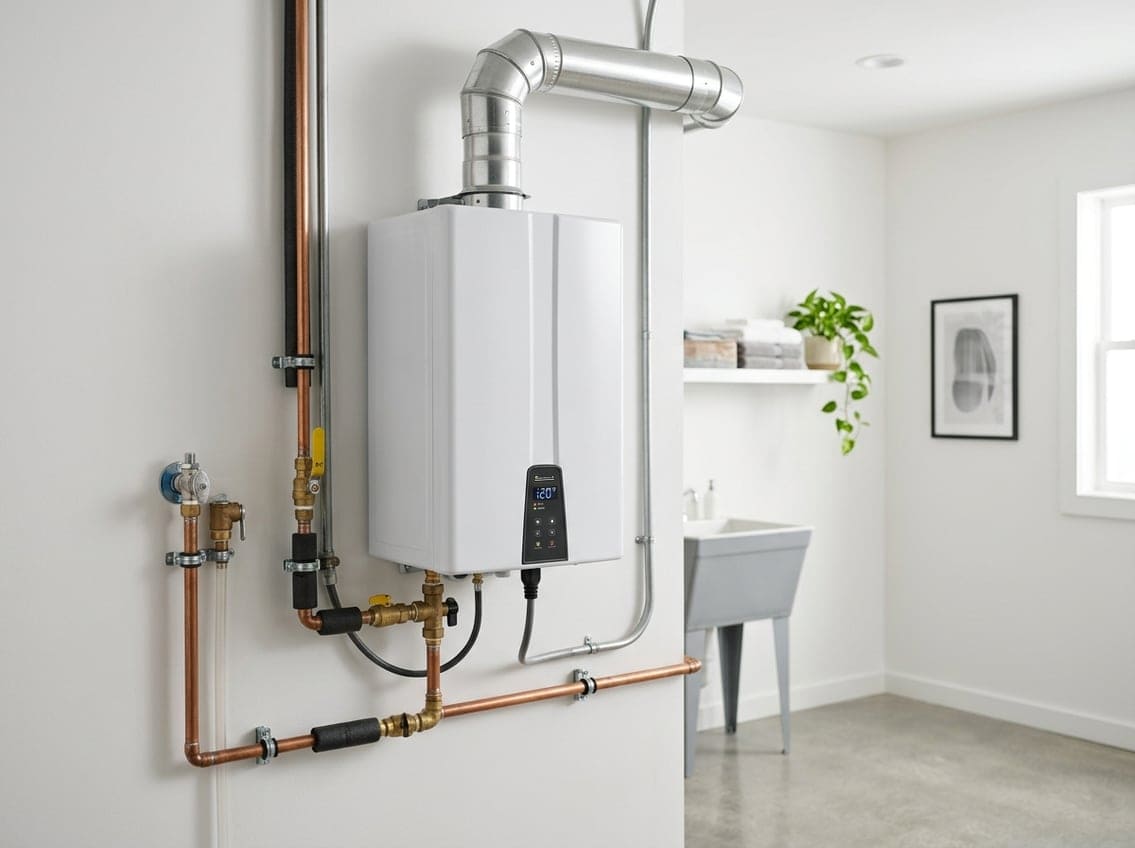
Indoor tankless water heaters give you hot water on demand without taking up floor space like traditional tank models. These compact units mount on walls and heat water only when you need it, which can cut energy costs while providing an endless supply of hot water for showers, dishes, and laundry.
Last Updated: June 2026 | Will Montgomery is a mechanical engineer who has evaluated dozens of tankless water heater installations across residential and commercial applications. His hands-on experience with gas and electric systems informs every recommendation on this page.
The best indoor tankless water heaters for 2026 include models from Rheem, Stiebel Eltron, and EcoSmart, with options in both gas and electric that can serve single fixtures or entire homes depending on their flow rate capacity. Gas models typically deliver higher flow rates of 7 gallons per minute or more, making them suitable for larger households with multiple bathrooms. Electric units work well for smaller homes or point-of-use applications near individual sinks and showers.
Choosing the right indoor tankless water heater depends on your household size, hot water needs, and available utilities. Flow rate determines how many fixtures can run at once, while power source affects both installation requirements and operating costs. This guide covers the top-rated tankless water heater models, sizing guidelines, installation considerations, and long-term savings to help homeowners make an informed decision.
Key Takeaways
- Indoor tankless water heaters heat water on demand and mount on walls to save floor space compared to traditional tank models
- Gas-powered units provide higher flow rates for whole-home use while electric models work better for smaller applications or single fixtures
- Proper sizing based on simultaneous hot water demand and professional installation ensure optimal performance and energy savings
Key Benefits of Going Tankless Indoors

Indoor tankless water heaters deliver hot water instantly while using less energy than traditional tank models. These compact units last longer and require less maintenance, making them a practical choice for homeowners who want reliable performance without sacrificing space.
On-Demand Hot Water and Efficiency
Tankless water heaters heat water on demand rather than storing it in a tank. When someone turns on a hot water faucet, cold water flows through the unit’s heat exchanger where either a gas burner or electric element heats it instantly.
This approach eliminates standby heat loss, which occurs when traditional tank heaters constantly reheat stored water. The result is lower energy consumption and reduced utility bills over time.
Indoor tankless models can maintain a steady flow of hot water for multiple fixtures. A household will never run out of hot water during back-to-back showers or while running the dishwasher and washing machine simultaneously. The system heats water continuously as long as there is demand.
Energy efficiency ratings for these units are measured by their uniform energy factor (UEF). A higher UEF indicates better efficiency and lower operating costs. Most indoor tankless heaters achieve UEF ratings between 0.87 and 0.99, significantly outperforming traditional tank heaters.
Space Saving and Modern Aesthetics
An indoor tankless water heater takes up minimal space compared to bulky tank models. Traditional water heaters typically require 16 square feet of floor space, while tankless units mount on walls and measure roughly the size of a small suitcase.
This compact design frees up valuable square footage in utility rooms, basements, or closets. Homeowners can reclaim this space for storage or other purposes.
The sleek appearance of modern tankless units fits well with contemporary home designs. Many models feature clean lines and neutral finishes that blend into their surroundings rather than dominating the space.
Installation flexibility is another advantage. These units can be mounted in various locations throughout the home, including bathrooms, laundry rooms, or mechanical closets. This placement flexibility allows for shorter pipe runs to fixtures, which reduces heat loss and delivers hot water faster.
Longevity and Maintenance Advantages
Indoor tankless water heaters typically last 20 years or more with proper maintenance. Traditional tank heaters usually need replacement after 10 to 15 years. This extended lifespan means homeowners replace their water heating system less frequently.
The maintenance requirements for indoor units are straightforward. Annual descaling prevents mineral buildup in the heat exchanger, especially in areas with hard water. This process involves flushing the system with a cleaning solution, which takes about an hour.
Indoor installation protects the unit from weather-related wear and temperature extremes. These protected conditions reduce stress on components and extend equipment life. Indoor units don’t face the corrosion risks that outdoor models encounter from rain, snow, and humidity.
Most manufacturers offer warranties ranging from 10 to 15 years on heat exchangers and 5 years on parts. These warranties reflect the reliability and durability built into indoor tankless systems.
How Indoor Tankless Water Heaters Work

Indoor tankless water heaters activate when you open a hot water tap, heating water instantly as it flows through the unit. The system uses either gas burners or electric elements to raise the water temperature in seconds, eliminating the need for a storage tank.
Heating Elements and Heat Exchangers
Gas-powered indoor tankless heaters use burners that produce between 120,000 and 200,000 BTU of heating power. When water flows through the unit, the burner ignites and heats a metal heat exchanger. Cold water passes through this heat exchanger, absorbing thermal energy before exiting to your faucet.
Electric indoor tankless heaters work differently. They use heating elements that range from 15,000 to 36,000 watts of power. These elements activate in stages based on demand. Running a single faucet might turn on one element, while a shower and dishwasher running together activate multiple elements.
The heat exchanger is the core component that transfers energy to the water. Gas models typically use copper or stainless steel exchangers designed to withstand high temperatures. Electric units have elements that directly contact the water, which speeds up the heating process.
Flow Rate and Temperature Rise Explained
Flow rate measures how many gallons per minute (GPM) a tankless water heater can heat. A typical shower uses about 2.5 GPM, while a dishwasher uses 1.5 GPM. Your indoor tankless heater must handle all fixtures running at the same time during peak usage.
Temperature rise is the difference between incoming cold water and your desired hot water temperature. Groundwater entering your home might be 40°F in winter or 70°F in summer. To reach 120°F output, a unit needs to provide an 80°F rise in winter or a 50°F rise in summer.
Colder climates require higher BTU capacity to achieve the same flow rate. A unit that delivers 5 GPM in Arizona might only produce 3 GPM in Minnesota due to colder groundwater temperatures. This affects which size indoor tankless heater you need for your home.
Differences From Traditional Tank Models
Traditional tank water heaters store 40 to 80 gallons of pre-heated water. They constantly maintain water temperature even when you’re not using hot water, which wastes energy. Once the tank empties, you must wait 30 to 60 minutes for it to refill and reheat.
Indoor tankless water heaters heat water on demand, activating only when a faucet opens. A flow sensor detects water movement and signals the heating system to start. When you close the tap, the unit shuts off completely. This eliminates standby energy loss.
Tank models take up significant floor space, usually requiring a dedicated closet or utility room corner. An indoor tankless heater mounts on a wall and measures roughly the size of a suitcase. This compact design frees up valuable square footage in your home.
Types of Indoor Tankless Water Heaters

Indoor tankless water heaters come in two main power types that affect their performance and installation requirements. Electric models connect to your home’s electrical system, while gas units run on natural gas or propane and require proper venting.
Electric Tankless Water Heaters
Electric tankless water heaters heat water using electrical resistance elements as water flows through the unit. These models don’t need venting since they produce no combustion gases.
An electric tankless water heater typically delivers between 1.5 to 4.3 gallons per minute (GPM). They work well for smaller homes, apartments, or single-fixture applications like bathroom sinks.
Most electric models require significant electrical capacity. Some units need a dedicated 40-amp circuit breaker and may require electrical panel upgrades in older homes.
Installation costs tend to be lower than gas models since no venting or gas lines are needed. The compact size allows for flexible placement near the point of use, which reduces heat loss in pipes.
Gas Tankless Water Heaters
Gas tankless water heaters burn natural gas or propane to heat water through a heat exchanger. These units deliver higher flow rates than electric models, typically between 3.6 to 7 GPM or more.
A gas tankless water heater can supply multiple fixtures at the same time. This makes them suitable for larger households with simultaneous hot water demands from showers, dishwashers, and washing machines.
Gas units require proper venting to remove combustion gases safely. They need either direct vent systems or power vent systems that route exhaust outside through walls or roofs.
Professional installation is necessary to connect gas lines and install proper venting systems. Gas models also need annual maintenance to keep burners and heat exchangers working efficiently.
Pros and Cons by Fuel Type
Electric Models:
- Lower upfront costs ($100-$600)
- No venting required
- Easier installation
- Lower flow rates (1.5-4.3 GPM)
- May require electrical upgrades
Gas Models:
- Higher flow rates (3.6-7 GPM)
- Can serve whole home
- Higher upfront costs ($600-$1,000+)
- Requires venting system
- Needs professional installation
The choice between fuel types depends on household size and hot water demand. Single-person homes or apartments often do well with electric models, while families needing multiple simultaneous hot water sources benefit from gas units.
Top Picks and Brands for 2026

The Rinnai RU199iN leads as the most reliable condensing gas unit for standard homes, while the Rheem RTEX-18 offers exceptional value for warm climates. Large households benefit from the Navien NPE-240A2’s superior flow rate and built-in features.
Best Overall Indoor Tankless Models
The Rinnai RU199iN stands out as the top indoor tankless water heater for most homes in 2026. This gas tankless water heater delivers 11 GPM with a 0.96 UEF rating, handling 3-4 bathroom homes without issue. The condensing heat exchanger captures exhaust heat that standard units waste, saving $100-$150 annually on gas costs.
The unit requires PVC or CPVC venting, which costs less than the stainless steel needed for non-condensing models. It produces condensate that needs a drain line. Installation takes 4-6 hours on a direct swap from an existing gas tank.
Key advantages include:
- Proven reliability across thousands of installations
- Nationwide parts availability at local supply houses
- 12-year heat exchanger warranty
- Support for recirculation systems with external pump
The base model lacks a built-in recirculation pump, which adds $300-$600 if instant hot water at distant fixtures is needed. The 199,000 BTU max output handles moderate climates effectively.
Best Value and Budget-Friendly Choices
The Rheem RTEX-18 electric tankless water heater offers the best value for warm climate installations. This 18 kW unit costs $400-$500 and delivers 3.5 GPM at a 35-degree temperature rise. The 0.99 UEF rating provides near-perfect electrical efficiency.
This indoor tankless heater works well in Florida, Texas, or Southern California where ground water runs 65-70 degrees. Cold climates see reduced performance, dropping below 2 GPM at a 70-degree temperature rise. Installation requires 200-amp service with two open 40-amp double-pole breakers.
The unit installs in 2-3 hours with no venting, combustion, or condensate drain required. It fits in utility closets where gas units cannot go. Ongoing maintenance costs stay minimal compared to gas models.
The EcoSmart ECO 27 provides another strong electric option at $350-$450 for all-electric homes, though it requires three 40-amp breakers and more electrical headroom.
Premium and High-Capacity Recommendations
The Navien NPE-240A2 delivers the highest capacity for large homes with 4+ bathrooms. This gas tankless water heater produces 11.2 GPM at 0.97 UEF, outperforming competitors on both flow and efficiency. The unit includes a 0.8-gallon buffer tank and built-in recirculation pump as standard equipment.
The integrated buffer tank eliminates cold-water sandwich issues without external components. Everything needed for instant hot water at every fixture comes in the box. The 199,900 BTU max output handles significant simultaneous demand.
Service coverage is stronger in metro areas than rural locations. The 15-year heat exchanger warranty exceeds most competitors. Smart app controls allow remote monitoring and adjustment.
The Rinnai RSC199iN serves cold climate homes needing maximum performance, offering 11 GPM with built-in recirculation for $1,100-$1,400. This indoor tankless heater handles incoming ground water at 40-50 degrees while maintaining 2 simultaneous showers.
Sizing and Selecting the Right Model
From experience: We run a natural gas tankless on our home’s boiler — the endless hot water is real, but so is the wait for warm water at the tap. If you’re renovating a bathroom, a small point-of-use electric tankless that activates until the incoming water reaches temperature can solve that last-leg delay without replacing your whole setup.

Choosing the right indoor tankless water heater requires calculating your home’s hot water demand and matching it to a unit’s flow rate capacity. Temperature rise, simultaneous fixture use, and available installation space all play critical roles in selecting a model that performs efficiently.
Determining Household Hot Water Needs
The number of people in a home and their daily routines determine hot water requirements. A household of one or two people typically needs less capacity than a family of four or more who may run multiple fixtures simultaneously.
Start by listing all water-using fixtures and appliances. Showers, dishwashers, washing machines, and bathroom sinks each draw hot water at different rates. Morning routines often create peak demand when several people shower while the dishwasher or washing machine runs.
The best tankless water heater models range from compact units serving single bathrooms to whole-house systems handling six or more fixtures at once. A single person in an apartment might only need a 3 GPM unit, while a busy family household requires 7-10 GPM capacity.
Calculating Flow Rate and GPM Requirements
Flow rate measures how many gallons per minute a tankless water heater can deliver at a specific temperature. Each fixture has a standard flow rate: showers use 2.0-2.5 GPM, bathroom faucets use 0.5-1.5 GPM, and dishwashers use 1.0-1.5 GPM.
Add up the GPM of all fixtures that might run simultaneously during peak usage times. If two showers (5 GPM total) and a kitchen sink (1.5 GPM) could run together, the minimum required flow rate is 6.5 GPM.
Temperature rise matters too. Sizing tankless water heaters depends on the difference between incoming groundwater temperature and desired output temperature. Cold climates with 40°F groundwater need more heating power than warm regions with 70°F inlet temperatures.
Climate and Installation Space Considerations
Groundwater temperature varies significantly by region and season. Northern states often have inlet temperatures around 40-50°F, while southern areas see 60-70°F or higher. This difference directly affects the heating capacity needed from an indoor tankless heater.
A unit that delivers 7 GPM in Florida might only produce 4 GPM in Minnesota due to the larger temperature rise required. Always check manufacturer specifications for your climate zone.
Indoor installation requires adequate ventilation for gas models and sufficient electrical capacity for electric units. Wall-mounted designs save floor space but need proper clearances from combustible materials. Gas models need venting systems that handle exhaust temperatures, while electric units require dedicated circuits with appropriate amperage.
Installation, Safety, and Maintenance Essentials

Indoor tankless water heaters require specific installation requirements and ongoing care to work safely and efficiently. Gas models need proper venting and adequate gas supply, while electric units may require electrical system upgrades.
Ventilation and Gas Line Requirements
Gas tankless water heaters must have proper venting to safely remove combustion gases from the home. Most indoor models use direct vent or power vent systems with stainless steel or approved PVC pipe. The vent must maintain proper clearance from windows, doors, and air intakes.
Gas line sizing is critical for performance. Many tankless units require higher BTU input than traditional tank heaters, which means the existing gas line may be too small. A professional should verify the gas line diameter, pressure, and total BTU load before installation.
Key venting requirements include:
- Using only manufacturer-approved vent materials
- Keeping vent runs within maximum allowed length
- Following required slope for condensate drainage
- Maintaining proper clearance from building openings
- Directing exhaust gases safely outdoors
Natural gas models work best in homes with existing gas service, while propane units offer flexibility in rural areas without natural gas access.
Electrical Considerations and Upgrades
Electric tankless water heaters typically require significant electrical upgrades. Most whole-house electric models need 100 to 150 amps of dedicated power, which exceeds what many older homes can provide. A licensed electrician must evaluate the main electrical panel capacity before installation.
Gas models also need electricity for ignition, controls, and fan-assisted venting. These units usually require a standard 120-volt outlet near the installation location.
Common electrical requirements:
- Dedicated circuit breakers
- Proper wire gauge for amperage
- GFCI protection in wet locations
- Grounded outlets
- Surge protection for sensitive electronics
Homeowners should budget for panel upgrades or subpanel installation if their electrical system cannot handle the load. Professional installation helps ensure code compliance and safe operation.
Routine Care and Descaling Tips
Regular maintenance protects performance and extends service life. The most important task is flushing the heat exchanger to remove mineral buildup. Hard water areas require annual descaling with white vinegar or a commercial descaling solution.
Essential maintenance tasks:
- Clean the inlet water filter every 3-6 months
- Flush the heat exchanger annually
- Inspect venting for blockage or damage
- Check for water or gas leaks
- Monitor error codes and address issues promptly
Service valves make flushing easier by allowing homeowners to circulate descaling solution through the unit without disconnecting plumbing lines. A small recirculating pump and two hoses are needed for the flushing process.
Electric models require less maintenance than gas units but still benefit from regular filter cleaning and periodic flushing. Keeping the area around any indoor tankless heater clear ensures proper airflow and easy access for service work.
Cost, Rebates, and Long-Term Savings
Indoor tankless water heaters require a larger upfront investment than traditional tank models, but installation costs range from $2,800 to $6,400 depending on fuel type and existing infrastructure. Energy savings of 24-34% and available tax credits help offset these initial expenses over time.
Upfront and Installation Expenses
The unit itself costs between $200 and $3,200 depending on size and fuel type. Budget electric models start around $200-$600, while premium gas units reach $2,000-$3,200.
Installation labor adds $700-$2,500 for electric tankless water heaters and $1,500-$4,500 for gas models. The wide range reflects complexity differences. Simple replacements cost less than fuel-type conversions or installations requiring infrastructure upgrades.
Additional expenses often surprise homeowners. Electric units may need electrical panel upgrades ($1,500-$3,000) or dedicated circuits ($300-$800). Gas indoor tankless heaters require proper venting systems ($300-$1,200) and potentially gas line upgrades ($500-$2,000). Permits and inspections add another $50-$500 in most areas.
Operating Costs and Utility Savings
Monthly energy expenses depend on fuel type and household usage. A typical four-person household spends roughly $370 annually on gas or $580 annually on electricity to operate an indoor tankless heater.
Gas models typically cost less to operate than electric versions in most regions. The 20-year ownership cost for gas tankless water heaters totals around $13,599 compared to $16,898 for electric units when factoring in energy rates and maintenance.
Break-even periods vary. Gas tankless water heaters reach break-even in 6-10 years when replacing gas tanks. Electric conversions take longer at 8-14 years. High-usage households and rising utility rates accelerate payback timelines.
Potential Tax Credits and Rebates
Federal tax credits offer 30% back on installation costs, up to $600 maximum. Eligible units must meet Energy Factor requirements of 0.95 or higher. Homeowners claim this credit using IRS Form 5695.
State and utility rebates provide additional savings. California residents receive $100-$500, New York offers $250-$750 through NYSERDA, and Massachusetts provides $300-$600 via Mass Save programs. Texas utilities offer $50-$300 depending on the provider.
Combined incentives can reduce total costs by $350-$1,200. These rebates apply to both electric and gas indoor tankless heaters that meet efficiency standards.
Frequently Asked Questions
Electric units work better in warm climates with lower groundwater temperatures, while gas units deliver higher flow rates for larger homes. Most homes with 2-3 bathrooms need 8-10 GPM capacity, and proper venting plus adequate electrical or gas infrastructure are critical for safe indoor installation.
Should I choose an electric or gas unit for an indoor installation?
Gas units deliver higher flow rates and work well in all climates. A typical gas model produces 8-11 GPM, which handles multiple simultaneous fixtures without issue.
Electric units work best in warm climates where incoming water temperature stays above 60°F. In cold climates, electric models struggle to heat water fast enough during winter months.
Gas units cost more upfront, ranging from $900-$1,400 for quality models. Electric units start around $300-$900. However, gas units typically cost less to operate in most regions where natural gas prices stay competitive with electricity rates.
Indoor installation requires proper ventilation for gas units. Electric models need adequate electrical panel capacity but no venting.
What size unit do I need to run two bathrooms at the same time?
Two bathrooms running simultaneously require 8-10 GPM capacity in moderate climates. This accounts for two showers at 2.5 GPM each, plus a sink at 1.5 GPM.
The Rinnai RU180iN delivers 10 GPM, which provides headroom for 2-3 bathrooms with room to spare. In cold climates where groundwater drops below 50°F, flow capacity decreases by 20-30%.
A 9-10 GPM unit handles most 2-3 bathroom homes comfortably. Homes in northern states should add 2 GPM to their baseline calculation to account for colder incoming water temperatures.
Rinnai has operated in North America since 1974 and maintains the deepest service network in the industry. Parts availability and technician familiarity make repairs faster and less expensive.
Navien offers the highest efficiency rating at 0.97 UEF and includes built-in recirculation pumps in premium models. The NPE-240A2 eliminates the cold water sandwich problem that affects other tankless units.
Rinnai units feature proven durability with 12-15 year heat exchanger warranties. The RU199iN provides 11 GPM at 0.96 UEF efficiency for $1,000-$1,300.
Navien’s built-in ComfortFlow buffer tank and recirculation system deliver instant hot water at every tap. This feature matters most in larger homes where fixtures sit far from the heater. Navien includes a 15-year heat exchanger warranty on most models.
What venting requirements apply to indoor gas units, and can I use existing venting?
Condensing gas units require PVC venting at 3-4 inches in diameter. These units exhaust at lower temperatures around 110-130°F, which allows plastic pipes to handle the gases safely.
Non-condensing units need stainless steel or aluminum venting rated for 300-400°F exhaust temperatures. Existing metal flues from old tank heaters often work with non-condensing tankless units.
Condensing models cannot use existing metal flues without modifications. The cooler exhaust causes condensation inside metal vents, leading to corrosion problems. PVC venting systems cost $300-$800 to install depending on the distance to an exterior wall.
Vertical or horizontal venting works for most units. Horizontal venting through an exterior wall costs less than vertical venting through the roof. Most manufacturers allow up to 100 feet of total vent length with proper sizing.
How much electrical capacity or gas line sizing is typically required for a whole-home setup?
Electric whole-house units need 150-200 amp electrical service. A 36 kW unit like the Stiebel Eltron Tempra 36 Plus draws 150 amps at 240 volts.
Most homes built before 2000 have 100-150 amp service. Upgrading to 200 amps costs $1,500-$3,000 depending on local utility requirements and panel distance from the meter.
Gas units require 3/4-inch gas lines for models above 180,000 BTU. Homes with existing 1/2-inch lines need upgrades to deliver adequate fuel volume. A 199,000 BTU unit needs approximately 200 cubic feet per hour at peak demand.
Gas meter capacity must match the heater’s BTU rating plus other gas appliances. A home with a gas furnace at 80,000 BTU and a tankless heater at 199,000 BTU needs 280,000 BTU total capacity. Many older meters max out at 250,000 BTU and require utility upgrades.
What routine maintenance is needed to prevent scale buildup and keep performance consistent?
Annual descaling flushes remove mineral deposits that reduce efficiency and flow rate. Hard water areas with 10+ grains per gallon need descaling every 6-12 months.
Descaling involves pumping white vinegar or commercial descaler through the heat exchanger for 45-60 minutes. This process costs $150-$250 when performed by a technician or $30-$50 for DIY with a pump kit.
Inlet filter screens need cleaning every 3-6 months. These screens catch sediment before it reaches the heat exchanger. Cleaning takes 5 minutes and requires only a bucket and garden hose.
Condensate neutralizer cartridges in condensing units need replacement every 1-2 years. These cartridges cost $30-$60 and neutralize acidic condensate before it enters drainage systems. Air intake filters on sealed combustion units require cleaning twice yearly to maintain proper airflow.