


What Is the Best Commercial Gas Tankless Water Heater?
Quick Pick on Best Commercial Natural Gas Tankless Water Heaters
Benefits of Gas Tankless Water Heaters For Commercial Use
As mentioned earlier, tankless gas water heaters are energy-efficient appliances designed to supply an instant supply of water without compromising their performance. It has been found that these appliances can reduce the cost of energy by 50%. Let’s have a look at the primary benefits of tankless water heating units.Long-Term Cost Energy Savings
These units are energy efficient, meaning that they can help you in saving the cost of energy in the long run. In general, these units are well-design to reduce stand by heat loss that occurs with tank models. Constant heating is needed with the tank model because there is some heat that escapes from the water tank. This unit is designed to heat water on demand, thereby eliminating the need for maintaining a constant supply of water.Requires Less Storage
These appliances are compact, making them a great option for homes with limited storage spaces. In addition to this, they don’t require a storage tank to store hot water. In essence, these units are designed to take less physical space when compared to tank-style units. Most of the tankless water heaters are rectangular. On average, they are around 18 inches wide, 27 inches tall, and 10 inches deep. One can either fit his tankless heater in the closet or mount it on the wall.High-Life expectancy
Most of these units are made of quality materials, thereby increasing their lifespan. The average lifespan of this water heater is 12 years, while that of the tankless unit is more than 20 years. Buying one can help you save money in the long run since you will not be required to buy a new one soon or replace the tank soon.Limitation of Commercial Gas Tankless Water Heaters
High initial cost
A commercial gas heater has a higher installation cost and upfront cost as compared to the tank-style model. These units are expensive because of the high installation costs. For instance, special wires must be installed before mounting a tankless heater. In fact, this is one of the biggest downside associated with these appliances.Takes long to deliver or generate hot water
Findings show that it takes a considerable time for this appliance to deliver and generate hot water because it does not have a constant supply of water like the tank-style model. The time taken to deliver the hot water depends on the distance between the tap and the heating unit.Inconsistent Water Temperature, especially where multiple units are used
This appliance might not keep up with the high demand for hot water when everyone wants to take a shower at the same time. Again, some issues might arise when someone runs the dishwasher and the shower at the same time. For this reason, it is important to consider the unit’s flow rate before making the final purchasing decision.5 Things You Must Know On Picking Commercial Gas Tankless Water Heaters
The current market has different models and types of commercial gas tankless heaters that one can choose from. Ideally, you should look for an appliance that is easy to use and one that meets your water needs and budget. The following are the essential facts that one must put into consideration when looking for a gas tankless water heater:The Power Input of a Heater
These appliances have different power ratings. You should look for a heater that can deliver enough water for your household. In addition to this, you should look for a heater that can effectively deliver hot water. The water supplied or delivered by the heater should be enough to meet your excitations and needs.Flow Rate of Heater
The flow rate of a water heater is the amount of hot water that can be delivered by the appliance within a given time. A heater with a high flow rate will be required to supply instant hot water to your entire home. Knowing the flow rate of an appliance can help you in sizing your tankless water heater.Condensing vs Non-Condensing
Investing in a condensing gas tankless appliance can help you in saving money because it has a low installation cost. Furthermore, this unit is energy-efficient and is known for emitting cool exhaust air. It is, therefore, a suitable alternative to the non-condensing model. Non-condensing models are designed for outdoor placements like mobile homes, camping, and cabins. In addition to these non-condensing models are relatively smaller and cheaper than condensing units.Consider Venting
Venting is another important element of a gas water heater. Both the tank-style and tankless models are known for eliminating hazardous gases. These gasses should be removed or eliminated from the unit. Nearly all the modern tankless gas units come with two various venting options. These include direct and power venting. Ideally, you should look for a unit that can sufficiently get rid of all the hazardous gases like carbon monoxide.Energy Factor
This is another essential thing that can help you in determining the energy efficiency of your heating appliance. One can get more information about the energy factor of an appliance by checking the product’s description.Best Commercial Gas Tankless Water Heater Reviews
1. Best Outdoor Installation – Rinnai V65eN Series High-Efficiency Gas Tankless Water Heater

- Energy efficient-Uses less energy
- Has a compact design
- Low emissions
- Reliable and easy to install


2. Best Indoor Installation – Rinnai V65IN Commercial Gas Tankless Water Heater

- It is a combination of comfort and high efficiency
- It is compact, meaning it requires less storage space
- Easy to install

3. Best For the Whole House – Excel Pro Commercial Gas Tankless Water Heater
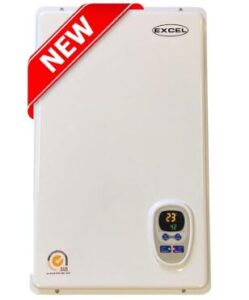
- It has a high flow rate
- It comes with a digital display unit that allows one to set the required water temperature
- It is super compact
- It has a high heating capability
4. Best Efficiency – Rinnai V94iN Indoor Commercial Gas Tankless Water Heater
- Uses less energy
- It is energy-efficient
- It can be installed in limited spaces, thanks to its compact design
5. Best Low Nox – Rinnai RUc9iN Indoor Gas Tankless Heater

- Requires less space
- Energy-efficient
- It has a high heating capacity-199,000 BTU
- Produces ultra-low emissions
6. Best Propane & Natural Gas Powered – Rinnai RL94iN HE+ Indoor Tankless Water Heater

- It uses less energy
- It is reliable and energy-efficient
- It has a compact design for easy installation
7. Best Large Flow Rate – AO Smith ATI-340H-N Commercial Residential Condensing Tankless Water Heater

- Energy efficient
- Comes with in-built safety features
- It has a five-year warranty
How to Use a Commercial Tankless Water Heater?
This appliance consists of a tap, shower, and electric coil or gas-fired burners. You should open the tap whenever you want to heat water. Coldwater will pass through your tankless water unit when the tap is opened. The cold water from the tap then is heated by the gas-fired burner. You should ensure that the system is properly maintained for it to operate efficiently and minimize heat loss.Conclusion
Picking the right commercial gas tankless water heater can save a lot of money and reduce the emission of hazardous gases. One can get the best value for his money by purchasing a water heater that meets the needs of your family and budget. The appliances discussed in this post are energy efficient, reliable, and affordable. Additionally, these units are also easy to install and compact. In general, you should look for an appliance that can effectively deliver and generate hot water for your entire home.Other Types of Heater You Will Need:
- Top 4 Best Commercial Electrical Tankless Water Heater Reviews & Guides
- Top 7 Best Cheapest Propane Tankless Water Heater Reviews
- Top 4 Best 40-Gallon Natural Gas Water Heater Reviews For Large Family Shower Use
Frequently Asked Questions
What makes a tankless water heater suitable for commercial use?
Commercial-grade units are built for continuous operation with higher GPM ratings (5–10+ GPM), durable components, and commercial certifications such as NSF/ANSI. Modulating burners adjust BTU output to match varying demand throughout the day, reducing fuel waste compared to single-stage units.
How many GPM does a commercial tankless heater need?
Calculate your peak simultaneous fixture demand, then add 20–30% as a buffer. A small restaurant may need 4–6 GPM; a hotel laundry facility may require 15–20+ GPM. Undersizing a commercial heater leads to cold water complaints and premature component wear.
How long do commercial gas tankless water heaters last?
With professional installation and regular maintenance, commercial gas tankless heaters typically last 15–20 years. Scale buildup from hard water is the primary cause of premature failure; descaling every 1–2 years is essential in hard water installations.
Can commercial tankless heaters handle simultaneous high demand?
Yes, within a unit’s rated GPM capacity. For very high demands, multiple units are installed in a cascade or parallel configuration. This approach also provides redundancy — if one unit needs service, the others continue to supply hot water.
What certifications should a commercial tankless heater have?
Look for UL listing, CSA approval for gas models, and ASME certification for pressurized vessels. Food service applications typically require NSF/ANSI certification. Always verify with local codes, as additional certifications may be required by jurisdiction.