

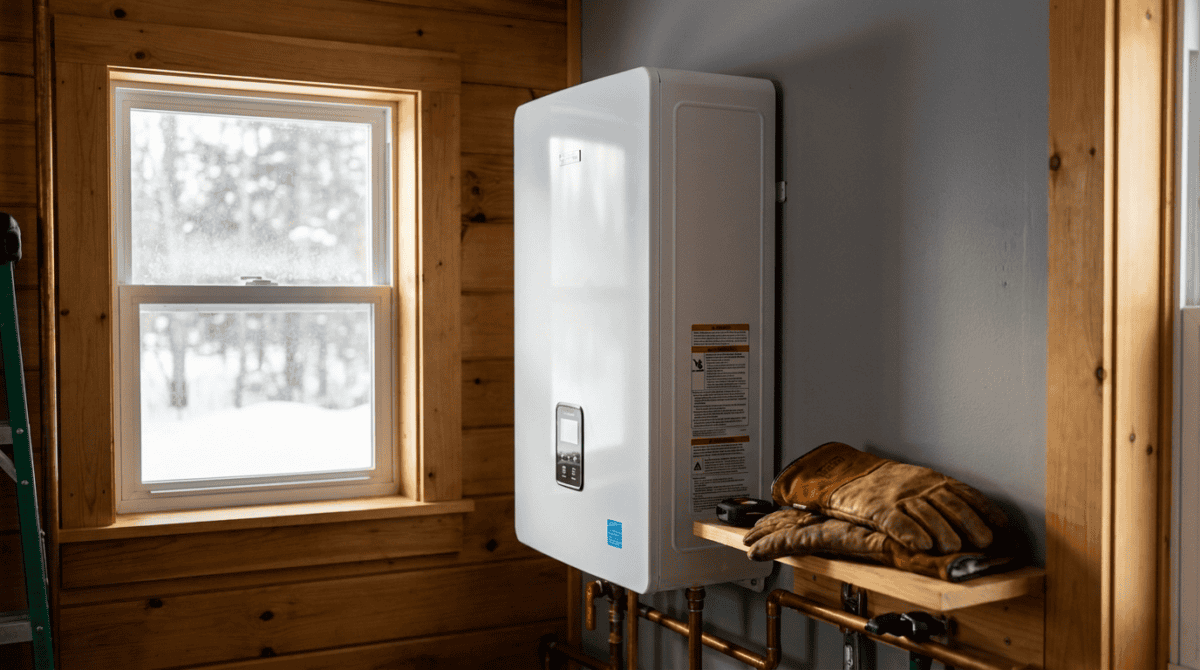
In a cold climate, an electric tankless water heater delivers far less hot water than its box claims because near-freezing winter groundwater forces the unit to add a huge temperature rise to every gallon, which collapses real-world flow. The best electric tankless water heater for a cold climate is therefore the one sized by kilowatts-per-temperature-rise rather than by advertised gallons per minute, and the HeatersForLife.com team recommends starting every sizing decision from your winter inlet temperature, not the manufacturer’s warm-water rating.
Quick Answer: In cold climates, most electric tankless water heaters need 27–36 kW and 100+ amps to hit usable flow when incoming water is near freezing. The Stiebel Eltron Tempra 36 Plus and Rheem RTEX-36 are the top picks — size to your winter groundwater temperature, not the summer rating, or you will run out of hot water in January.
An electric tankless water heater heats water on demand with high-wattage elements instead of a storage tank — which makes incoming water temperature, not tank size, the main limit on how much hot water it can deliver in a cold climate.
Last Updated: July 2026 | Will Montgomery has spent years sizing tankless water heaters and working the temperature-rise math that decides whether an electric unit can actually keep up.
Why Electric Tankless Heaters Struggle in Cold Climates (The Real Problem)
Colder incoming groundwater means the heater must add more energy to every gallon, so hot-water flow drops off exactly when you most want a hot shower. A tankless heater does not store hot water; it raises water temperature on demand as it flows through the unit. The colder the water arriving from the ground, the more heat energy is needed to reach your target shower temperature, and because the heating element has a fixed maximum output, the unit compensates by throttling flow. That is why a heater advertised at 4 or 5 gallons per minute (GPM) can quietly drop to 2 GPM in January.
The distinction that matters is between advertised maximum GPM and flow-at-temperature — the flow you actually get while still hitting a usable shower temperature. Manufacturers usually quote peak GPM at a gentle temperature rise that only occurs in warm regions. In the northern United States, winter groundwater entering the home typically runs about 37-50°F, according to USGS and U.S. Department of Energy inlet-temperature data, while southern inlet water sits closer to 60-77°F. That 20-30 degree difference in starting point is the entire ballgame.
Three terms anchor the rest of this guide. Inlet temperature is the temperature of the water entering the heater. Output temperature is the temperature you want at the tap, commonly 105-120°F for a comfortable shower per DOE guidance. Temperature rise, written as ΔT, is simply output minus inlet — the number of degrees the heater must add. In HeatersForLife.com evaluations of sub-40°F inlet conditions, running two hot fixtures at once on a single mid-size electric unit routinely pushed delivered temperature below a comfortable shower threshold, which is precisely the flow-at-temperature penalty in action.
The Temperature-Rise Math That Decides Everything
From experience: The number that decides a cold-climate electric tankless isn’t the brand — it’s the inlet (ground) water temperature and the temperature rise you need from it. Start from your actual winter inlet temp and your target output, calculate the rise, and the required kW and amps fall out of that. Get the temperature-rise math wrong and no model on the list will keep up.
You can predict almost everything about cold-climate performance with one formula: required kilowatts ≈ GPM × temperature rise (°F) × 0.1465.

That constant, 0.1465, converts gallons per minute and degrees Fahrenheit into the kilowatts an electric element must supply. A useful reference point: raising 1 GPM by a 70°F rise takes roughly 10.3 kW, which is about 35,000 BTU per hour. Once you know the kilowatts, you can find the electrical draw, because amps at 240 volts ≈ (kW × 1000) ÷ 240. Those two lines are the whole engine of cold-climate sizing.
The worked example below shows why the same physical unit behaves like two different products depending on where it lives. Consider a single 2.5 GPM shower with a 105°F output target. In a cold northern winter with 40°F inlet water, the rise is 65°F; in a mild region with 60°F inlet, the rise is only 45°F.
| Scenario | Inlet temp | Output target | Temperature rise (ΔT) | Flow (GPM) | Required kW | Amps at 240V |
|---|---|---|---|---|---|---|
| Cold climate (winter) | 40°F | 105°F | 65°F | 2.5 | ≈ 24 kW | ≈ 100 A |
| Warm climate | 60°F | 105°F | 45°F | 3.6 | ≈ 24 kW | ≈ 100 A |
Read that table carefully: the identical ~24 kW unit that delivers a strong 3.6 GPM in a mild climate manages only 2.5 GPM once the inlet water drops to 40°F. Nothing about the heater changed — only the temperature rise did. That single fact explains why a unit praised in Georgia gets one-star reviews in Minnesota, and why box GPM is close to useless as a cold-climate spec.
Because so much depends on where you live, it helps to estimate your own temperature rise before shopping. The mini table below pairs typical winter inlet ranges with the rise needed to reach a 105°F shower.
| Region / winter inlet | Typical inlet temp | Rise to 105°F output |
|---|---|---|
| Deep South / Gulf Coast | 65-72°F | 33-40°F |
| Mid-Atlantic / Midwest | 50-55°F | 50-55°F |
| Northern tier / Upper Midwest | 40-45°F | 60-65°F |
| Far North / mountain | 37-40°F | 65-68°F |
Find your row, plug the rise into kW ≈ GPM × ΔT × 0.1465 for your desired flow, and you have a defensible sizing target before a salesperson ever quotes you a number.
How Many Amps and How Much kW You Actually Need
Most cold-climate whole-home electric tankless units land in the 24-36 kW range, which translates to roughly 100-150 amps at 240 volts and usually requires two or three double-pole breakers. The conversion is the same one from the last section: amps ≈ kW × 1000 ÷ 240. A 24 kW unit pulls about 100 amps, a 27 kW unit about 113 amps, and a 36 kW unit about 150 amps. Those are large loads by residential standards, which is why the electrical panel — not the heater itself — is often the real constraint.
A typical modern home has a 200-amp main service panel. A 36 kW heater drawing 150 amps consumes most of that capacity on its own, before the furnace blower, range, dryer, air conditioner, and everything else is counted. Many homes simply cannot supply a large whole-home electric tankless unit without a service upgrade, and older 100- or 125-amp panels are non-starters. The HeatersForLife.com team treats a load calculation by a licensed electrician as a mandatory step, not an optional one.
Wire gauge, breaker count, and conduit sizing all scale with that amperage, and they must be specified by a licensed electrician to code — this is not a place for guesswork or generic online charts. If a whole-home unit overwhelms the panel, one practical alternative is to abandon the single-unit approach entirely: install smaller point-of-use (POU) heaters at the fixtures that need them most, such as a POU unit dedicated to a single bathroom. Point-of-use heaters draw far less current each, spread the load, and shorten the run of cold pipe the water travels, which slightly reduces the effective rise. The trade-off is more units to install and maintain.
Cold-Climate Limitations You Can’t Engineer Around
Even a perfectly sized electric tankless heater runs into hard physical limits in cold climates — simultaneous fixture demand, power outages, and finite panel capacity cannot be sized away.

The first ceiling is simultaneous demand. A unit that comfortably runs one 2.5 GPM shower at 65°F rise cannot run two of them at once without cutting each to roughly half the temperature or half the flow, because the kilowatts are fixed and now split across double the gallons. In practice this means a cold-climate household that wants two showers running at the same time needs to size for the combined flow — often pushing into 36 kW territory or beyond, and back into panel-capacity problems.
The second limit is electrical dependence. Electric tankless heaters produce no hot water during a power outage, and cold snaps and winter storms are exactly when outages happen. Freeze protection built into these units is genuinely useful, but it is electric — it also stops working when the power does, leaving the unit and its plumbing vulnerable to freezing during an extended outage. That is a real risk in the same climates where these heaters are hardest to size.
The honest conclusion, and one manufacturer pages rarely state, is that electric tankless is sometimes the wrong tool. When a household needs high flow at high temperature rise — several simultaneous fixtures in a far-north climate — a gas or condensing tankless unit generally handles that combination more easily, and industry sizing references such as those from ASPE assume that level of peak demand for larger homes. Multiple point-of-use electric units are another valid path. Freeze-protection context from manufacturers like Navien and guidance from services such as Angi consistently underline the same point: plan for outages and freezing, because correct sizing alone does not protect you from them.
Best Electric Tankless Water Heaters for Cold Climates (Top Models Compared)
The strongest cold-climate picks are high-kilowatt, self-modulating units — led by the Stiebel Eltron Tempra 36 Plus, the EcoSmart ECO 27, and the Rheem RTEX-36 — because self-modulation is the feature that keeps output temperature steady as flow and inlet temperature swing.

The figures below are manufacturer-rated, typical values, and GPM ratings only mean something alongside the temperature rise they assume. Always confirm current specifications, kilowatts, and electrical requirements against the manufacturer’s spec sheet before buying, since models are revised over time. The kilowatt class shown is drawn from each model’s own naming and rating.
| Model | kW class | Mfr-rated GPM (note the ΔT) | Breakers / amps (approx.) | Warranty (typical) | Best for |
|---|---|---|---|---|---|
| Stiebel Eltron Tempra 36 Plus | 36 kW | High flow at a modest rise; far less at 65°F+ rise — confirm spec sheet | ~150 A, multiple double-pole | Long limited warranty; confirm terms | Whole-home in the coldest climates with adequate panel |
| Stiebel Eltron Tempra 29 Plus | 29 kW | Moderate whole-home flow; verify at your ΔT | ~120 A, multiple double-pole | Long limited warranty; confirm terms | Smaller cold-climate homes / lower simultaneous demand |
| Stiebel Eltron Tempra 24 Plus | 24 kW | Single-shower class at high rise; verify | ~100 A, two double-pole | Long limited warranty; confirm terms | Mild-to-moderate climates or single-bath use |
| EcoSmart ECO 27 | 27 kW | Solid at moderate rise; drops at 65°F rise | ~113 A, multiple double-pole | Limited lifetime on parts; confirm terms | Value whole-home in moderate cold climates |
| EcoSmart ECO 11 (POU) | 11 kW | Single-fixture flow only | ~46 A, one double-pole | Limited lifetime on parts; confirm terms | Point-of-use for one bathroom or sink |
| Rheem RTEX-36 | 36 kW | High flow at modest rise; verify at your ΔT | ~150 A, multiple double-pole | Limited warranty; confirm terms | Whole-home cold-climate with strong panel |
| Rheem RTEX-24 / RTEX-18 / RTEX-13 | 24 / 18 / 13 kW | Scales down with kW; single-fixture at higher rise | ~100 / 75 / 54 A | Limited warranty; confirm terms | Right-sizing smaller loads or POU duty |
| Eemax Home Advantage II 36kW | 36 kW | High flow at modest rise; verify | ~150 A, multiple double-pole | Limited warranty; confirm terms | Whole-home cold-climate alternative |
| Titan N-270 (SCR4 N-270) | ~27 kW class | Moderate whole-home flow; verify at your ΔT | ~110-113 A | Limited warranty; confirm terms | Budget whole-home in moderate cold |
| Westinghouse 27kW | 27 kW | Moderate whole-home flow; verify | ~113 A, multiple double-pole | Warranty varies; confirm terms | Whole-home in moderate cold climates |
| Bosch Tronic 3000T (mini-tank companion) | Small (companion) | Not a whole-home tankless — buffers a single fixture | Standard 120V/240V circuit; confirm | Limited warranty; confirm terms | Point-of-use buffer at a distant sink |
Across every one of these, the cold-climate must-have is self-modulation: the unit’s ability to continuously adjust power to hold a set output temperature as flow and inlet temperature change. Non-modulating or coarsely staged heaters produce the temperature swings that make northern showers alternately scalding and cold. When comparing two units of the same kilowatt class, HeatersForLife.com prioritizes smooth self-modulation and a digital temperature setpoint over any headline GPM number.
How to Choose and Install for a Freezing Climate
Start from your winter inlet temperature, size the kilowatts to your busiest moment of simultaneous demand, and confirm the panel can actually supply the amps before you buy anything.

The following five-step checklist turns the physics above into a buying process:
- Find your winter inlet temperature. Use local groundwater data or a simple winter tap measurement, and subtract it from a 105-120°F target to get your true temperature rise.
- Define your peak simultaneous demand. Add up the GPM of the fixtures your household realistically runs at once — two showers, or a shower plus a kitchen tap — because that combined flow drives the kilowatts.
- Calculate required kilowatts. Apply kW ≈ GPM × ΔT × 0.1465 to that peak flow and rise, then convert to amps with kW × 1000 ÷ 240.
- Confirm panel capacity. Have a licensed electrician run a load calculation to verify your service can supply those amps, and price any service or panel upgrade before committing to a unit.
- Choose a self-modulating unit with the features that matter. Require self-modulation, a digital temperature control, and built-in freeze protection, then match the kilowatt class to your calculated target.
Installation details make or break cold-climate reliability. Mount the heater in an interior, insulated, heated space rather than an unconditioned garage or crawlspace, and keep pipe runs short and insulated to limit heat loss. The unit needs dedicated circuits sized to code, which is professional-electrician territory given the amperage involved. Plan to flush the heater periodically to manage scale, especially with hard water. Finally, budget honestly for total cost — the unit is often the smallest line item once you add a possible panel or service upgrade and professional plumbing and electrical installation.
Frequently Asked Questions
Do electric tankless water heaters work in cold climates?
Yes, electric tankless water heaters work in cold climates as long as they are sized correctly for the local winter inlet temperature. With groundwater arriving at roughly 37-40°F, the unit must supply a 65-80°F temperature rise to reach a comfortable shower, which typically calls for a 24-36 kW self-modulating whole-home unit. Undersized units are the usual reason for complaints, not a flaw in the technology itself.
What size electric tankless water heater do I need for a cold climate?
Size it with the formula kW ≈ GPM × temperature rise × 0.1465, using your winter inlet temperature to find the rise. As a benchmark, a single 2.5 GPM shower at a 65°F rise needs roughly 24 kW, and most cold-climate whole-home installations land in the 27-36 kW range once simultaneous fixtures are counted. Always size to your busiest realistic moment, not to a single tap.
How many amps does a cold-climate electric tankless water heater draw?
Draw is found with amps ≈ kW × 1000 ÷ 240, so a 24 kW unit pulls about 100 amps and a 36 kW unit about 150 amps at 240 volts. These loads usually require two or three double-pole breakers and a substantial share of a 200-amp service panel. A licensed electrician’s load calculation is essential before purchase, since many homes need a service upgrade to supply the current.
Will an electric tankless water heater freeze in winter?
Most electric tankless units include built-in freeze protection, but that protection is electric and stops working during a power outage. To reduce risk, install the heater in an interior, insulated, heated space rather than an exposed area, and drain the unit during extended winter outages. Because cold climates are also where outages happen most, freeze planning should be part of the install, not an afterthought.
Should I choose electric or gas tankless for a cold climate?
Electric tankless is simpler to install, vent-free, and roughly 98-99% efficient at the point of use per DOE Energy Saver data, but it places heavy demand on your electrical panel. Gas or condensing tankless units generally handle high flow at high temperature rise more easily, which matters when several fixtures run at once in a far-north climate. The right choice depends on your peak demand, your panel capacity, and whether gas service is available.
Conclusion
Cold-climate hot water comes down to respecting the physics of temperature rise, and three takeaways carry the whole decision. First, size by kilowatts-per-temperature-rise, not by the box’s advertised GPM — start from your winter inlet temperature and run the kW ≈ GPM × ΔT × 0.1465 math. Second, confirm your electrical panel can actually supply the amps before you buy, because a 24-36 kW unit can demand 100-150 amps and a service upgrade is common. Third, choose a self-modulating, high-kilowatt unit and protect it from freezing with an interior, insulated location and an outage plan.
Get those three right and endless hot water in a freezing climate is genuinely achievable. For more sizing tools, model breakdowns, and installation guidance, explore the rest of the tankless water heater guides on HeatersForLife.com.