

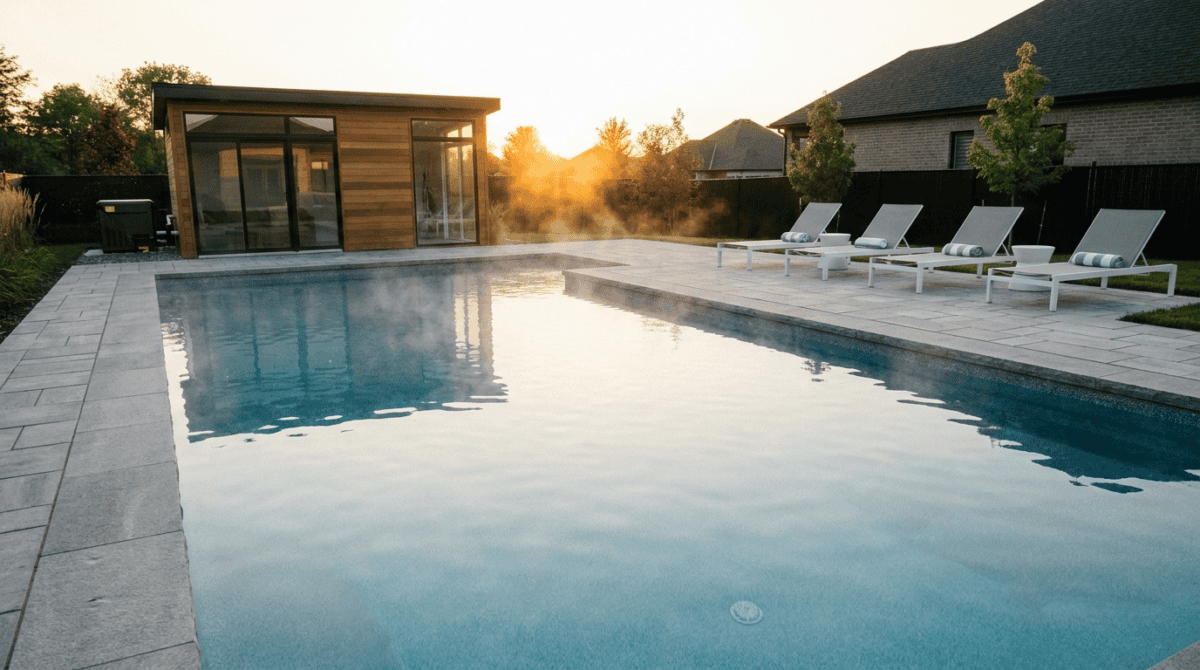
Inground pools hold thousands more gallons than above-ground pools and lose heat across a large exposed surface, so fuel choice and BTU sizing matter far more here than they do on a small portable pool. A properly sized 400,000 BTU natural-gas heater from a proven brand such as the Hayward Universal H-Series, Pentair MasterTemp, or Raypak is the standard choice for most residential inground pools, with propane reserved for pads where no gas line reaches, and this HeatersForLife.com guide walks through the picks and the sizing math below.
Quick Answer: For most residential inground pools, a 400,000 BTU natural gas heater from Hayward (Universal H-Series), Pentair (MasterTemp), or Raypak is the standard pick. Size by pool surface area — roughly 300,000–400,000 BTU for a typical inground pool — and use propane only where no gas line reaches the pad.
A gas pool heater for an inground pool is a gas-fired heat exchanger, sized in BTU to the pool’s surface area, that warms water fast on demand regardless of air temperature — the practical choice for the larger water volume and heat loss of an inground pool.
Last Updated: July 2026 | Will Montgomery has spent years sizing and servicing gas pool heaters and their gas-line runs, and knows where inground installs go over budget.
Why Inground Pools Need a Different Heater Approach Than Above-Ground
Inground pools demand higher-BTU gas heaters because they hold larger water volumes, sit on permanent equipment pads with fixed plumbing, and lose heat across a big exposed surface.
A typical residential inground pool holds anywhere from 15,000 to 30,000 gallons or more, several times the volume of an above-ground pool. That extra water needs meaningfully more heat energy to raise and hold at a comfortable temperature, which is why the gas heaters that suit inground pools cluster around the 300,000 to 400,000 BTU range rather than the compact units sold for above-ground setups.
The permanence of an inground installation also changes the picture. The heater lives on a fixed equipment pad alongside the pump and filter, with a dedicated fuel run brought to that pad and plumbing that is set in place rather than seasonally assembled and drained. That permanence rewards buying the right unit once and sizing the gas supply to match it, because reworking a gas line or repiping a pad after the fact is far more expensive than getting the specification right before the first install.
Gas heaters earn their place at inground scale because they heat quickly regardless of outdoor air temperature. Unlike a heat pump, which pulls warmth from the surrounding air and slows down on cool nights, a gas burner delivers full output on demand, which matters when there is a large volume of water to bring up to temperature before a weekend or an unexpected cool spell.
The HeatersForLife.com team notes that the most common mistake buyers make is under-sizing the heater to save money upfront. An undersized unit runs longer, cycles harder, and never quite keeps pace with heat loss on a big pool. Because most of a pool’s heat escapes through surface evaporation rather than through the walls, a larger surface area means faster heat loss, and that is exactly why sizing should follow surface area rather than a rough guess. Industry resources such as Leslie’s and Inyo make the same point: it is the exposed water surface, not the gallon count alone, that governs how fast a pool sheds warmth on a breezy or cool evening.
How to Size a Gas Pool Heater for an Inground Pool (BTU by Surface Area)
Size a gas pool heater by surface area: divide the pool’s surface area in square feet by 3, multiply by 1,000 to get the minimum BTU rating, then round up to the next available unit.

Surface area is the number that matters because evaporation off the top of the water drives most heat loss. A more precise sizing formula multiplies the surface area by the temperature differential you want to maintain and then by a factor of 12, but the divide-by-three shortcut gets most owners into the right ballpark quickly. A secondary sanity check is roughly 20 to 50 BTU per gallon, which is useful for confirming a choice rather than making it, according to guidance from resources like Heater Advisor.
Always round up. A 400,000 BTU heater on a large pool heats the water faster and then cycles less often to hold temperature, which is easier on the equipment than an undersized unit that runs flat out. As a worked example, a 16-by-32-foot pool has roughly 512 square feet of surface, which yields about a 170,000 BTU minimum, so the HeatersForLife.com team would recommend a 300,000 to 400,000 BTU unit for comfortable, quick recovery.
| Pool size | Surface area | Minimum BTU | Recommended |
|---|---|---|---|
| 14×28 | ~392 sq ft | ~130k | 200k-266k |
| 16×32 | ~512 sq ft | ~170k | 300k-400k |
| 18×36 | ~648 sq ft | ~216k | 400k |
| 20×40 | ~800 sq ft | ~266k | 400k+ |
| 24×44 | ~1,056 sq ft | ~352k | 400k (or dual) |
For most residential inground pools, a heater in the 100,000 to 400,000 BTU band covers the job, with the larger 400,000 BTU units being the safe default once a pool passes roughly 600 square feet of surface. Very large pools sometimes justify a dual-heater arrangement to keep recovery times reasonable.
Natural Gas vs. Propane for Inground Pools
Choose natural gas when a line already reaches the equipment pad, since it is cheaper to run at inground volume; choose propane only when no natural-gas line is available, because large inground pools burn liquid propane faster.
Natural gas is the default for most suburban inground pools because the fuel is piped continuously to the property and costs less per hour of run time. At inground volumes, where the heater may run for hours to bring the water up to temperature, that per-hour savings compounds into a real difference over a season. For readers who want a deeper dive into natural-gas-only models and their controls, the site’s dedicated Best Natural Gas Pool Heater guide covers that ground in detail and is worth reading alongside this article.
Propane remains a practical option for rural pads and homes with no natural-gas service. It offers real flexibility, since a propane tank can be placed almost anywhere, but its higher per-unit cost is amplified by the large volume of water an inground pool holds. Owners choosing propane should budget for noticeably higher fuel bills over the swimming season, and should factor in tank rental or purchase and periodic refills as part of the total cost of ownership.
Most of the heaters covered here ship in both natural-gas and liquid-propane versions, so the fuel decision is about what is available at the pad rather than which model to buy. Verify the exact fuel configuration at the time of purchase, and confirm gas service and capacity with the local utility before ordering a high-BTU unit.
Best Gas Pool Heaters for Inground Pools (Compared)
The top gas pool heaters for inground pools are the Hayward Universal H-Series, the Pentair MasterTemp, and the Raypak RP2100 and AVIA, all of which offer high-BTU natural-gas and propane versions with durable heat exchangers.

Each of these units is built for the sustained, high-output duty an inground pool demands. The differences come down to heat-exchanger material, automation compatibility, and the exact BTU rating that matches a given pool’s surface area from the table above.
| Model | BTU | Fuel | Heat exchanger | Notable | Best for |
|---|---|---|---|---|---|
| Hayward Universal H-Series (W3H400FDN) | 400,000 | NG/LP | Cupro-nickel | Low NOx, versatile controls | Most inground pools |
| Pentair MasterTemp (EC-462028) | 400,000 | NG/LP | Copper | Low NOx, fast heat-up, IntelliCenter-ready | Smart-automation setups |
| Raypak RP2100 (P-R406A) | 399,000 | NG/LP | Copper/cupro-nickel | Digital, rugged | Reliability-first |
| Raypak AVIA (PR404A) | 399,000 | NG/LP | — | WiFi-ready, Low NOx | App control |
| Hayward H-Series (smaller) | 150k-250k | NG/LP | Cupro-nickel | Right-size smaller inground | 14×28-16×32 |
| Pentair MasterTemp 125 (EC-462026) | 125,000 | NG/LP | Copper | Compact | Small inground/spa |
The Hayward Universal H-Series in its W3H400FDN 400,000 BTU form is the versatile default, and Hayward also offers 150,000, 200,000, and 250,000 BTU versions to right-size a smaller inground pool. Its cupro-nickel heat exchanger, Low NOx emissions, and adaptable controls make it a comfortable fit for the widest range of pools. Electronic ignition, rather than a standing pilot light, is standard across these modern units, which improves both efficiency and reliability compared with older heaters.
The Pentair MasterTemp EC-462028 leans toward homeowners building a smart-automation setup, with fast heat-up, Low NOx operation, and IntelliCenter readiness; a compact MasterTemp 125 (EC-462026) at 125,000 BTU serves small inground pools and spa applications. Raypak’s RP2100 (P-R406A) appeals to reliability-first buyers with its rugged digital build, while the Raypak AVIA (PR404A) adds WiFi control and Low NOx emissions for owners who want app management.
The HeatersForLife.com team leans toward cupro-nickel heat exchangers for saltwater and high-use pools because the material resists corrosion better over years of hard duty. Owners comparing options should also keep the Jandy JXi and LXi lines and the Sta-Rite Max-E-Therm on their shortlist, since they cover similar ground and may suit a particular pad or automation ecosystem better.
Installation: Gas-Line Sizing, the Equipment Pad, and Plumbing
From experience: When an inground install runs over on budget or time, it is almost always the gas-line run — hitting a big rock on the trench route, or waiting on the weather so you are not tearing up the yard worse than you have to. The heater itself rarely causes the delay; getting fuel to the pad does.
A gas inground heater is a professional install: a licensed technician sizes the gas line to feed up to roughly 400,000 BTU per hour, mounts the unit on the pad after the filter, and ties in electrical, venting, and bonding.

Gas-line sizing is the detail that most often trips up an inground install. A line that is undersized for the run length or fails a pressure test will starve the burner, robbing the heater of the output it is rated to deliver. A licensed tech calculates the correct diameter to feed the unit’s full demand before the heater is ever fired.
On the pad, plumbing follows a set order: water flows from the pump to the filter, then to the heater, then through any chlorinator, and finally back to the pool returns. Placing the heater after the filter keeps debris out of the heat exchanger, and the unit needs adequate flow, measured in gallons per minute, to operate safely and efficiently. Matching the heater to the inground pump and filter’s GPM is part of a correct install.
The unit also needs 120-volt control power, proper electrical bonding, and code-compliant venting for its Low NOx burner. Because a mistake here carries gas, fire, and carbon-monoxide risk, this is emphatically not a do-it-yourself project. Confirm the gas line’s capacity before ordering a 400,000 BTU unit, so the fuel supply and the heater are matched from the start.
What It Costs to Run a Gas Heater on an Inground Pool
Expect a few thousand dollars installed plus meaningful ongoing fuel costs, with natural gas cheaper per hour than propane and larger inground volumes raising both heat-up time and seasonal expense.

The installed price reflects not just the heater but the gas-line work, pad plumbing, electrical, and venting a professional install requires, and it varies with the length of the fuel run and the condition of the existing pad. Beyond that upfront number, the running cost is driven by fuel, and here natural gas holds a clear per-hour advantage over propane. The larger the pool’s volume, the longer each heat-up takes and the higher the seasonal total climbs.
The single biggest lever for controlling those running costs is a solar or thermal cover. Because surface evaporation is where most heat escapes, a cover that sits on the water when the pool is not in use dramatically cuts the heater’s workload. Pairing a right-sized heater with a good cover does more to lower fuel bills than any other single choice an owner can make.
A quality gas pool heater lasts roughly 7 to 10 years with regular maintenance, according to sources such as Vita, and a cupro-nickel heat exchanger is worth the premium on saltwater or heavily used pools for the extra corrosion resistance it brings over that lifespan. Simple habits extend that life: keep water chemistry balanced to protect the heat exchanger, maintain the flow rate the unit needs, and have the burner and venting checked at the start of each season. Between fuel savings and longevity, the cover-plus-correct-heater combination is the smartest way to keep an inground pool warm without overspending.
Frequently Asked Questions
What size gas heater do I need for an inground pool?
Size by surface area: divide the pool’s square footage by 3 and multiply by 1,000 for the minimum BTU rating, then round up to the next available unit. Most residential inground pools land in the 300,000 to 400,000 BTU range. For a 20-by-40-foot pool or larger, choose a 400,000 BTU heater.
Should I use natural gas or propane for an inground pool?
Natural gas is the better and cheaper choice whenever a line already reaches the equipment pad, which is the case for most suburban pools. Propane makes sense only when no natural-gas line is available, such as on a rural property. If you go with propane, budget for noticeably higher fuel costs at inground volume.
Can I install a gas pool heater myself?
No. A gas inground heater install involves gas-line sizing, pressure testing, electrical connections, bonding, and code-compliant venting, all of which carry gas, fire, and carbon-monoxide risk. A licensed installer is required to size and connect the unit safely.
What is the best gas pool heater for an inground pool?
The Hayward Universal H-Series (W3H400FDN, 400,000 BTU) is the versatile default for most inground pools. The Pentair MasterTemp is the pick for smart-automation setups, and the Raypak RP2100 or AVIA suits owners who prioritize rugged, reliable operation.
How long does a gas pool heater last, and what gas-line size do I need?
A gas pool heater typically lasts 7 to 10 years with regular maintenance, and a cupro-nickel heat exchanger can extend that life on saltwater or high-use pools. A 400,000 BTU unit needs a gas line sized and pressure-tested by a licensed technician to feed its full demand, so confirm that capacity before you buy.
Conclusion
The right gas heater for an inground pool comes down to three decisions made in the correct order.
- Size by surface area and round up: divide square footage by 3, multiply by 1,000, and choose the next unit up, which puts most pools in the 300,000 to 400,000 BTU range.
- Pick natural gas when a line reaches the pad and propane only when it does not, since fuel cost compounds quickly at inground volume.
- Budget for a professional gas-line and pad install, and pair the heater with a thermal cover to cut running costs.
With those choices settled, a proven model like the Hayward Universal H-Series, Pentair MasterTemp, or Raypak will keep an inground pool comfortable for years, delivering fast, dependable heat on demand no matter the outdoor temperature. Explore more Pool guides on HeatersForLife.com, including the dedicated Best Natural Gas Pool Heater guide, to go deeper before you buy.