

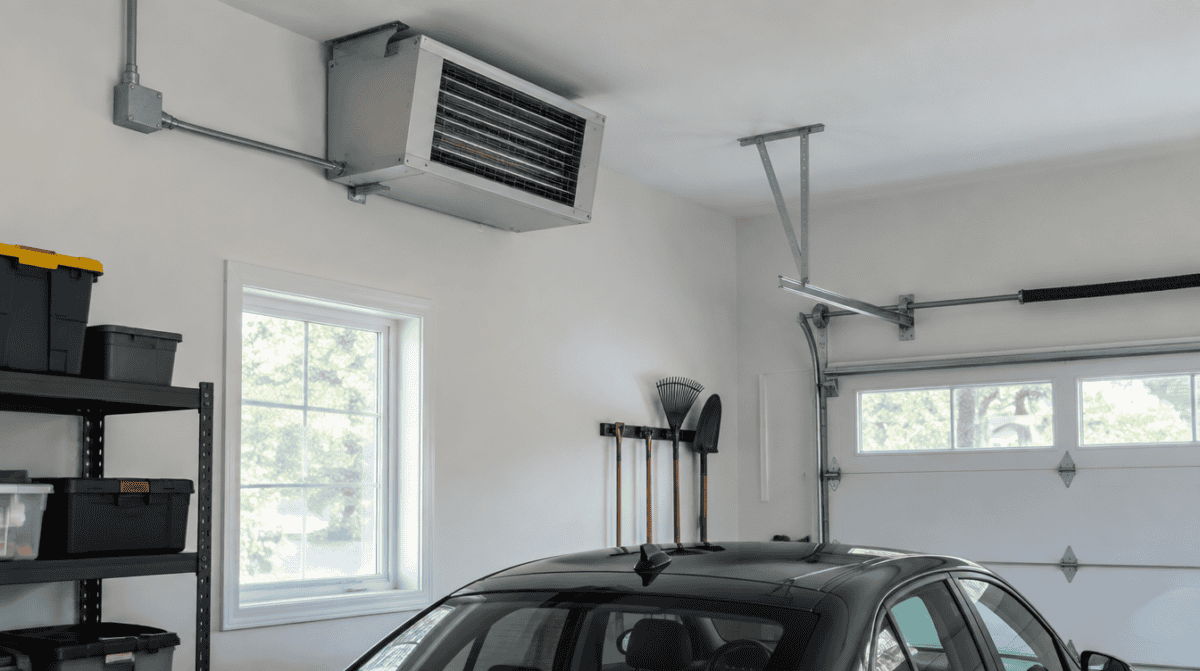
Wiring a 240V garage heater comes down to three numbers pulled from the heater’s own nameplate: its wattage sets the amps, the amps set the breaker and wire gauge, and its control type decides whether you need a neutral. At heatersforlife.com we walk through each of those in order so you can size the circuit correctly and talk to your electrician with confidence.
Quick answer: Most 240V garage heaters are pure resistive loads, so they need only two hot wires and a ground — no neutral. Size the circuit to the heater’s amp draw plus the 80% continuous-load rule: a 5,000W heater pulls about 20.8A at 240V and belongs on a 30-amp breaker with 10 AWG copper. Only heaters with 120V thermostats, fans, or digital controls require a neutral, and the nameplate or wiring diagram will tell you.
This article is educational. Line-voltage wiring is regulated by the National Electrical Code and local rules, and a permit plus a licensed electrician is the right call for a hardwired 240V circuit. Use this to understand the job, not to skip the professional.

Last Updated: September 2026 | Will Montgomery has an engineering background and has spent years installing, testing, and troubleshooting electric and propane heaters in homes, apartments, and uninsulated garages.
How to turn heater watts into amps
Divide the heater’s wattage by 240 volts to get the current it draws in amps. A resistive electric heater converts essentially all of its electricity into heat, so the math is simple and honest: watts ÷ volts = amps. A 4,800W unit on a 240V circuit draws 20 amps; a 7,500W unit draws about 31 amps. Every wiring decision below flows from that single number, so read it off the nameplate rather than guessing from the box.
One physics note worth keeping straight: all resistive electric heaters are roughly 100% efficient, so two 5,000W heaters produce the same heat and cost the same to run regardless of brand or element style. A typical example of the class is the Comfort Zone 5,000 W ceiling-mount garage heater (240V, hardwired, three heat settings), which lands in the 30-amp / 10 AWG row of the table above. Wattage — not marketing — is what determines both the heat output and the circuit you have to build. If you are still deciding how big a heater you need, our garage heater sizing guide converts square footage and insulation into a target wattage first.
Wire gauge and breaker size by heater wattage
Pick the breaker and wire from the heater’s amp draw after adding the 25% continuous-load margin the code requires. A garage heater runs for hours at a time, which the National Electrical Code treats as a “continuous load.” The rule is that a breaker can carry only 80% of its rating continuously, so you size the circuit as if the heater draws 125% of its actual amps. The table below does that math for the common wattages, using copper wire.

| Heater wattage (240V) | Actual amps | Breaker size | Copper wire gauge |
|---|---|---|---|
| 3,000 W | 12.5 A | 20 A | 12 AWG |
| 4,000 W | 16.7 A | 25 A | 10 AWG |
| 4,800–5,000 W | 20–20.8 A | 30 A | 10 AWG |
| 7,500 W | 31.3 A | 40 A | 8 AWG |
| 10,000 W | 41.7 A | 60 A | 6 AWG |
Two cautions on the table. First, wire ampacity depends on the insulation rating (most modern NM-B cable uses the 60°C column), the run length, and temperature, so a long run can force you up a gauge to fight voltage drop. Second, never put a bigger breaker on a heater than the wire is rated for — the breaker protects the wire, not the heater. When in doubt, match the wire to the breaker, not to the heater.
Do you need a neutral for a 240V heater?
A straight 240V heating element needs only two hots and a ground; you need a neutral only when part of the heater runs on 120V. A pure resistive element does not care about neutral — it sits across the two 240V legs and the ground is there purely for safety. That is why so many garage heaters are wired with 10/2 NM-B cable (two conductors plus ground) rather than 10/3.
The exception is any heater whose thermostat, control board, cooling fan, or LED display is powered at 120V. Those units tap one hot leg to neutral to get 120V for the low-voltage side, so they require a neutral and are wired with 10/3 (three conductors plus ground). The nameplate, the wiring diagram inside the junction box, or the spec sheet will state “3-wire + ground” or show a white neutral lead. When the diagram shows only two line terminals and a ground lug, no neutral is needed.

A safe wiring sequence in plain terms
Kill the power, confirm it is dead with a non-contact voltage tester, land the conductors on the right terminals, and only then re-energize. The order of operations for a hardwired unit looks like this:

- Turn off the breaker feeding the circuit and verify zero voltage at the heater’s junction box with a tester — do not trust the breaker label alone.
- Run the correctly sized cable from the panel to a disconnect within sight of the heater, as most installations require a means of disconnect.
- Land the two hot conductors (black and red on 240V cable) on the heater’s line terminals, and bond the bare or green ground to the ground lug.
- If the unit needs a neutral, land the white conductor on the neutral terminal; if it does not, cap it or omit it per the cable you chose.
- Set the built-in or remote thermostat, restore power, and confirm the element heats and the fan (if any) runs.
Because a mistake here can start a fire or energize the cabinet, this is the step where a licensed electrician earns their fee. If your goal was simply to avoid hardwiring altogether, a plug-in unit may be the better path — see our guide to heating a garage on 120V for options that skip the panel work, and our roundup of the best 240V garage heaters for a 20-amp circuit when you want hardwired heat sized to an existing breaker.
Cost and fuel context before you commit
Will’s note: I priced this out for my own rough 20 by 20 uninsulated garage and went propane instead. Just keeping the chill off that space takes about 24,000 BTU per hour, which is a little over 7,000 watts of electric heat, and a 7,500-watt unit needs a 40-amp circuit by code. Between the panel work, the wire, and the breaker, a propane torpedo heater was far cheaper for how often I use the space, and I can carry it anywhere.
Wiring a 240V circuit only makes sense once you know electric heat fits your garage and budget. A 240V electric heater is clean, quiet, and maintenance-free, but at higher wattages it can pull real money on the meter, and equal wattage always costs the same to run no matter the brand. If you are weighing electric against burning fuel, our comparison of an electric vs propane garage heater lays out the cost-per-hour trade so you do not wire an expensive circuit for the wrong heat source. And if the whole project starts with an uninsulated shell, our how to heat a garage pillar covers the cheapest real-world path first.
Voltage drop and long cable runs
On a long run from the panel to a detached garage, voltage drop can force you up a wire size even when the amp table says otherwise. Every foot of cable has resistance, and a 240V heater sitting 80 or 120 feet from the panel can see enough voltage sag to reduce its heat output and warm the conductors more than intended. The common rule of thumb is to keep voltage drop under 3% on a branch circuit. In practice that means a 30-amp circuit feeding a heater 100 feet away is often bumped from 10 AWG to 8 AWG copper to stay within that limit. If your garage is detached or the panel is on the far side of the house, tell your electrician the exact run length so the wire is sized for distance, not just amps.
Aluminum wire changes the math too. Aluminum carries less current than copper of the same gauge, so a circuit sized in copper needs a larger aluminum conductor for the same load. Because the tables above assume copper, do not substitute aluminum without re-sizing.
Disconnects, thermostats, and controls
Code generally requires a way to shut the heater off within sight of it, and how you control temperature affects the wiring. A hardwired garage heater usually needs a disconnecting means — often a simple switch or a unit-mounted disconnect — so the circuit can be de-energized for service without walking back to the panel. Temperature control comes in two flavors that change the install. A line-voltage wall thermostat is wired in series with the heater on the same 240V circuit and switches the full heater load, so it must be rated for the heater’s amps. A heater with a built-in thermostat needs no separate wall stat but gives you less flexible placement. Decide which you want before the cable is run, because a remote line-voltage thermostat changes where the conductors terminate.
Frequently asked questions
Does a 240V garage heater need a neutral wire?
Only if the heater has 120V controls, a fan, or a display. A pure 240V resistive heater uses two hot legs and a ground, so it is wired with 2-conductor-plus-ground cable and no neutral. Check the nameplate or wiring diagram, which will call out a neutral or a “3-wire + ground” requirement when one exists.
What size breaker do I need for a 5,000W 240V heater?
A 30-amp breaker with 10 AWG copper wire. The heater draws about 20.8 amps, and the continuous-load rule requires the circuit to be sized for 125% of that (about 26 amps), which lands on a 30-amp breaker.
What wire gauge for a 240V garage heater?
It depends on wattage: 12 AWG for a 20-amp/3,000W circuit, 10 AWG for a 25–30-amp/up-to-5,000W circuit, 8 AWG for a 40-amp/7,500W circuit, and 6 AWG for a 60-amp/10,000W circuit. Long runs may require going up a gauge to limit voltage drop.
Can I wire a 240V heater with 10/2 cable?
Yes, if the heater does not need a neutral, which most straight-resistive garage heaters do not. The black and red conductors serve as the two hots and the bare conductor is the ground. Use 10/3 only when the unit requires a neutral for 120V controls.
Should I hire an electrician to wire a garage heater?
For a hardwired 240V circuit, yes. It involves working in your electrical panel, sizing conductors and overcurrent protection to code, and usually pulling a permit. A licensed electrician makes the install safe and inspectable, and often costs less than the damage a wiring error can cause.
Will Montgomery is an engineer who has sized and priced 240V heater circuits for his own uninsulated garage and shop buildings, and has wired, run, and repaired electric and propane heaters for years.