

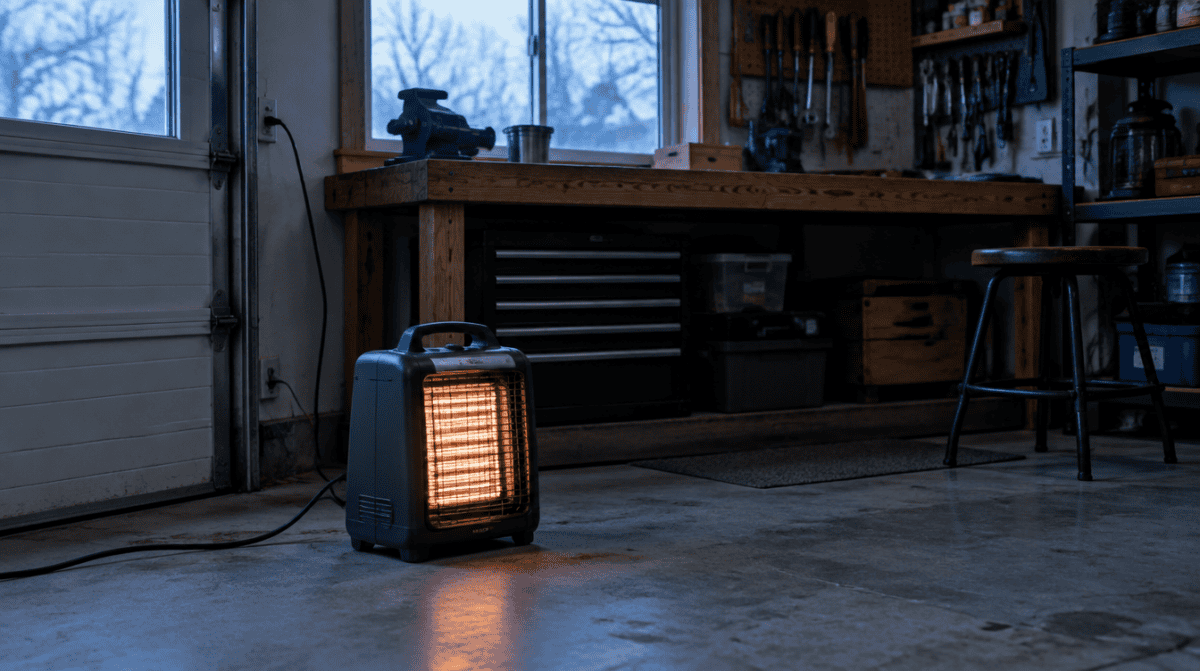
Quick answer: A standard 120-volt plug-in heater tops out at 1,500 watts, or roughly 5,100 BTU per hour, which is enough to warm a small, insulated one-car garage or take the edge off a work zone, but not enough to heat a large or uninsulated space. HeatersForLife.com recommends matching a 120V heater to a well-insulated bay of about 150 square feet or less and using spot heating for anything larger, rather than expecting whole-garage warmth.
Plenty of garages have only standard 120-volt outlets and no easy way to run a 240-volt circuit. The good news is that a 120V heater can be genuinely useful in the right size space; the key is having realistic expectations about what 1,500 watts can do.
Last Updated: September 2026 | Will Montgomery has an engineering background and has spent years installing, testing, and troubleshooting electric and propane heaters in homes, apartments, and uninsulated garages.
Can a 120V heater actually heat a garage?
Will’s note: I have never used a plug-in electric heater for real auxiliary heat in a big space. At home the garage runs on propane, and in the larger work buildings it has always been kerosene or diesel forced-air jet heaters. A 120V heater earns its keep at the bench, not as the plan for heating the whole building.
A 120V heater can heat a small, insulated garage, but it cannot overcome the heat loss of a large bay or an uninsulated, drafty space. Every plug-in electric heater is limited to 1,500 watts on a standard 15-amp, 120-volt outlet, because that is the safe ceiling for the circuit. All resistive electric heaters are essentially 100 percent efficient, so a 1,500-watt ceramic, fan, or infrared heater all deliver the same total heat; the differences are in how that heat is distributed, not how much there is.
That 1,500-watt ceiling is the whole story. If a garage loses heat faster than 5,100 BTU per hour, a single 120V heater will run constantly and never catch up. Insulation, door seals, and garage size decide whether it succeeds.
What 1,500 watts of heat can and can’t do
1,500 watts equals about 5,100 BTU per hour, which comfortably heats roughly 150 square feet of insulated space but falls short in larger or poorly insulated garages. A useful rule of thumb for a moderately insulated garage in a cool climate is about 10 watts per square foot; drafty or uninsulated spaces need far more. The table below shows realistic expectations.

| Garage size | Insulated? | Will one 120V (1,500W) heater work? |
|---|---|---|
| Up to ~150 sq ft (small single bay) | Yes | Yes, can hold a comfortable temperature |
| ~150–250 sq ft (single bay) | Yes | Partly; good for spot heat, slow to warm fully |
| ~250 sq ft single bay | No | No; use as spot heat only |
| Two-car (400+ sq ft) | Any | No; needs 240V or multiple circuits |
For a full walk-through of sizing math by square footage, insulation, and climate, see the HeatersForLife.com guide to garage heater sizing in watts and BTU.
Best 120V plug-in options for a garage
The most practical 120V garage heaters are 1,500-watt ceramic fan-forced units for fast area heat and infrared or radiant heaters for aiming warmth directly at a work zone. Ceramic fan heaters push warm air across a space and are best in a small enclosed bay. Infrared and quartz radiant heaters warm objects and people directly, which makes them the better choice when the goal is to stay warm at a bench rather than heat all the air in the room.
Example 120V picks (verified on Amazon, Sept 2026): the Dr Infrared DR-968 (1,500 W dual infrared quartz + PTC, standard 120 V plug, 12.5 A) for aimed bench heat, and the Vornado MVH (1,500 W vortex fan-forced, 3 heat settings, auto shut-off) for circulating warm air in a small insulated bay.
Whatever the type, a 120V garage heater must be plugged directly into a wall outlet. A 1,500-watt heater draws about 12.5 amps, close to the full capacity of a 15-amp circuit, so extension cords and shared circuits invite tripped breakers and overheating. HeatersForLife.com covers that load in how many amps a space heater uses and what to do if it keeps tripping the breaker.

How to get the most from a 120V garage heater
Because a 120V heater has a fixed 1,500-watt output, the way to feel warmer is to reduce heat loss and concentrate the heat where the work happens. Sealing the garage door with weatherstripping (a 16 ft T-end bottom seal is about $26), insulating the door and walls (a reflective single-door insulation kit runs about $50), and closing off unused space all shrink the area the heater has to fight. Running the heater on a dedicated outlet and pre-warming the space before working gives it a head start.
For anything larger than a small insulated bay, spot heating beats trying to warm the whole room. Point an infrared heater at the workbench and dress warmly, and the same 1,500 watts becomes far more effective. The HeatersForLife.com guide on the cheapest real-world ways to heat a garage goes deeper on these tactics, including uninsulated spaces.

When you should step up to 240V
Move up to a 240V hardwired heater when the garage is larger than a small single bay, poorly insulated, or needs to hold a steady temperature for long periods. A 240V circuit can supply far more than 1,500 watts, so a 240-volt garage heater delivers the higher, sustained output a two-car or uninsulated garage requires. It does require running a dedicated circuit, which usually means an electrician.

Homeowners weighing that upgrade can compare options in the HeatersForLife.com guides to the best 240V garage heaters for a 20-amp circuit, the overall best garage heaters, and the running-cost comparison in electric vs propane vs natural gas garage heaters. If propane is on the table, read whether propane heaters are safe indoors first.
Frequently asked questions
Can a 120V space heater heat a garage?
Yes, if the garage is small and insulated. A 1,500-watt 120V heater can hold a comfortable temperature in a bay of about 150 square feet or less, but only provides spot heat in larger or uninsulated garages.
How many BTU is a 1,500-watt 120V heater?
About 5,100 BTU per hour. That is the maximum any standard 120-volt plug-in heater can produce, because 1,500 watts is the safe ceiling for a 15-amp circuit.
Is a 120V or 240V heater better for a garage?
A 120V heater is simplest and plugs into any outlet, but it is capped at 1,500 watts. A 240V heater supplies more heat for larger or uninsulated garages but needs a dedicated circuit installed.
Can I run two 120V heaters in my garage?
Only if each is on its own separate 15-amp circuit. Two 1,500-watt heaters on the same circuit will overload it and trip the breaker, so most garages cannot power two at once.
Why won’t my 120V heater warm my garage?
The garage is likely too large or too poorly insulated for 1,500 watts. Seal the door, add insulation, shrink the heated area, or switch to spot heating a work zone instead of the whole room.
Written and reviewed by Will Montgomery, who has installed, tested, and repaired electric and propane heaters for years.