

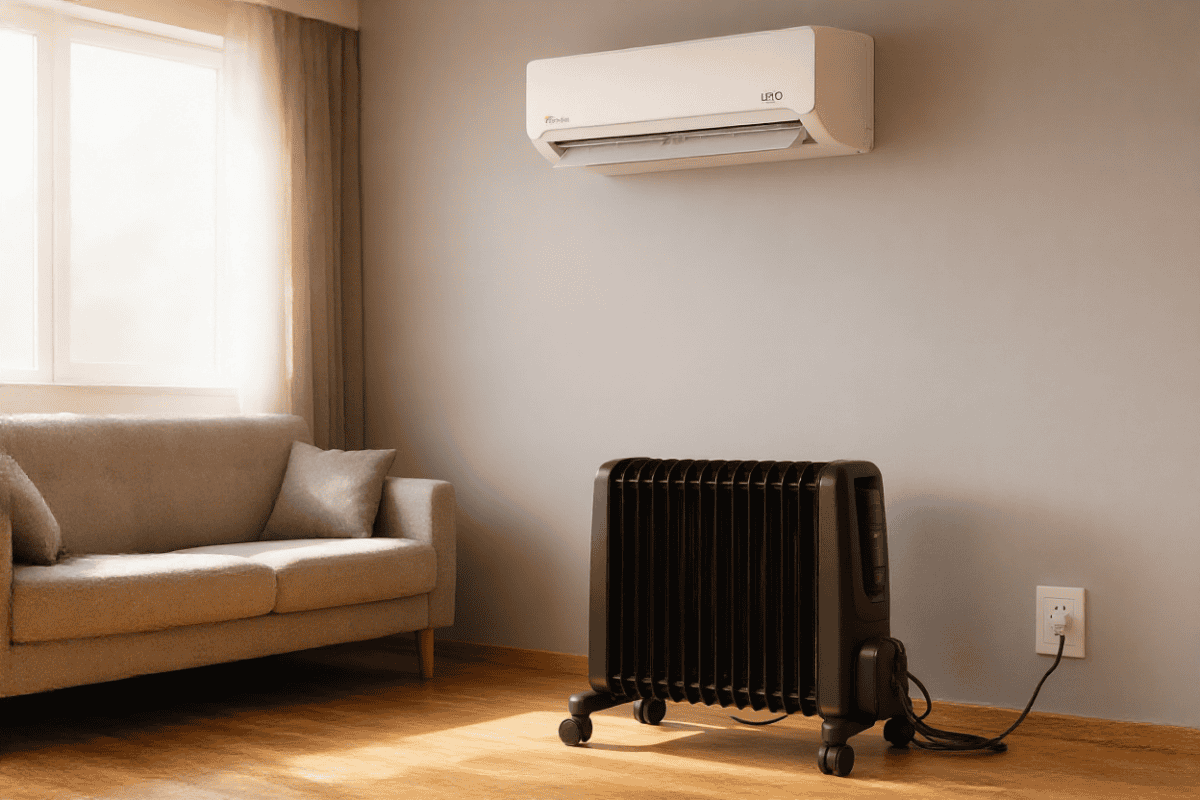
A mini split is cheaper to run than a space heater because it moves heat instead of generating it, delivering two to four units of warmth for every unit of electricity, while a space heater delivers only one. This heatersforlife.com breakdown shows the true running-cost gap for heating a single room, and explains why a space heater still wins on upfront cost and flexibility.
Last Updated: September 2026 | Will Montgomery has an engineering background and has spent years installing, testing, and troubleshooting electric and propane heaters.
Quick Answer: Is a Mini Split Cheaper Than a Space Heater for One Room?
For continuous heating of one room, a mini split is cheaper to run than a space heater, but a space heater costs far less to buy and is the smarter choice for occasional or short-term heating. A ductless mini split heat pump has a heating coefficient of performance (COP) between roughly 2.5 and 4 in mild-to-moderate cold, meaning it produces 2.5 to 4 kWh of heat for every 1 kWh of electricity it draws. An electric space heater has a COP of 1: every 1 kWh of electricity becomes exactly 1 kWh of heat. To deliver the same warmth as a 1500-watt space heater, a mini split might draw only 400 to 600 watts. The catch is that a mini split costs $2,000 to $5,000 or more installed, while a space heater costs $30 to $150.
Why a Mini Split Uses Less Electricity for the Same Heat
A mini split does not create heat; it pumps existing heat from outdoor air into the room, which is why it can beat the 100 percent efficiency ceiling that every space heater is stuck at. Electric resistance heaters — ceramic, oil-filled, infrared, fan, or baseboard — are all essentially 100 percent efficient, so none of them can turn 1 kWh of electricity into more than 1 kWh of heat. That is a hard physical limit, and it is why the type of space heater never changes the running cost. A heat pump sidesteps the limit entirely by using electricity to run a compressor that relocates heat rather than generate it. Even on a cold day there is heat energy in outdoor air, and the mini split concentrates it indoors. This is the same principle behind a refrigerator running in reverse, and it is why heat pumps are the efficiency benchmark that heatersforlife.com references throughout its cost guides.
The efficiency advantage is not fixed. A mini split’s COP falls as the outdoor temperature drops, because there is less ambient heat to gather. In mild weather a good unit may hit a COP of 3.5 or 4; near 5°F it may fall to 2 or below. Cold-climate models hold their efficiency better, but the pattern is universal: the colder it gets, the smaller the mini split’s edge over resistance heat becomes, though it almost always stays ahead.
True Running-Cost Breakdown for One Room
Over a month of steady heating, a mini split typically costs half to a third of what a space heater costs to run, because it draws a fraction of the wattage for the same comfort. The table below assumes electricity at 17 cents per kWh, eight hours of heating per day for 30 days, and a mini split averaging a COP of 3. Both figures assume the units are delivering roughly the same amount of heat to the room.
| Metric | 1500W Space Heater | Mini Split (COP 3) |
|---|---|---|
| Electricity drawn per hour | 1.5 kWh | ~0.5 kWh |
| Cost per hour @ 17¢/kWh | ~$0.25 | ~$0.085 |
| Cost per 8-hour day | ~$2.00 | ~$0.68 |
| Cost per 30-day month | ~$61 | ~$20 |
| Upfront equipment cost | $30–$150 | $2,000–$5,000+ installed |
| Also provides cooling | No | Yes (air conditioning in summer) |

Example products for this comparison: a 12,000 BTU unit like the Senville LETO mini split heat pump on the mini-split side, and a 1500W unit like the De’Longhi Dragon digital oil-filled radiator on the space-heater side.
The running-cost gap is real — roughly $40 a month in this example — but so is the $2,000-plus price gap. A reader can plug their own electricity rate and hours into the space heater running-cost calculator to see the resistance-side number for their situation, then compare it against a mini split running at about a third of that.
How Long It Takes a Mini Split to Pay for Itself
A mini split’s lower running cost only justifies its price when it heats a room continuously through many winters, not when it replaces a heater used a few hours a week. If a mini split saves about $40 a month for the four coldest months, that is roughly $160 a year in heating savings. Against a $3,000 installed cost, simple payback on heating alone is close to 18 to 20 years — longer than many people stay in a home. The math changes sharply when the same unit also replaces window air conditioners in summer, because then it earns its keep year-round and the payback can shrink to well under a decade. For anyone heating a single room occasionally, the space heater’s tiny purchase price is impossible to beat: it would take many years for the running-cost savings of a mini split to overcome the upfront difference.
When a Space Heater Is Still the Better Buy

A space heater beats a mini split whenever heating is temporary, occasional, or in a space where a permanent installation makes no sense. Renters cannot bolt a mini split to a wall and run a line set through the exterior, so a portable space heater is the practical choice, as covered in the heatersforlife.com guide to the best space heaters for small apartments. A space heater also wins for a guest room used a few nights a year, a workshop warmed only while someone is in it, or a home office used seasonally. Because it plugs into a standard outlet and moves from room to room, a space heater offers flexibility a fixed mini split cannot. And since all resistance heaters cost the same to run per watt, the choice among them comes down to comfort and features rather than efficiency — heatersforlife.com explains the differences in its overview of space heater types.
When a Mini Split Is Worth the Investment

A mini split is worth it when a household heats the same room for long stretches every winter, wants cooling in the same unit, or is trying to cut a large electric-resistance heating bill. A primary living space occupied all day, a converted garage or addition with no ductwork, or a home replacing costly electric baseboard heat are the strongest cases. In these situations the mini split runs enough hours for its efficiency to matter, and the added summer air conditioning turns a long heating payback into a reasonable whole-year one. Households on expensive electricity see the fastest returns, because every kWh the heat pump avoids drawing is worth more.
Cold-Climate Performance and Backup Heat
Will’s note: What surprised me most is how cold it can get outside while a heat pump still holds the room at a comfortable temperature. On cost per unit of heat it is the most economical option going. The caution is that a standard mini split loses a lot of output somewhere around freezing, so if you do not have a true cold-climate model, keep a space heater around for the coldest nights.
In deep cold a mini split’s efficiency drops and its heat output shrinks, which is why cold-climate models and a backup heat source matter in northern regions. A standard mini split may struggle below about 5°F, losing both capacity and efficiency as the outdoor coil works harder to extract dwindling ambient heat. Cold-climate or hyper-heat models use variable-speed compressors and improved refrigerant control to keep delivering usable heat down to 0°F or lower, though even they see their COP slide toward 2 in the worst cold. This is the one scenario where a space heater earns a place alongside a mini split: many households in cold climates keep a portable electric heater on hand as emergency backup for the coldest nights or for a power situation where the mini split cannot keep up. Because a space heater’s output is fixed and immediate, it is a reliable stopgap, even though it costs three times as much per unit of heat. For readers weighing a heater as backup, heatersforlife.com covers picking one in the guide to the best space heaters for large or drafty rooms.
It is also worth noting that a mini split’s rated efficiency assumes proper sizing and clean filters. An oversized unit short-cycles and loses efficiency, while a clogged filter or a snow-blocked outdoor coil can cut output sharply. A space heater has none of this maintenance burden — it is simply plugged in — which is part of why it remains the low-hassle choice for occasional heating even though it costs more to run continuously.
Comfort and Air Quality Differences
A mini split circulates and filters air for even, thermostat-controlled comfort, while a space heater creates a warm zone near the unit and can dry or stratify the air in a room. A mini split’s indoor head distributes conditioned air across the room and holds a set temperature closely, so the space stays evenly warm without hot and cold spots. Its filter also captures dust and, on many models, helps with allergens. A space heater, by contrast, tends to make the area near it noticeably warmer than the far corners, and a fan-forced model can stir up dust. Neither adds moisture, so both can leave winter air feeling dry. For a bedroom or a room occupied all day, the mini split’s even, quiet, filtered warmth is a comfort upgrade that the running-cost table alone does not capture — another reason the two devices serve genuinely different needs rather than being simple substitutes.
Safety and Setup Differences
A mini split is a professionally installed, permanently wired appliance, while a space heater is a plug-in device that carries the fire risks common to all portable heaters. A mini split needs a dedicated circuit, an outdoor condenser, and refrigerant lines installed by a qualified technician, but once in place it runs unattended and safely for years. A space heater must be plugged directly into a wall outlet, never a power strip or extension cord, and kept at least three feet from anything flammable. Anyone relying on a space heater for long hours should review the heatersforlife.com guidance on running a space heater overnight and on how many amps a 1500-watt heater draws, since a full-power heater sits near the limit of a standard 15-amp circuit.
Frequently Asked Questions
Is a mini split cheaper than a space heater for one room?
To run, yes. A mini split delivers the same heat for roughly a third of the electricity because it moves heat rather than generating it. But a space heater costs far less to buy, so for occasional heating the space heater is cheaper overall.
How much does it cost to run a mini split versus a space heater per month?
Heating one room eight hours a day for a month costs about $61 for a 1500-watt space heater and about $20 for a mini split at a COP of 3, assuming 17 cents per kWh. Colder weather narrows the gap because the heat pump’s efficiency drops.
Does a mini split lose efficiency in cold weather?
Yes. A mini split’s COP falls as the outdoor temperature drops because there is less heat in the outside air to gather. Cold-climate models hold up better, but every heat pump is most efficient in mild cold and least efficient in deep cold.
Why is a space heater only 100 percent efficient?
An electric resistance heater converts electricity directly into heat, and 1 kWh of electricity can only become 1 kWh of heat. A heat pump beats this by using electricity to move existing heat instead of creating it, which is why it can exceed 100 percent effective efficiency.
Is it worth installing a mini split just for heating?
Usually not on heating savings alone, since payback can stretch past 15 years. A mini split makes financial sense when it also replaces summer air conditioning or a costly electric-resistance system, which shortens the payback considerably.
Written and reviewed by Will Montgomery, who has installed, tested, and repaired electric and propane heaters for years.