

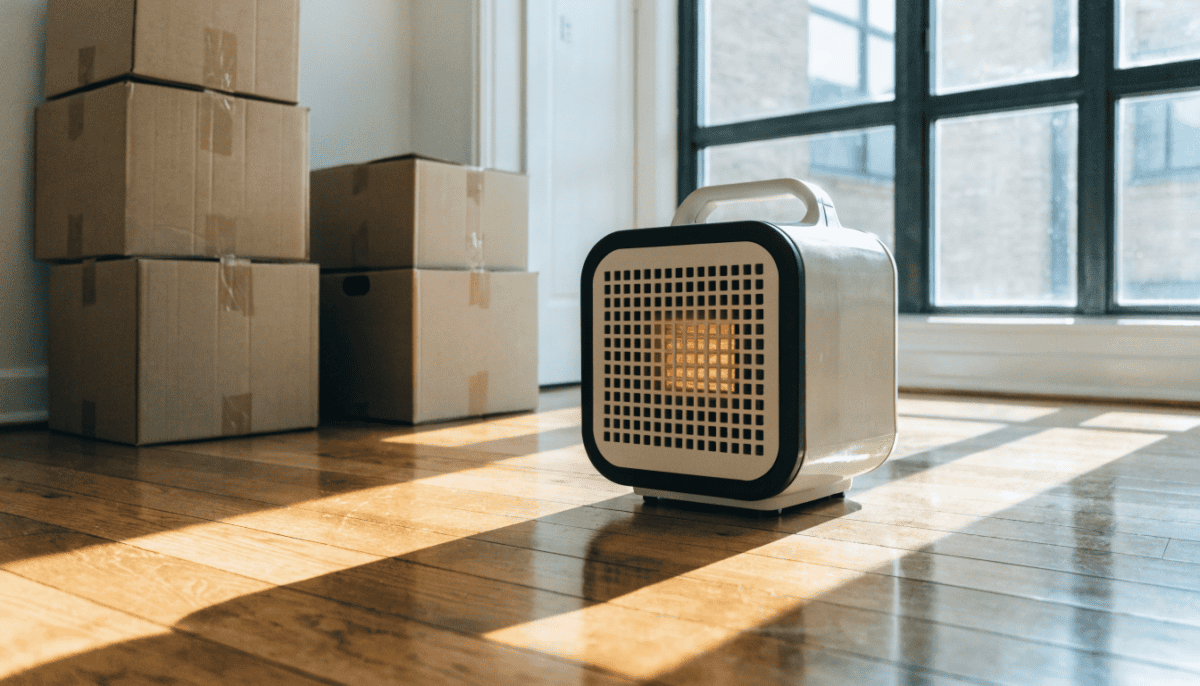
The most portable space heaters for renters who move often are compact ceramic and personal-sized heaters that weigh just a few pounds, have a built-in carry handle, plug into any standard 120V outlet, and pack into a moving box without fuss. This guide from heatersforlife.com explains what actually makes a heater easy to move, which types travel best, and how to pick one that warms the room without becoming dead weight on moving day.
Last Updated: September 2026 | Will Montgomery has an engineering background and has spent years installing, testing, and troubleshooting electric and propane heaters.
Quick Answer: what movers should look for
A renter who moves frequently should choose a lightweight ceramic heater with a carry handle, a compact footprint, and full safety shutoffs, in the 750W to 1500W range depending on room size.
- Weight: a few pounds, light enough to carry in one hand.
- Grip: a built-in handle or a shape that is easy to grab.
- Power: up to 1500W on a standard outlet; 750W personal units for desks and small rooms.
- Safety: tip-over switch and overheat protection, since portable units get moved and bumped.
Our picks: two heaters that move as easily as you do
Top pick: Lasko 754201 Portable Ceramic Heater (about $45). Nine inches tall, about three and a half pounds, with the molded carry handle this article recommends. It fits in a moving box between two towels and plugs into any 120V outlet at the new place.
Budget: BLACK+DECKER BHDC201 Personal Ceramic Heater, 1500W (about $27). Small enough to live on a desk, light enough to carry one-handed, and cheap enough that owning one per room costs less than one big heater.
What actually makes a space heater “portable”
A space heater is truly portable when it is light enough to carry in one hand, small enough to pack, and simple enough to just plug in at the next place, without needing special wiring or a heavy, awkward body. Portability is more than a marketing word, and the details separate a heater that travels well from one that becomes a chore.
Weight is the first factor: compact ceramic and personal heaters typically weigh only a few pounds, while oil-filled radiators can weigh fifteen pounds or more and are genuinely heavy to lug up stairs. A built-in handle or a grab-friendly shape turns carrying from a two-handed hug into a one-hand lift. Cord length matters at the new place, where outlet positions are unknown, and a slightly longer built-in cord adds flexibility, though it must never be extended with a power strip. Finally, every truly portable heater runs on a standard 120V household outlet, so there is nothing to install and nothing left behind. The underlying heater designs and how they differ are covered in space heater types explained.

The best heater types for people who move a lot
Compact ceramic heaters and personal desk heaters are the best types for frequent movers, because they combine low weight, a small footprint, and fast warm-up in a package that packs and re-deploys in seconds. Not every heater type travels equally well.
Compact ceramic heaters are the workhorse pick: a small fan-forced ceramic unit weighs only a few pounds, warms a room quickly, and often includes a handle molded into the housing. Personal or desk heaters are even smaller, usually 750W or less, ideal for a home office, a dorm, or warming the immediate space around a chair rather than a whole room. Low-profile flat panel heaters travel reasonably well too and run silently, a plus for light sleepers as noted in the quietest space heaters guide. The types to avoid for a mover are heavy oil-filled radiators, which hold heat well but are a burden to carry, and large tower units that are bulky to pack. For renters also weighing overall apartment suitability, the best space heaters for apartments guide covers compact picks in more depth.
Portability comparison by heater type
The table below compares common heater types on the factors a frequent mover cares about most: weight, packing size, warm-up speed, and the room size each realistically handles.
| Heater type | Typical weight | Packing size | Warm-up speed | Best for |
|---|---|---|---|---|
| Personal/desk ceramic | 1-3 lb | Very small | Fast (spot heat) | Desks, dorms, one chair |
| Compact ceramic | 3-6 lb | Small | Fast | Bedrooms, small rooms |
| Flat panel/micathermic | 4-8 lb | Slim, flat | Moderate | Quiet whole-room heat |
| Fan-forced tower | 4-8 lb | Tall, bulky | Fast | Wider coverage |
| Oil-filled radiator | 12-18 lb | Large, heavy | Slow | Steady heat, rarely moved |
A quick reality check on running cost: a lighter heater is not a cheaper heater to operate. All of these convert nearly all their electricity into heat, so a 1500W compact ceramic costs the same per hour as a 1500W oil-filled radiator. Portability is about the moving day, not the electric bill, and the bill itself is broken down in space heater cost to run.
Features a frequent mover should prioritize
For someone who moves often, the features that matter most are a carry handle, a compact and packable shape, sturdy tip-over and overheat protection, and simple controls that work anywhere without setup.
- Built-in carry handle: the single feature that most improves moving day.
- Compact, packable body: fits in a moving box or the corner of a car trunk.
- Tip-over switch and overheat cutoff: essential because portable units are constantly moved and bumped.
- Durable housing: survives being packed, stacked, and jostled.
- Simple mechanical or clearly labeled controls: no relearning at each new place.
- A cord long enough to reach an outlet without ever resorting to an extension cord.

Sizing a portable heater and using it safely at the new place
A portable heater should still be sized to the room using the rough guide of 10 watts per square foot, and at every new address it must be plugged directly into a wall outlet rather than a power strip or extension cord. Portability does not change the physics or the safety rules.
A 750W personal heater is meant to warm the space right around a person, not a whole room, so expecting it to heat a 200-square-foot living room leads to disappointment. A 1500W compact ceramic, by contrast, can warm a well-insulated room up to roughly 150 square feet. When arriving at a new place with unfamiliar wiring, the safest habit is to give the heater its own wall outlet and avoid running it on the same circuit as other high-draw appliances, since a 1500W heater already draws about 12.5 amps. Above all, never bridge the gap to a distant outlet with a power strip or light extension cord; a heater’s sustained load can overheat an undersized cord and start a fire, as explained in the guide on why you should never plug a space heater into a power strip.
One heater that follows you, or one for each room?
A frequent mover is almost always better served by one or two genuinely portable heaters that travel from home to home than by a heater in every room, because portable spot heating is what makes renting flexible and keeps the electric bill down. The whole point of a portable heater is to put warmth where a person actually is.
Central heating warms every room whether or not anyone is in it, which is wasteful in a home where one or two rooms are used at a time. A renter with a portable heater can lower the main thermostat and carry warmth to the occupied room, whether that is the bedroom at night or the home office by day. Two lightweight units, one for the sleeping area and one for the daytime space, cover most of a small apartment while still fitting in a single moving box. A person who buys a bulky heater for every room ends up with heavy gear to haul at the next move and little added comfort, since only the occupied room ever needs heat at a given moment.
A moving-day and off-season storage checklist
Treating a portable heater like the small appliance it is, both on moving day and during storage, keeps it safe and extends its life across many moves. A few habits prevent the most common problems.
From experience: I will be honest — I never did anything special storing heaters between moves, and I paid for it in dust. Do it smarter than I did: keep the original box, or slide the heater into a garbage bag before it goes on the shelf, so the elements are not caked in dust when you fire it up next fall.
- Cool it fully before packing: a warm heater packed in a box can scorch surrounding items.
- Loosely coil the cord: tight wrapping around the body stresses the wire over time; secure it with a hook-and-loop tie, not a hard kink.
- Pack it upright and cushioned: protect the grille and controls the way any electronic appliance would be protected.
- Label the box “heater”: so it is easy to find first at the cold new place.
- Store it dry and dust-free: keep it in its box or a bag off-season so dust does not pack into the vents, which can trip the overheat sensor next winter.
- Inspect the cord and plug before each reuse: a cracked cord or bent plug is a reason to retire the unit, not to keep using it.
Following these steps means a single well-chosen portable heater can move with a renter for years, plugging in and warming the room within minutes of arriving at each new address.
Frequently asked questions
What is the most portable type of space heater?
A personal or compact ceramic heater is the most portable, weighing only a few pounds with a small footprint and often a built-in handle. It packs easily and plugs into any standard outlet at the next place.
Are small portable heaters powerful enough to heat a room?
A 1500W compact ceramic heater can warm a well-insulated room up to about 150 square feet. Sub-1000W personal heaters are designed for spot heat around a desk or chair, not whole rooms.
Can I pack a space heater in a moving box?
Yes. Lightweight ceramic and personal heaters pack easily; let the unit cool fully first, wrap the cord, and cushion it like any small appliance. Heavy oil-filled radiators are far more awkward to move.
Do portable heaters use more electricity?
No. A portable heater uses the same electricity as any other heater of the same wattage, because all electric resistance heaters are nearly 100 percent efficient. A 750W personal heater simply uses less power because it produces less heat.
Is it safe to move a space heater between apartments and just plug it in?
Yes, as long as it plugs directly into a wall outlet on a circuit that is not overloaded, and it has working tip-over and overheat protection. Avoid power strips and extension cords at every address.
Written and reviewed by Will Montgomery, who has installed, tested, and repaired electric and propane heaters for years.