

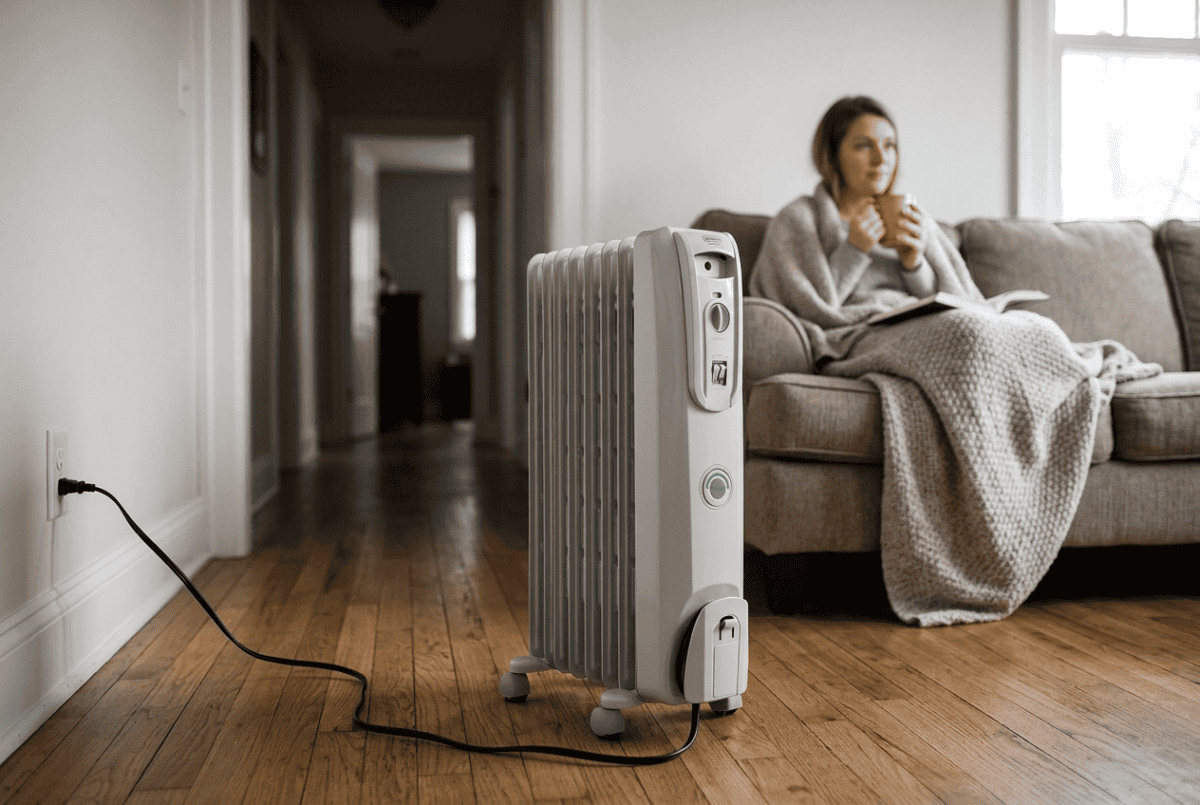
Zone-heating one room with a space heater saves money only when a household turns the central thermostat down and heats just the room it is actually using. This guide from heatersforlife.com breaks down when swapping central heat for a single space heater lowers the bill, and when it quietly makes the bill worse.
Last Updated: September 2026 | Will Montgomery has an engineering background and has spent years installing, testing, and troubleshooting electric and propane heaters.
Quick Answer: Does a Space Heater Cost Less Than Central Heat?
A space heater costs less than central heat only when it replaces whole-home heating in the one room a person occupies, not when it runs alongside a furnace that is still keeping the rest of the house warm. An electric space heater turns nearly every watt into heat, so a 1500-watt unit uses about 1.5 kWh per hour, or roughly 25 cents per hour at the U.S. average of about 17 cents per kWh. A gas furnace produces heat more cheaply per unit (natural gas delivers usable heat at roughly a third the cost of electric resistance), but it heats the entire house. The savings from zone heating come from heating far less space, not from the heater being cheaper per BTU.
How the Two Systems Actually Spend Money
Central heat spends money on volume, while a space heater spends money on wattage and hours. A central furnace or heat pump is sized to bring an entire home to temperature and hold it there, so its cost scales with the square footage it conditions and how low the outdoor temperature drops. An electric space heater has a fixed ceiling: a standard 120-volt outlet caps a heater at 1500 watts, because 1500 watts already draws about 12.5 amps on a 15-amp circuit. That means one space heater can only ever cost about 25 cents per hour to run, no matter how cold it gets outside. The trade-off is that 1500 watts can comfortably heat one small-to-medium room, not a whole floor.
Because all electric resistance heaters are close to 100 percent efficient, the type of space heater does not change the running cost. A ceramic, oil-filled, infrared, or fan heater set to 1500 watts all cost the same to run for the same hours. Heatersforlife.com covers this in detail in the guide to whether infrared heaters really save money.
The Real Cost Comparison, Side by Side
Zone heating one occupied room with a space heater can cut heating spend during the hours a household clusters in a single space, while central heat wins whenever multiple rooms need to be warm at once. The table below assumes electricity at 17 cents per kWh and natural gas heat costing roughly 6 cents per usable kWh (about a third of electric resistance). Actual rates vary by region and season, so the figures show the pattern rather than an exact bill.
| Scenario | What runs | Approx. cost for 8 hours | Best when |
|---|---|---|---|
| Heat one room only | One 1500W electric space heater | ~$2.00 | One person, one occupied room, rest of house cool |
| Heat whole house (gas) | Gas furnace holding 2,000 sq ft | ~$3.50–$6.00 | Several rooms occupied, multiple people |
| Heat whole house (electric resistance) | Electric furnace or baseboards, whole home | ~$10–$18 | Rarely the cheap option |
| Space heater PLUS furnace still on | Both running | Furnace cost + ~$2.00 | Never cheaper — this is the common mistake |

Example products for this comparison: a quiet 1500W zone heater such as the De’Longhi EW7707CM oil-filled radiator for steady background heat, or the Lasko digital ceramic tower when a room needs to warm up fast on a timer.
The pattern is clear: the space heater wins only when it lets the furnace back off. A reader who wants the exact per-hour math for their own electricity rate can use the space heater running-cost calculator.
When Zone Heating With a Space Heater Saves the Most
Will’s note: The one time our furnace quit for a week, we ran four infrared heaters on thermostats with the room doors closed. Nights were around 30°F and days about 50°F, and the rooms we were actually in stayed comfortable. A friend later ran the numbers on turning his furnace down and heating just the room he was in: about $20 a month saved. He was single with no kids at the time, which is exactly the household this works for.

Zone heating pays off best for a single person or couple who spend most of the day and evening in one or two rooms and can let the rest of the home drift cooler. A home office used eight hours a day, a bedroom used overnight, or a living room used in the evening are ideal candidates. In each case the household lowers the central thermostat by several degrees and lets the space heater carry the one room that matters. The colder the region and the higher the natural-gas or electric-furnace load, the more a few degrees of setback saves, because the furnace runs against a smaller temperature gap for the unoccupied rooms.
Households heating with expensive electric resistance central systems or older propane furnaces see the biggest gains, because their whole-home heat is costly per hour. Homes on cheap natural gas save less, but still benefit when only one room is in use.
When Central Heat Is Still the Cheaper Choice
Central heat is cheaper whenever a household needs several rooms warm at the same time, or when the space heater cannot keep its room comfortable without running flat out. A family spread across a kitchen, two bedrooms, and a living room would need three or four space heaters running at once — that is 4,500 to 6,000 watts, which not only costs more than a gas furnace but can overload circuits. In that situation the furnace, which was engineered to move heat efficiently through the whole home, is both cheaper and safer. Central heat also wins in very cold climates where a single 1500-watt heater simply cannot overcome the heat loss of a large or drafty room; a reader facing that should read the guide to the best space heaters for large or drafty rooms before assuming one unit is enough.
Why Gas vs Electric Prices Decide the Whole Question
The savings from zone heating depend heavily on what a household pays for its central-heat fuel versus its electricity, because that ratio decides how expensive the space heater’s electricity looks by comparison. Natural gas typically delivers usable heat at roughly a third the cost of electric resistance, so a home on cheap gas is already heating efficiently and only saves by shrinking the space it heats. A home on electric-resistance central heat — an electric furnace or whole-house baseboards — pays the same high per-unit rate as the space heater, so the only variable is volume, and heating one room instead of the whole house saves dramatically. Homes on propane or heating oil fall in between, and their savings swing with fuel prices. The practical takeaway is that the more expensive a home’s central heat is to run, the more a single well-placed space heater saves when it lets that system back off. A household unsure of its own numbers can compare its central-heat cost against the roughly 25-cents-per-hour figure a 1500-watt heater always costs, using the heatersforlife.com cheapest-to-run heater breakdown as a reference for the electric side.
Safety and Practical Limits of Leaning on a Space Heater

A space heater used for zone heating must be plugged directly into a wall outlet, given clear space, and treated as a supplement rather than an around-the-clock furnace replacement. Space heaters are a leading cause of home heating fires, so they should never run on a power strip or extension cord and should sit at least three feet from bedding, curtains, and furniture. Anyone planning to run one overnight should first read heatersforlife.com on whether it is safe to leave a space heater on overnight and on why a space heater should never be plugged into a power strip. Renters whose landlords have let the central heat fail should also know their rights, covered in the guide for a cold apartment when a landlord will not fix the heat.
How to Set Up Zone Heating So It Actually Saves

Effective zone heating comes down to three moves: lower the central thermostat, close off the room being heated, and size the space heater to that room. The central thermostat should drop as far as comfort and pipe-safety allow — many households set back to the low 60s or high 50s for the rest of the house while keeping the occupied room comfortable. Closing the door and, where practical, the heating vents to that room concentrates the space heater’s output instead of letting it leak into cold hallways. Sizing matters too: a rough rule of thumb is about 10 watts of heating per square foot for a reasonably insulated room, so a full 1500-watt heater comfortably covers roughly 150 square feet. A room larger than that will leave the heater running continuously and may still feel cool, which erases the savings.
Insulation and draft-sealing multiply the benefit. Weatherstripping a drafty door, closing curtains at night, and adding a door draft stopper all reduce how hard the space heater has to work, letting it cycle off sooner and cost less per hour. A household that heats one sealed, right-sized room while the furnace idles at a low setback is running the space heater the way it genuinely saves money.
Frequently Asked Questions
Is it cheaper to run a space heater or central heat?
It is cheaper to run one space heater than central heat only when the space heater lets the household lower the central thermostat and heat a single occupied room. If the furnace stays at its normal setting and the space heater runs on top of it, the total cost is always higher.
How much does it cost to run a 1500-watt space heater all day?
A 1500-watt heater uses 1.5 kWh per hour, or about 25 cents per hour at 17 cents per kWh. Running it for 8 hours costs roughly $2.00, and running it a full 24 hours costs about $6.00 at that rate.
Can one space heater replace a furnace for a whole house?
No. A single 1500-watt heater can only warm one small-to-medium room. Heating a whole house would require several heaters, which costs more than a gas furnace and can overload electrical circuits.
Does turning down the thermostat and using a space heater really save money?
Yes, when a household spends its time in one room. Lowering the central thermostat several degrees reduces the furnace’s workload for every unoccupied room, and the space heater only spends about 25 cents an hour to carry the one room in use.
Which is more efficient, a space heater or a heat pump?
A heat pump is far more efficient because it moves heat rather than generating it, delivering two to four units of heat per unit of electricity. A resistance space heater delivers one unit of heat per unit of electricity, so a heat pump or mini split is cheaper to run for continuous whole-room heating.
Written and reviewed by Will Montgomery, who has installed, tested, and repaired electric and propane heaters for years.