

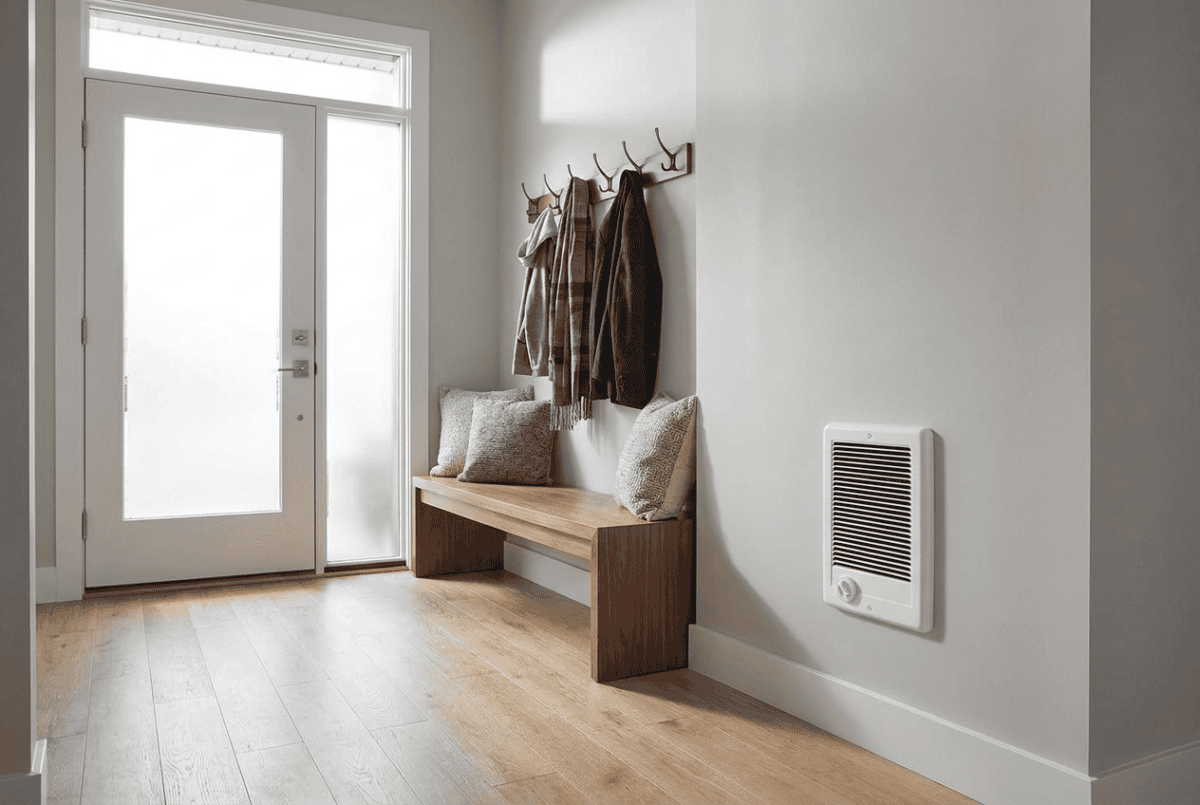
A wall-mounted electric heater and an electric baseboard heater cost the same to run at equal wattage, so the real choice is about heat delivery, install, and how a room is used rather than efficiency. This heatersforlife.com comparison lays out which permanent electric heat makes more sense for a single room, from a small bathroom to a large living space.
Last Updated: September 2026 | Will Montgomery has an engineering background and has spent years installing, testing, and troubleshooting electric and propane heaters.
Quick Answer: Wall Heater or Baseboard for One Room?
A wall-mounted fan heater warms a room faster and suits small or bathroom spaces, while an electric baseboard heater runs silently and heats evenly, making it better for bedrooms and larger rooms where quiet, steady warmth matters. Both are electric resistance heaters, so at the same wattage they cost exactly the same to run — there is no efficiency winner. A 1500-watt wall heater and a 1500-watt baseboard both produce 1500 watts of heat and cost about 25 cents per hour at 17 cents per kWh. The decision rests on speed, noise, placement, and installation.
They Cost the Same to Run — Here Is Why
Because both are electric resistance heaters, every watt they draw becomes heat, so running cost depends only on wattage and hours, not on the style of heater. This is one of the most misunderstood points in home heating: people expect one design to be cheaper, but a 1500-watt wall heater and a 1500-watt baseboard are both essentially 100 percent efficient. Neither can turn a kilowatt-hour of electricity into more than a kilowatt-hour of heat. The only way to spend less is to use fewer watts or fewer hours, which comes down to insulation, thermostat control, and room size — not the heater’s shape. Heatersforlife.com applies this same physics across its cost coverage, including the guide to the cheapest space heaters to run.
How the Heat Feels: Fan-Forced vs Natural Convection

A wall heater pushes warm air into the room with a fan for fast, targeted heat, while a baseboard warms the air gently along the floor and lets it rise naturally for even, silent coverage. The fan in a wall-mounted unit means the room warms quickly and the heat can be aimed, which is why wall heaters are popular in bathrooms and entryways where a quick burst of warmth matters. The downside is fan noise, which can be intrusive in a bedroom or a quiet office. A baseboard heater has no fan; it relies on convection, drawing cool air across its heating element near the floor and letting the warmed air rise. That makes it nearly silent and very even, but slower to bring a cold room up to temperature. For a room where someone sleeps or concentrates, the silence of baseboard heat is often worth the slower warm-up.
Installation, Placement, and Cost to Buy

A wall heater installs in a single spot and frees up floor and wall space, while a baseboard runs along the base of a wall and needs that length kept clear of furniture and drapes. A wall-mounted heater is recessed or surface-mounted in one location, which is tidy and keeps the unit off the floor away from pets and clutter. A baseboard needs a run of open wall — often several feet — and furniture, long curtains, and bedding must stay clear of it to prevent fire and to let air circulate. Both are commonly available as 120-volt plug-in or hardwired units and as 240-volt hardwired units; higher-wattage 240-volt models require a dedicated circuit and, in most areas, a licensed electrician. The table below summarizes the trade-offs.
| Factor | Wall-Mounted Heater | Electric Baseboard |
|---|---|---|
| Heat delivery | Fan-forced, fast, aimable | Natural convection, even |
| Noise | Audible fan | Silent |
| Warm-up speed | Fast | Slower |
| Space used | One spot on the wall | Several feet along the floor |
| Best rooms | Bathroom, entry, small room | Bedroom, living room, larger room |
| Running cost at same watts | Identical | Identical |
Example products for this comparison: a Cadet Com-Pak CSC152TW 240V wall heater with built-in thermostat for the fan-forced wall unit, and a Cadet 1000W convection baseboard heater for the baseboard option.
Which Room Suits Which Heater

Wall heaters win small, quick-heat spaces, while baseboards win rooms that need quiet, steady, whole-room warmth. A bathroom benefits from a wall heater’s fast burst of warmth for the few minutes it is needed. An entryway or a small home office that someone steps into and wants warm quickly also favors the fan-forced wall unit. A bedroom, by contrast, is a strong case for baseboard heat: the silence supports sleep and the even convection avoids the hot-and-cold cycling of a fan. Larger living rooms often use a longer baseboard run, or several, to spread heat evenly across the space. For renters who cannot hardwire anything, a plug-in wall-panel heater is a middle path, covered in the heatersforlife.com guide to the best plug-in wall and panel heaters for renters.
120-Volt vs 240-Volt: What Changes
Will’s note: Most bathrooms do not have a 240-volt run to them, and pulling one is real electrician money. For a small bathroom, the smaller 120-volt wall heaters that run on a normal circuit are usually the practical answer. Whichever you install, keeping towels, curtains, and rugs clear of it matters more than which type you picked.
Both heaters come in 120-volt and 240-volt versions, and the voltage sets the maximum heat output and whether a dedicated circuit is required, but it does not change the cost per unit of heat. A 120-volt unit plugs into a standard outlet and is capped at 1500 watts, because that already draws about 12.5 amps on a common 15-amp circuit. That is enough for a small-to-medium room but not for a large or drafty one. A 240-volt version can deliver far more heat — often 2,000 to 5,000 watts for baseboards and higher-output wall heaters — which warms a big room quickly, but it must be hardwired to a dedicated 240-volt circuit installed by a licensed electrician. The key point for the bill is that a watt of heat costs the same whether it comes from a 120-volt or a 240-volt heater; the higher voltage simply allows more watts, which means more heat and a proportionally higher cost per hour when running at full output. Choosing 240-volt is about capacity for a larger room, not about saving money per unit of warmth.
Thermostat Control Makes the Real Difference in Cost
Because the heater style does not affect efficiency, the biggest lever on the electric bill is how precisely the thermostat holds the room at the lowest comfortable temperature. A built-in line-voltage thermostat that cycles the heater tightly around a setpoint wastes less than an old mechanical dial that overshoots and lets the room swing warm before shutting off. Programmable and smart thermostats add the ability to set the room back automatically when it is empty or when everyone is asleep, which cuts hours of runtime that no change in heater design could match. Many baseboards use a wall-mounted thermostat controlling the whole run, while wall heaters often have an integrated thermostat and timer. Whichever style a household picks, pairing it with accurate temperature control, good insulation, and correct sizing does far more for the running cost than the choice between fan-forced and convection heat. Heatersforlife.com reinforces this across its cost guides, including the breakdown of what a heater actually costs to run per hour, night, and month.
Safety Considerations for Both
Both heaters are safe when installed correctly and given clearance, but each has its own hazard: baseboards ignite drapes and furniture placed too close, and wall heaters overheat when their airflow is blocked. A baseboard needs clear space in front and above so air can circulate, and curtains must not hang into it. A wall heater’s intake and outlet must stay unobstructed, and it should not be mounted where towels or clothing can fall against it. Hardwired 240-volt versions of either should be installed on a dedicated circuit by a qualified electrician, both for safety and to avoid nuisance breaker trips. Plug-in versions follow the same rules as any portable heater: plug directly into a wall outlet, never a power strip or extension cord, as heatersforlife.com explains in its guide to why heaters should never use a power strip. A full-power 1500-watt unit draws about 12.5 amps, close to the limit of a 15-amp circuit, which is detailed in the guide to how many amps a heater draws.
The Bottom Line
Since a wall heater and a baseboard cost the same to run, the right choice is whichever matches the room: fan-forced wall heat for speed in small spaces, silent baseboard convection for even warmth in bedrooms and larger rooms. A household should decide based on noise tolerance, how fast the room needs to warm, how much wall or floor space is free, and whether the unit will be plugged in or hardwired. Efficiency does not enter the decision, because both convert electricity to heat at the same rate. Getting the wattage right for the room size — roughly 10 watts per square foot for a well-insulated space — matters far more to the bill than the style of heater. For a broader look at how the different electric heater designs compare, heatersforlife.com maintains an overview of space heater types.
Frequently Asked Questions
Is a wall heater better than baseboard?
Neither is universally better. A wall heater warms a room faster and suits small or bathroom spaces, while a baseboard is silent and heats evenly, making it better for bedrooms and larger rooms. They cost the same to run at equal wattage.
Does a wall heater or baseboard use less electricity?
They use the same electricity at the same wattage. Both are electric resistance heaters that are essentially 100 percent efficient, so a 1500-watt wall heater and a 1500-watt baseboard cost identical amounts to run for the same hours.
Are baseboard heaters a fire hazard?
They are safe when given clearance, but they can ignite curtains, furniture, or bedding placed too close. Keep the area in front of and above a baseboard clear so air can circulate and nothing can fall against the element.
Do wall heaters and baseboards need a special circuit?
Higher-wattage 240-volt models require a dedicated circuit and usually a licensed electrician. Lower-wattage 120-volt plug-in versions use a standard outlet but should never share a circuit with other large loads or run on a power strip.
Which is quieter, a wall heater or baseboard?
A baseboard is quieter. It heats by natural convection with no fan, so it runs silently. A wall heater uses a fan to push warm air, which is faster but produces audible noise that can be distracting in a bedroom or office.
Written and reviewed by Will Montgomery, who has installed, tested, and repaired electric and propane heaters for years.