

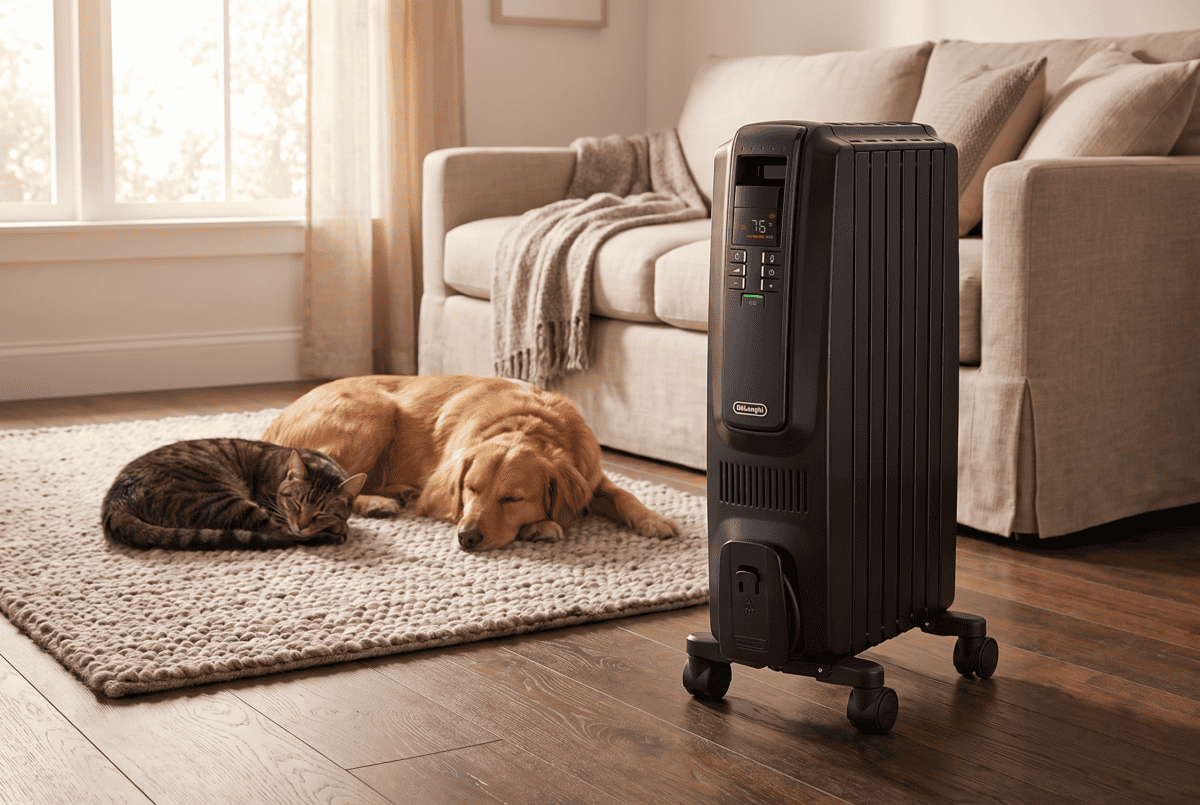
A pet-safe space heater is one with a sealed or cool-touch exterior, a tip-over switch that cuts power the instant it is knocked over, and overheat protection, so a curious dog or cat cannot burn itself, start a fire, or get shocked. This guide from heatersforlife.com explains exactly which features make a heater safe around animals, which heater types are the safest bets, and how to place one so pets stay warm and out of danger.
Last Updated: September 2026 | Will Montgomery has an engineering background and has spent years installing, testing, and troubleshooting electric and propane heaters.
Quick Answer: the safest heater for homes with pets
For most pet owners, a sealed oil-filled radiator or an enclosed ceramic heater with a tip-over switch, overheat cutoff, and a cool or low-temperature exterior is the safest choice.
- Require: tip-over shutoff, overheat protection, and no exposed glowing element.
- Prefer: a cool-touch or low-surface-temperature housing a nose or paw cannot get burned on.
- Prefer: a stable, hard-to-tip base, or a wall-mount panel out of paw reach.
- Avoid: open-coil heaters, exposed quartz elements, and tall tippy units near big dogs.
Our picks: three heaters that pass the pet test
Top pick: De’Longhi Dragon Digital Oil-Filled Radiator, 1500W (about $190). A sealed oil-filled radiator with no exposed element, a tip-over cutoff, and a digital thermostat — every box on this article’s checklist. The chimney-style fins keep more of the hot surface away from curious noses.
Classic choice: De’Longhi Oil-Filled Radiator, 1500W (about $130). The standard version of the same sealed design: silent, no fan to spook a cat, and lower surface temperatures than any glowing-element heater.
Budget: Amazon Basics Portable Oil Radiator (about $72). The same sealed oil-filled principle with three heat settings, overheat protection, and ETL certification, at about a third the price of the Dragon.
What actually makes a space heater “pet-safe”
A space heater is pet-safe when its design removes the three ways an animal gets hurt: burns from a hot surface, fire from a tipped-over or covered heater, and shock or injury from chewing or contact with an exposed element. Marketing uses the phrase loosely, so it helps to know the specific protections that matter.
The first is a tip-over switch, a weighted or spring mechanism that cuts power the moment the heater is not upright. A dog’s wagging tail or a cat’s leap can topple a floor unit, and a tip-over switch turns that from a fire risk into a non-event. The second is overheat protection, a sensor that shuts the element down if the heater is covered by a blanket, a pet bed, or a pile of fur and dust. The third is the exterior temperature: a sealed oil-filled radiator or a well-designed ceramic unit stays cool enough to touch, while an open-element or quartz heater can reach temperatures that burn a nose or paw instantly. The differences between these designs are covered in the guide to space heater types explained.

The best heater types for homes with pets
Oil-filled radiators and fully enclosed ceramic heaters are the two safest heater types for homes with pets, because neither exposes a glowing element and both can be found with cool-touch housings and full safety shutoffs. Each has a different strength.
An oil-filled radiator warms slowly and holds heat, and its finned exterior, while warm, generally stays below the temperature that causes an instant burn, though a pet should still not lie directly against it for long. It is heavy and stable, which makes it hard for even a large dog to knock over. An enclosed ceramic heater warms a room faster and, in cool-touch models, keeps the plastic housing safe to the touch while the element stays sealed behind a grille too fine for a paw. Wall-mounted panel heaters raise the whole appliance out of paw and tail reach, an elegant solution in a home with big or bouncy dogs, and they pair well with the compact picks in the best space heaters for apartments guide. The heater types to approach with caution are open-coil radiant heaters and exposed quartz or infrared bulbs, whose surfaces get dangerously hot, and tall, narrow tower units that tip easily unless weighted.
Pet-safety comparison by heater type
The table below ranks common heater types by the risks that matter most in a home with animals: how hot the surface gets, how easily it tips, and whether it hides its heating element.
From experience: I have had a small ceramic heater end up knocked over on the floor — pet or kid, nobody confessed — which is exactly why I will not run a small heater without a tip-over switch anymore. And our dog likes to lie right against our Amish-style infrared cabinet heater, a good reminder that a cool-touch cabinet matters just as much as the shutoff.
| Heater type | Surface temperature | Tip stability | Exposed element? | Pet-safety verdict |
|---|---|---|---|---|
| Oil-filled radiator | Warm, rarely burn-hot | Very stable (heavy) | No | Safest overall |
| Enclosed ceramic (cool-touch) | Cool housing, hot grille | Moderate | No (behind grille) | Very good |
| Wall-mounted panel | Warm, out of reach | Fixed to wall | No | Very good for big dogs |
| Fan-forced ceramic tower | Cool housing | Can tip if unweighted | No | Good with tip-over switch |
| Open-coil radiant | Very hot | Varies | Yes | Avoid around pets |
| Exposed quartz/infrared | Very hot face | Varies | Yes | Avoid around pets |
One efficiency note worth stating plainly: none of these types is cheaper to run than another at the same wattage. A 1500W ceramic heater and a 1500W oil-filled radiator produce the same heat and cost the same per hour; the pet-safety choice is about surfaces and stability, not the electric bill.
Features every pet owner should require
Beyond the heater type, the specific features that keep pets safe are a tip-over switch, overheat protection, a cool-touch exterior, and a stable base or wall mount.
- Tip-over shutoff: non-negotiable for any floor unit in a home with animals.
- Overheat cutoff: protects against a pet bed, blanket, or shed fur blocking the vents.
- Cool-touch or low-temperature housing: so a nose or paw that brushes the side is not burned.
- Enclosed element behind a fine grille: keeps paws, tails, and curious tongues away from the heat source.
- Heavy or wide base, or a wall mount: resists the bump, leap, or tail-swipe that topples lighter units.
- A short, manageable cord kept out of chewing range: a chewed cord is a shock and fire hazard.

Placement and habits that prevent accidents
Even the safest heater needs smart placement: keep it on a hard, level surface, give pets a warm spot at a safe distance rather than against the unit, and never leave a determined chewer alone with the cord. Behavior fills the gaps that hardware cannot.
Place the heater on a hard floor, not a rug or pet blanket that can bunch under it or block airflow, and keep it clear of curtains, bedding, and anything an animal might drag against it. Set up the pet’s bed a few feet away so the animal gets radiant warmth without lying on a hot surface, and route the power cord along a wall or under cord protectors so it is not an inviting chew toy. As with any space heater, plug it directly into a wall outlet, never a power strip or extension cord, because a heater’s sustained draw can overheat an undersized cord and cause a fire; the full explanation is in the guide on why you should never plug a space heater into a power strip. If the heater will run while no one is home or overnight, the extra precautions in leaving a space heater on overnight apply doubly in a home with pets. And because cats especially seek out quiet warmth to sleep near, a near-silent model like those in the quietest space heaters guide keeps them comfortable without a startling fan.
Extra care for puppies, kittens, and small pets
Puppies, kittens, birds, and small caged animals need extra caution because they are more curious, less coordinated, and far more sensitive to overheating and fumes than an adult cat or dog. The heater that is safe for a mellow older dog may not be safe for a tornado of a puppy.
Young animals chew everything, so cord management moves from good practice to essential; run the cord where it cannot be reached, or choose a wall-mounted panel with the cord dropping straight down out of range. Small mammals and birds are also vulnerable to overheating and to the light fumes some heaters give off when new, so a heater should never blow directly onto a cage or enclosure, and a brand-new unit should be run for its first hour in a ventilated room to burn off manufacturing residue before a small pet is nearby. For reptiles and other animals with specific temperature needs, a general-purpose space heater should supplement, never replace, the enclosure’s own regulated heat source. In every case, the smaller and younger the animal, the more the argument tilts toward a sealed, cool-touch, hard-to-tip heater rather than anything with an exposed hot face.
A quick pet-safe heater buying checklist
Before buying, a pet owner can run any heater through a short checklist that captures every safety point that matters in a home with animals. If a model misses any of the first three, it is worth passing on.
- Does it have a tip-over switch? If not, skip it for any floor unit around pets.
- Does it have overheat protection? Required, since fur, dust, and pet beds block vents.
- Is the exterior cool-touch or the element fully enclosed? No exposed glowing coils or bulbs.
- Is it stable or wall-mountable? Heavy base or wall mount beats a tippy tower.
- Can the cord be kept out of chewing range? Plan the placement before buying.
- Does it plug straight into a wall outlet? Never onto a power strip or extension cord.
Frequently asked questions
What is the safest type of space heater for cats and dogs?
A sealed oil-filled radiator is generally the safest, because it has no exposed element, a heavy stable base that resists tipping, and an exterior that stays warm rather than burn-hot. An enclosed cool-touch ceramic heater with a tip-over switch is a close second and warms a room faster.
Can a space heater burn my pet?
Yes, if the heater has a hot exterior or an exposed element. Open-coil, quartz, and infrared heaters can burn a nose or paw on contact, which is why cool-touch or sealed designs are recommended for homes with animals.
Are space heaters a fire risk with pets around?
They can be, mainly through tip-overs and blocked vents. A heater with a tip-over switch and overheat protection, placed on a hard surface clear of bedding and curtains, removes most of that risk. Never leave a pet unsupervised with the power cord.
Should I leave a heater on for my pet while I am away?
Only a heater with full safety shutoffs, plugged directly into the wall and placed well clear of anything flammable, and ideally on a thermostat or timer rather than running full-blast. Many owners set the home thermostat a little higher instead of leaving a space heater unattended.
Do pet-safe heaters cost more to run?
No. A pet-safe heater costs the same to run as any other heater of the same wattage, because all electric resistance heaters convert nearly all their electricity to heat. Choosing a safe model is about surfaces and stability, not energy use.
Written and reviewed by Will Montgomery, who has installed, tested, and repaired electric and propane heaters for years.